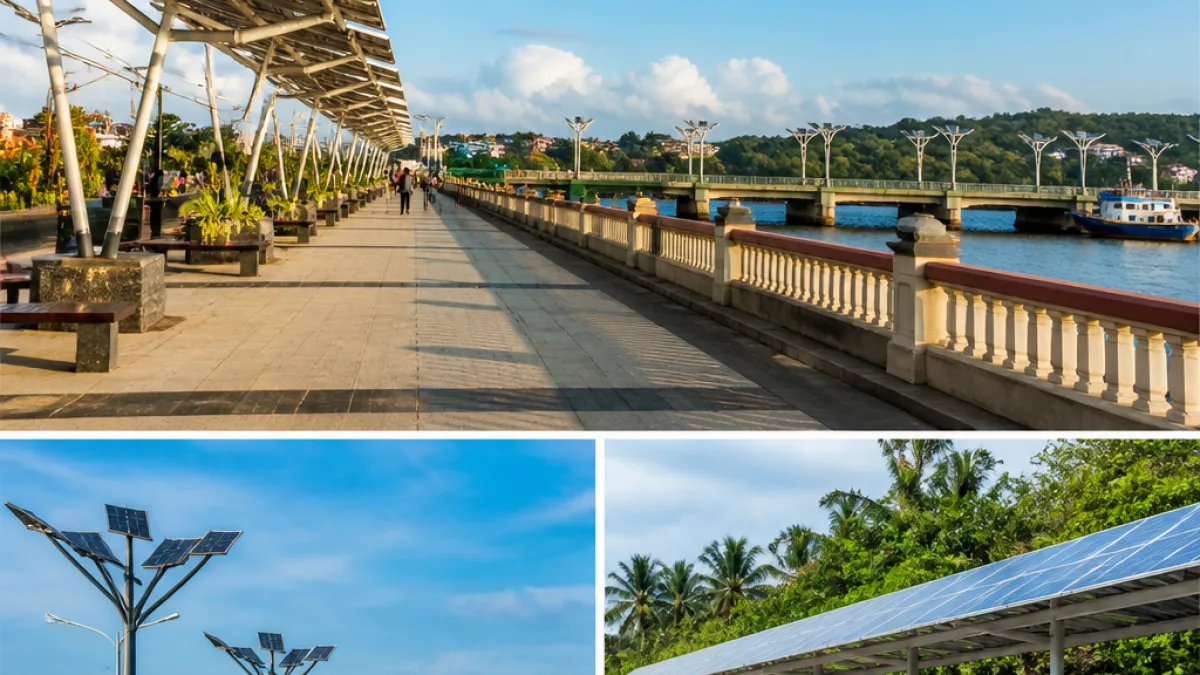
State DPR proposes solar canopy, solar trees and carport integrated with existing assets
Panaji — A detailed project report (DPR) prepared under the Indo‑German Energy Programme's “Energy Transition with DISCOMs” initiative has recommended three urban photovoltaic (UPV) installations in and around Panaji that do not require acquisition of fresh land, the DPR said.
The portfolio totals 276.4 kWp DC (244 kW AC) and comprises a solar‑sheltered walking shed at the Mandovi Riverfront, solar trees on the Ponte de Linhares Causeway at Ribandar, and a solar‑sheltered carport on Dr Jack de Sequeira Road, Miramar. The DPR was prepared by consultants working with GIZ in collaboration with government and utility stakeholders, the report stated.
Technical layout and capacities
According to the DPR, the three proposed systems are grid‑connected distributed solar assets that will integrate generation with existing public infrastructure while retaining current functions. The DPR gave sitewise capacities as follows:
- Mandovi Riverfront: 115.8 kWp DC / 99 kW AC — an elevated solar canopy integrated with pedestrian infrastructure.
- Ribandar (Ponte de Linhares Causeway): 25 kWp DC — solar‑tree structures designed for the causeway.
- Miramar (Dr Jack de Sequeira Road): 135.6 kWp DC / 120 kW AC — a solar‑sheltered carport.
| Location | Capacity (kWp DC) | Capacity (kW AC) |
|---|---|---|
| Mandovi Riverfront | 115.8 | 99 |
| Ribandar (Causeway) | 25 | — |
| Miramar (Carport) | 135.6 | 120 |
| Total | 276.4 | 244 |
Rationale and policy context
The DPR highlights Goa's limited availability of conventional land parcels for renewable projects and frames these UPV installations as a response to that constraint. It notes the State's dense urban fabric, existing public assets and proximity to electrical distribution networks as enabling factors for deploying solar by integrating systems with structures and spaces already in use.
“The three projects could serve as demonstration assets for scaling up urban photovoltaic deployment at other locations in Goa and potentially across India,” the DPR stated.
The initiative is linked to the Indo‑German Energy Programme and implemented by GIZ alongside government and utility stakeholders under the “Energy Transition with DISCOMs” workstream, the DPR said. The projects are designed as grid‑connected distributed solar systems, which implies generation will feed into the local distribution network rather than operate as isolated off‑grid units.
Implications for Panaji — benefits and considerations
By proposing installations that do not require greenfield land, the DPR seeks to overcome a major barrier to scaling renewables in urban Goa. The recommended models — elevated canopies, solar trees and carport arrays — aim to combine public amenity with energy generation.
- Potential benefits include local generation close to demand centres, reduced transmission losses, shaded public spaces and use of underutilised areas such as parking and walkways.
- Design and structural integration will need customisation for walking sheds, solar trees and carports, the DPR noted, indicating site‑specific engineering, load assessments and compatibility with existing utilities will be required.
- As grid‑connected systems, the projects will depend on coordination with the local distribution company (DISCOM) for interconnection, net‑metering or wheeling arrangements and potential upgrades to distribution infrastructure.
The DPR positions the three installations as demonstration assets that could inform larger urban PV rollouts elsewhere in Goa and beyond. The report does not, in the material supplied, provide cost estimates, timelines or final approvals; those steps would follow technical clearance, funding decisions and interagency coordination, the DPR indicated.
Stakeholders implementing the programme include GIZ and government and utility partners under the Indo‑German Energy Programme. The DPR recommends retaining existing public functions at sites while integrating solar systems, signalling a model of low‑impact renewables expansion for densely developed coastal urban areas such as Panaji.