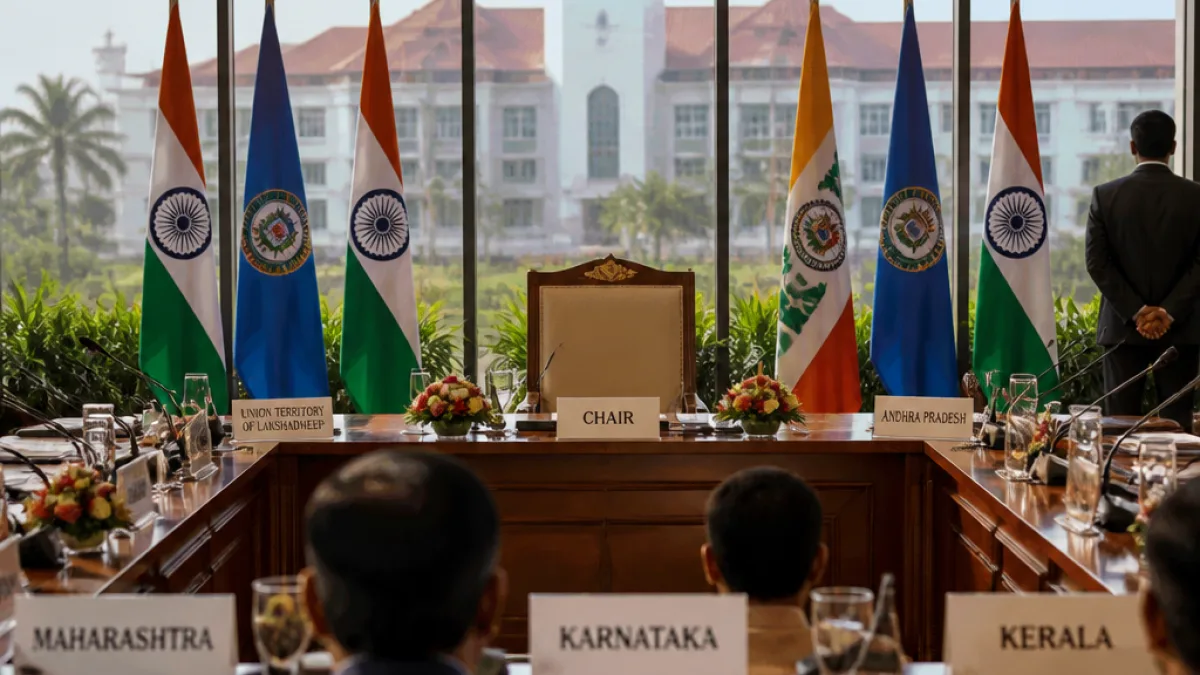
Panaji: Union Home Minister Amit Shah will chair the 28th meeting of the Western Zonal Council in Panaji on Monday, a government statement said on Saturday. The gathering is being organised by the Inter‑State Council Secretariat of the Ministry of Home Affairs and will be hosted by the Goa government.
Who will attend
The council brings together the chief ministers and two senior ministers from each member state. Senior officials from the Centre, the participating states and the Union Territory of Dadra and Nagar Haveli and Daman and Diu are also expected to take part, the statement said.
- Member states and UT: Goa, Gujarat, Maharashtra and Dadra and Nagar Haveli and Daman and Diu.
- Chairmanship: Amit Shah serves as the chairman of the Western Zonal Council.
- Vice‑chair: The Goa chief minister is the current vice‑chairman; the role rotates annually among the member states' chief ministers.
Purpose and process
The Zonal Council is an advisory body set up under the States Reorganisation Act, 1956, to foster cooperative federalism and provide a forum to resolve inter‑state or centre–state issues. Matters are typically first examined by the council's Standing Committee at the level of chief secretaries. Issues that remain unresolved are then taken up by the full Zonal Council for consideration, the statement noted.
Although the councils do not have executive authority, the statement highlighted their role as a structured platform for the Centre and states to discuss concerns that cross state boundaries or require coordination between governments.
"Prime Minister Narendra Modi has envisioned TEAM BHARAT for the country based on the principle of cooperative federalism, and the Zonal Councils are making an important contribution in this direction," the statement said.
Background and significance
Five zonal councils were constituted under sections 15 to 22 of the States Reorganisation Act in 1956. Over the past dozen years, the statement said, seventy meetings of various zonal councils and their standing committees have been held. The councils have been cited by the government as tools to harness both cooperative and competitive federalism to promote balanced development.
For Goa, hosting the Western Zonal Council brings administrative and political attention to regional issues affecting the state and its neighbours. The forum typically addresses topics such as inter‑state transport, water sharing, disaster management, border policing, infrastructure coordination and other matters that require multi‑state cooperation.
Format and expected outcomes
The meeting will assemble political leaders and senior bureaucrats. Issues proposed by member states — having passed through the Standing Committee — will be deliberated; unresolved items may be referred for further action or agreement at the zonal level. The council's recommendations are advisory, and implementation rests with the concerned governments.
| Body | Role |
|---|---|
| Inter‑State Council Secretariat (MHA) | Organiser |
| Western Zonal Council | Advisory forum for the western region |
| Standing Committee (Chief Secretaries) | Preliminary examination of matters |
Regional context
The Western Zonal Council covers a diverse set of jurisdictions: the small coastal state of Goa, the large industrial and agricultural states of Maharashtra and Gujarat, and the Union Territory that includes former Portuguese enclaves. Coordination in areas such as coastal security, tourism management, road and rail linkages and environmental protection often requires cross‑border dialogue among these administrations.
The central government has in recent years emphasised the use of institutional mechanisms to improve center–state relations and expedite resolution of multi‑state problems. The Zonal Councils, while advisory, are part of that architecture and provide a regularised forum for officials and ministers to negotiate practical arrangements.
What to watch
- Agendas tabled by the member states and any joint action plans agreed at the meeting.
- Follow‑up by the Goa administration on recommendations involving the state.
- Statements by participating chief ministers or central ministers that outline concrete timelines for cooperative initiatives.
The meeting in Panaji will be the latest instalment in the councils' long‑standing role as a mechanism for inter‑governmental dialogue in India’s federal structure.