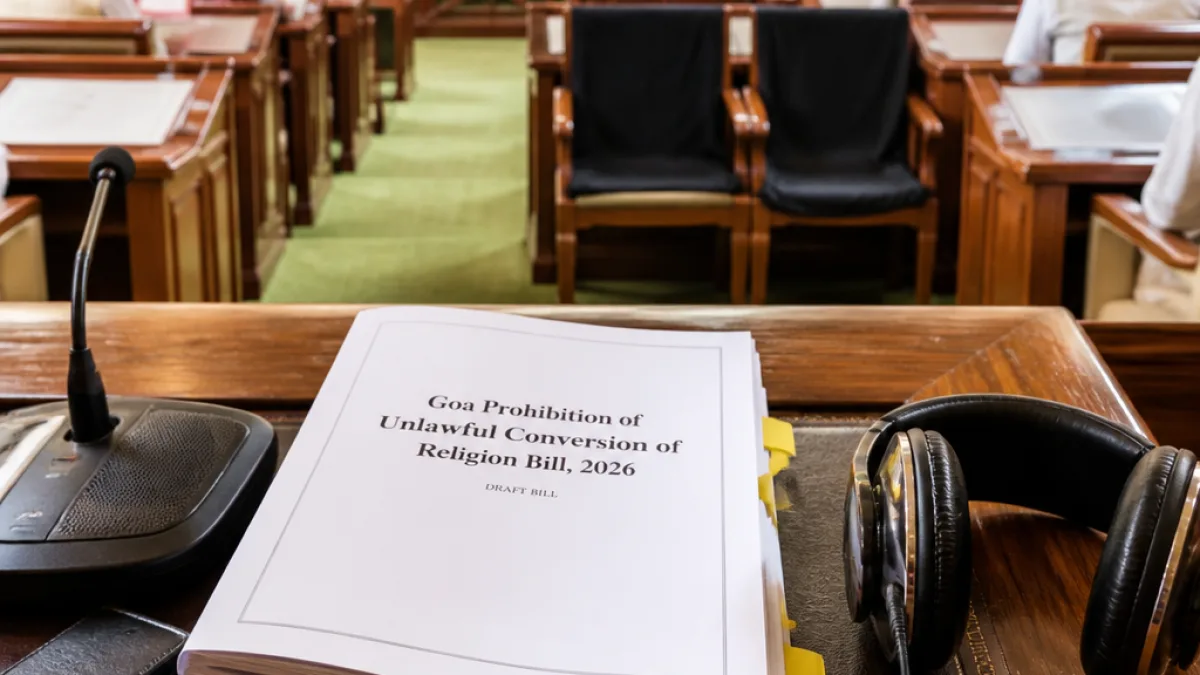
Panaji: The Goa Legislative Assembly will meet for a three-day monsoon session beginning 31 August, during which the BJP-led government intends to table the Goa Prohibition of Unlawful Conversion of Religion Bill, 2026, official records show.
Agenda and numbers
Joint Secretary (Legislature Department) Mohan Gaonkar told PTI that members have submitted a total of 883 questions for the session, which is scheduled to run through the standard three-day programme. The House, which formally has 40 seats, is operating with a present strength of 38 following the deaths of two MLAs — former Agriculture Minister Ravi Naik and Taleigao MLA Jennifer Monserrate.
What the bill seeks
The draft legislation, approved by the state cabinet this week, sets out stringent penalties for conversions it describes as obtained through "force, coercion, undue influence, allurement, fraudulent means or marriage". Under the proposals, perpetrators could face life imprisonment in the gravest cases, mandatory minimum fines and compensation to complainants.
| Provision | Penalty |
|---|---|
| Life sentence for specified offences | Life imprisonment |
| Minimum fine | ₹50,000 |
| Compensation to victims | Up to ₹5 lakh |
Political response
The bill has drawn criticism from the state Opposition. The Congress has argued the legislation could inflame communal tensions in Goa, which parties and observers frequently describe as relatively peaceful compared with some other states. An independent MLA who supports the government, Aleixo Reginaldo Lourenco, also urged the Chief Minister to reconsider the decision to table the measure, saying it may create communal disharmony.
- 883 questions submitted for the three-day session.
- Assembly strength reduced from 40 to 38 after two MLA deaths.
- Bill proposes life imprisonment, minimum ₹50,000 fine and up to ₹5 lakh compensation.
Legislative and practical considerations
Experts and lawmakers often focus on procedural and evidentiary issues when debating laws that criminalise conduct tied to belief and conversion, though PTI reporting does not include technical analysis from legal experts on this particular draft. The House will have the opportunity during the session to debate the principles of the bill, raise points of order and question ministers on its implementation and safeguards.
Context within state politics
State assemblies routinely use brief monsoon sittings to clear priority legislation and to answer a batch of questions from members. With elections in some states and a charged national landscape over issues of religion and conversion, the Goa bill arrives at a politically sensitive moment. The BJP-led cabinet's approval signals the government's intent to move the measure through the legislature this week.
What to expect during the session
Legislators will press ministers on the text and application of the bill. Given the Opposition's reservations, debates could focus on:
- Definitions and thresholds for what would constitute unlawful conversion.
- Procedural safeguards for complainants and the accused.
- Mechanisms for investigation and compensation to alleged victims.
The session's short duration means the assembly leadership will manage timing tightly; tabling the bill does not automatically ensure its passage within three days, but it does place the measure on the legislative calendar for immediate discussion.
PTI reporting provided the basis for the session's timetable and the bill's main provisions. The official announcement on questions and scheduling was attributed to the Legislature Department's joint secretary.