
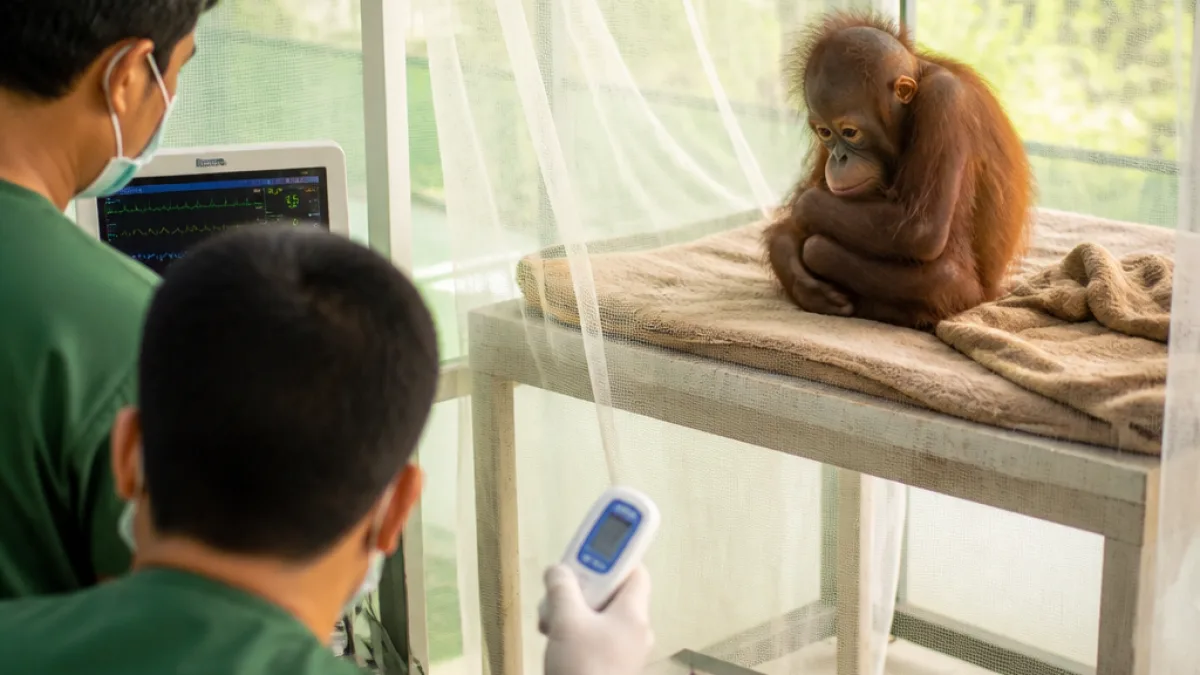
BHUBANESWAR: One of the five baby orangutans rescued from a forest in Odisha and placed under quarantine at Nandankanan Zoological Park since 8 September has been recording a high body temperature and is being closely monitored by the zoo's veterinary team, officials said on Monday.
Medical response and current condition
Veterinarians at the zoo reported that the affected infant developed fever on the day it arrived and, despite medication, has shown recurring elevations in temperature. The animal is receiving paracetamol-based medication and reduced feed, and staff are providing continuous observation and care.
"One of the orangutans has had a fever since the day it was brought here. The fever subsides when given medicine, but reappears again. But it is now stable and under strict medical supervision," a senior official said, according to PTI.
Zoo authorities said the other four rescued orangutans are healthy and responding normally to quarantine protocols. The five animals were isolated in a specially arranged enclosure and placed in a temperature-controlled room fitted with mosquito nets.
Possible causes and expert view
Officials and wildlife health experts have suggested that the fever may be related to stress, fatigue or abrupt change of environment. Orangutans are not native to India; they are rainforest species that require specific climatic and environmental conditions. Abrupt relocation from a forest setting into a zoo quarantine facility can trigger physiological responses, including elevated body temperature.
Aditya Acharya, head of the Centre for Wildlife Health at Odisha University of Agriculture and Technology (OUAT), noted that monitoring of high body temperature in orangutans follows procedures similar to humans. He confirmed that paracetamol-based drugs are commonly used to control fever when indicated.
Quarantine logistics and zoo capacity
The quarantine enclosure has recently seen more activity after the arrival of a larger consignment of animals. Officials said the zoo received 58 new animals in the recent period, making some areas relatively crowded. Nevertheless, separate arrangements have been made for the five orangutans to reduce cross-species exposure and to maintain biosecurity.
| Item | Status |
|---|---|
| Number of rescued orangutans | 5 |
| Orangutans with fever | 1 (under treatment) |
| Other orangutans | 4 healthy |
| New animals recently received at zoo | 58 |
What officials are doing
Zoo veterinarians have implemented several measures to aid recovery and prevent secondary infections:
- Isolation in a temperature-controlled room to maintain stable ambient conditions;
- Installation of mosquito nets to reduce vector exposure;
- Administering antipyretics (paracetamol-based) and reducing feed temporarily to lessen metabolic stress;
- Round-the-clock monitoring by veterinary staff to track temperature trends and overall behaviour.
Officials said further diagnostic tests will be used if the fever persists or if other symptoms appear. The exact cause of the elevated temperature will be evaluated by combining clinical observation with laboratory investigations if required.
Context and precautions
Orangutans are native to Southeast Asian rainforests and have specialised environmental and dietary needs. Sudden capture or transfer and confinement can cause significant stress, which may manifest as fever, loss of appetite or behavioural changes. Wildlife rescue and rehabilitation teams must balance immediate medical care with measures that help animals acclimatise gradually.
For the public, authorities reiterated that the animals are under professional care and that adherence to quarantine and biosecurity protocols at zoos helps protect both the rescued animals and resident species. Visitors should follow any instructions issued by zoo management and avoid attempting contact with quarantined animals.
The situation remains under close watch and further updates will be provided by zoo officials as the veterinary team continues treatment and observation.