
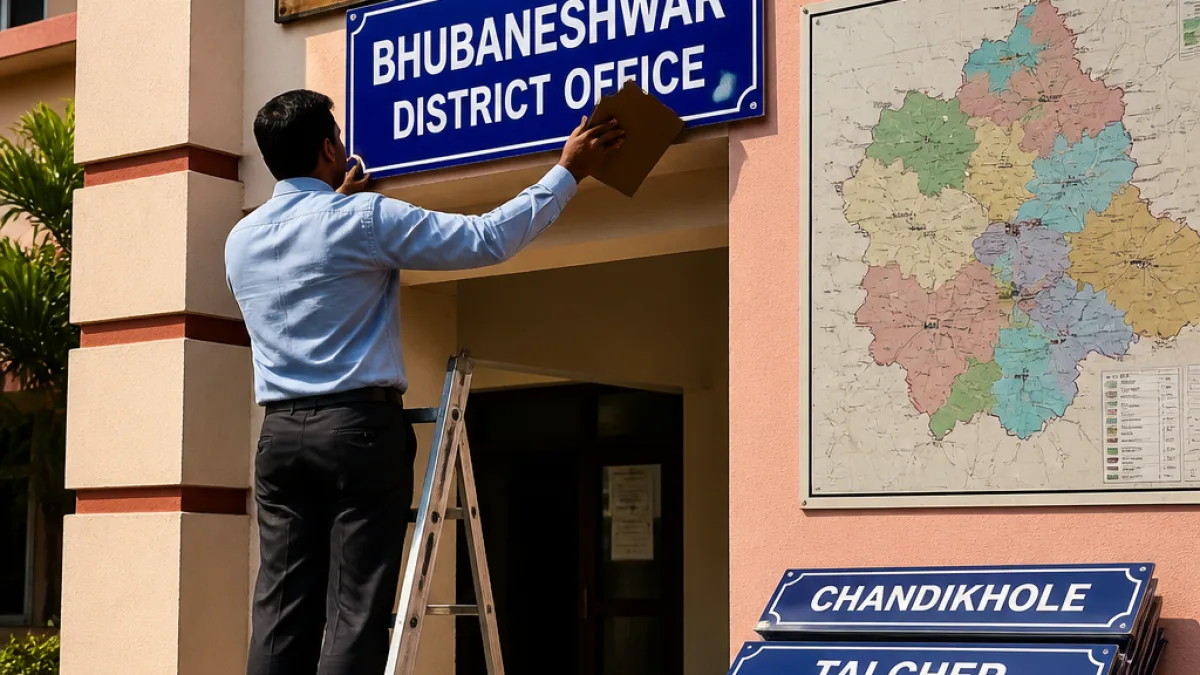
Bhubaneswar: The Odisha government has directed all district collectors to ensure uniform adoption of the state-approved revised English spellings of place names across government offices and institutions, the Additional Chief Secretary of the Revenue & Disaster Management Department has said.
Implementation order and timelines
In a letter issued on Saturday, Arabinda Padhee asked collectors to undertake a comprehensive review of nameplates and signboards in their districts and to ensure that the spellings notified by the state are used consistently. The instruction follows a gazette notification dated 22 June 2026, which required government offices and institutions to adopt the revised English spellings on their signboards within one month. A separate period of six months was prescribed for private and non-government establishments to implement the changes.
The department noted that the revised nomenclature is already being progressively adopted in several districts but that some government offices continue to display the older spellings. Collectors have been asked to personally review the status of implementation in all government offices, institutions and other establishments in their respective districts and to ensure the use of the government-approved forms.
Examples of revised spellings
The notification gives specific examples of the changes in romanised spellings to reflect Odia pronunciation. Among the replacements cited are:
- Angul to be written as Anugola
- Balasore to be written as Baleshwar
- Kendrapara to be written as Kendrapada
- Cuttack to be written as Kataka
- Jeypore to be replaced by Jayapur
- Soro to be replaced by Sora
| Old English Spelling | Revised Government-approved Spelling |
|---|---|
| Angul | Anugola |
| Balasore | Baleshwar |
| Kendrapara | Kendrapada |
| Cuttack | Kataka |
| Jeypore | Jayapur |
| Soro | Sora |
Why the change — and what it means
The move is framed as an effort to bring English renderings of place-names into conformity with their Odia pronunciation and to achieve consistency and uniformity in official nomenclature. The department warned that continued use of older spellings on government signboards could lead to inconsistencies and dilute the objective of the Cabinet decision that approved the revised names.
Practically, the order will affect a range of government items: departmental office signboards, nameplates, letterheads and other public-facing signage. While the gazette notification sets the timeline for implementation, enforcement is now being decentralised to district collectors who have been instructed to personally monitor compliance.
What collectors have been asked to do
- Conduct a district-wide review of nameplates and signboards in government offices and institutions.
- Ensure immediate replacement of old spellings on official signage where the revised forms are not yet in use.
- Facilitate implementation in private and non-government institutions as per the six-month timeline.
The letter from the Revenue & Disaster Management Department stressed administrative oversight by collectors in order to implement the State Cabinet decision effectively.
Local impact and practical considerations
The directive has administrative and operational implications. Government departments will need to plan for the replacement of signboards and stationery where necessary. Private institutions and businesses have a longer timeline but are expected to align with the official forms to avoid confusion in public records, transport signage and communication materials.
For residents and travellers, the spelling changes may appear gradually: maps, GPS entries, postal addresses and legal documents that use the older English forms may take time to reflect the new spellings. Citizens seeking government services should therefore be mindful of both old and revised spellings in the short term when filling forms or referring to locations.
The department has not indicated penalties for non-compliance in the letter; instead it has emphasised the need for consistent implementation through collector supervision. District administrations are likely to issue follow-up instructions on logistics and timelines for local offices.
As the state moves to standardise English spellings that reflect Odia pronunciation, district-level oversight will be central to translating the gazette notification into visible change on the ground.