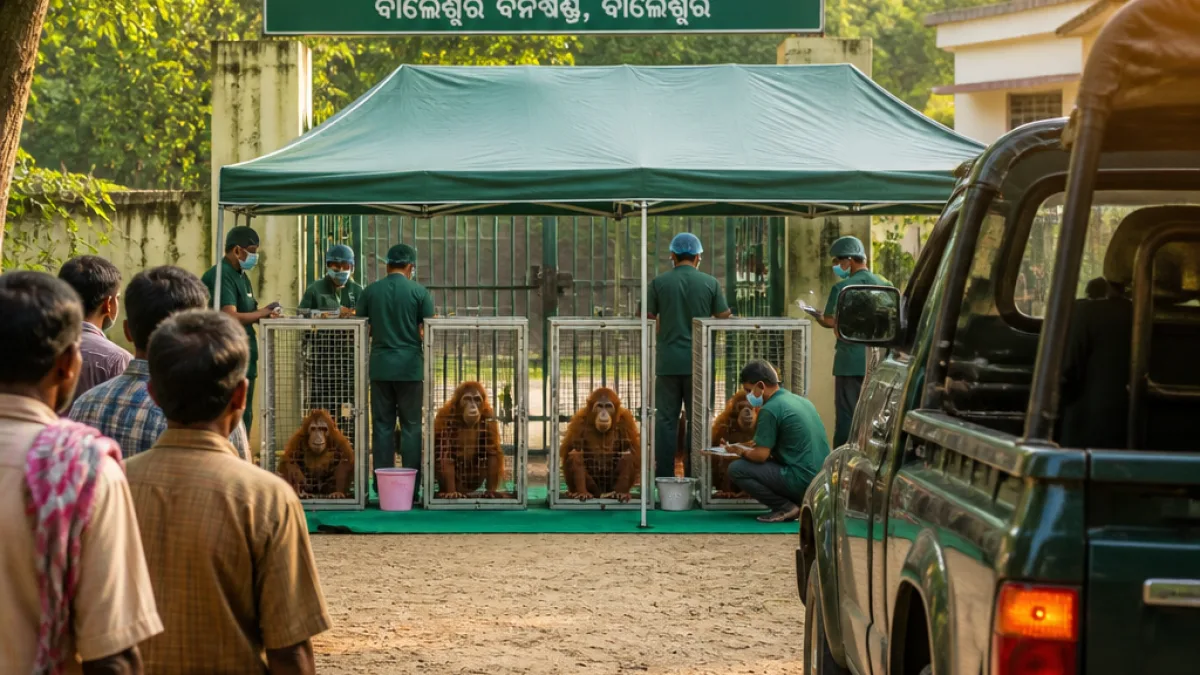
Forest officials in Balasore district recovered five juvenile orangutans from a forest area near Badapai village in the Bhograi region on Tuesday morning, an unusual occurrence in Odisha where these great apes are not native. The animals were taken to the divisional forest office for medical examination and care after local residents alerted authorities.
Rescue details and condition of the animals
According to Balasore Divisional Forest Officer Pratik Prakash Indalkar, the apes were spotted at about 6 am. The rescued individuals are small in size — estimated roughly between one and 1.5 feet in height — suggesting they are juveniles. Veterinary staff are examining and treating them at the forest office.
"We have rescued five baby orangutans and brought them to the forest office. Four of the five babies are healthy and eating food and drinking ORS. Veterinary doctors are examining and treating them and they are under the care and observation of the forest officials," said Divisional Forest Officer Pratik Prakash Indalkar.
Forest department officers reported that four of the five animals appeared in good health and were taking food and oral rehydration solution (ORS). One of the juveniles is under closer observation and receiving treatment from veterinary doctors.
| Parameter | Details |
|---|---|
| Location | Badapai village forest, Bhograi area, Balasore district |
| Time of sighting | About 6 am (Tuesday) |
| Number of animals | 5 juvenile orangutans |
| Condition | 4 healthy, 1 under treatment |
Suspected wildlife-smuggling angle
Officials said it is highly unlikely that orangutans — which are native only to parts of Southeast Asia — would be present naturally in Odisha. Senior forest authorities suspect the animals may have been brought into the State as part of an international wildlife-smuggling operation. Investigations are under way to determine their origin and how they came to be in the Balasore forests.
The quick arrival of onlookers following reports of the animals added to the challenge for forest personnel. Officers moved the apes to the divisional forest office to shield them from disturbance and to ensure proper clinical care.
Context and conservation implications
Orangutans are Asia's only great ape and are not part of the Indian wild fauna. Any appearance of such species in India raises questions about illegal trade networks, animal welfare and biosecurity. The presence of non-native wildlife in local habitats can increase disease risks for both animals and humans and presents complex legal and logistical issues for rescue and rehabilitation authorities.
- Immediate priorities: veterinary assessment, quarantine and tracing the animals' origin.
- Investigation: coordination between forest department, police and central wildlife agencies to determine trafficking links.
- Public safety: preventing crowds and handling the animals humanely.
What residents should know and do
Forest officials appealed to local communities to avoid approaching or crowding around rescued wildlife. Disturbance can stress animals and hinder medical care. People in forest fringes should report any unusual sightings to the nearest forest office or the police and allow trained personnel to handle the situation.
Authorities also reminded the public that handling or attempting to aid wild animals without expertise can be dangerous and may be an offence under wildlife protection laws.
Next steps
The forest department has seized custody of the five juveniles and will continue veterinary treatment and observation. Enquiries will focus on tracing the route by which the animals arrived in Odisha and identifying any persons responsible for their movement. If an illegal trade link is established, the case could involve reference to national and international wildlife crime statutes.
The unusual recovery has drawn attention from conservationists and law-enforcement agencies, and further details are expected as investigations progress.
(Reporting from Balasore)