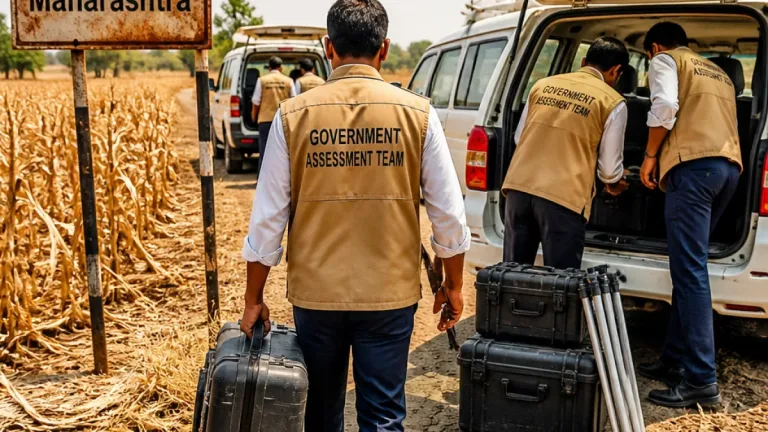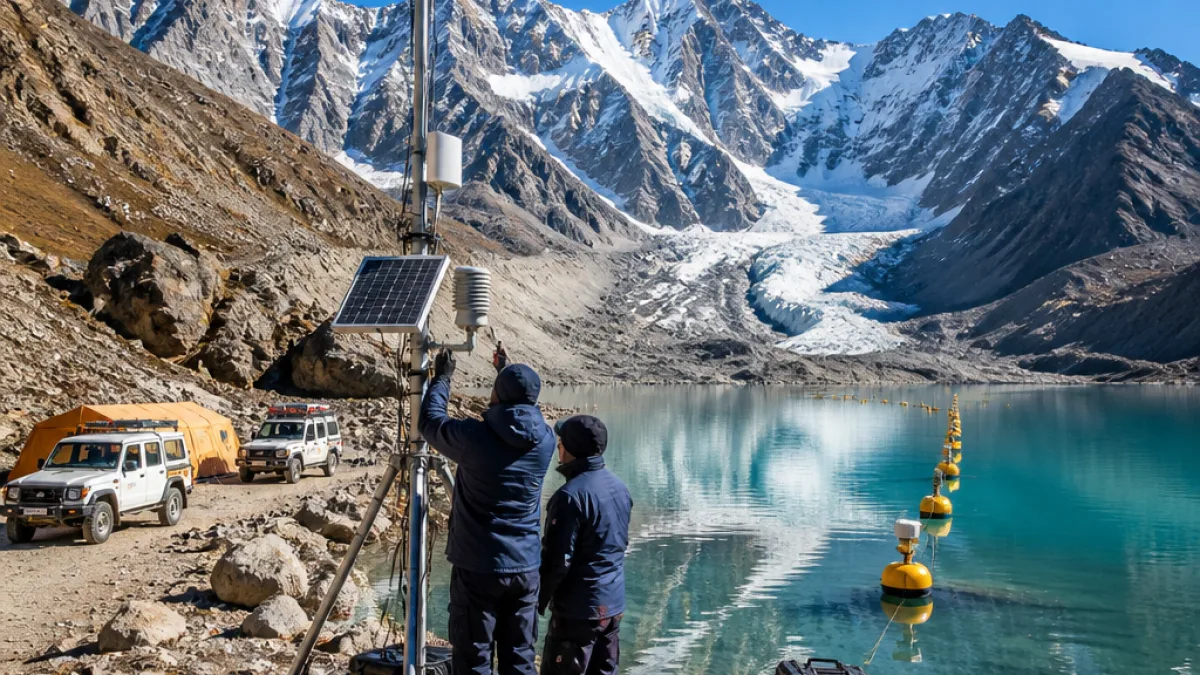
The state government has begun installing Uttarakhand’s first real-time early-warning system for a glacial lake at Vasundhara Tal in Chamoli, officials said, part of a move from mapping vulnerable water bodies to continuous monitoring to reduce the risk of glacial lake outburst floods (GLOFs).
Operation, agencies and timeline
A scientific and technical team from the Central Building Research Institute (CBRI), Roorkee, and the Wadia Institute of Himalayan Geology, Dehradun, departed for the high-altitude lake to begin work on the installation. The campaign is scheduled to run from 29 September to 15 October and is being supported on the ground by the State Disaster Response Force (SDRF), the National Disaster Response Force (NDRF) and the Indo-Tibetan Border Police (ITBP).
| Item | Detail |
|---|---|
| Site | Vasundhara Tal, Chamoli |
| Scientific teams | CBRI (Roorkee), Wadia Institute (Dehradun) |
| Operational support | SDRF, NDRF, ITBP |
| Schedule | 29 Sept — 15 Oct |
“This initiative will prove to be a milestone in reducing the dangers of GLOFs in the coming years and in understanding the risks,” Chief Secretary Anand Bardhan said at the flag-off.
Why Vasundhara Tal and why now
Vasundhara Tal is among the glacial lakes identified by the National Disaster Management Authority (NDMA) as being at elevated risk. In earlier assessments, the Uttarakhand State Disaster Management Authority had been preparing a plan to study and regularly monitor the state’s glacial lakes. The new installation marks the transition from periodic mapping to continuous, real-time monitoring at a high-risk site.
The move comes against a recent regional backdrop of destructive glacier-related events. In August, a major flood in Nepal’s Lhende Khola and Bhote Koshi river system, which initially drew attention as a possible earthquake-triggered event, was later found by the US Geological Survey to have been caused by a glacial collapse and debris flow. That disaster killed hundreds and destroyed roads, bridges and homes. Uttarakhand itself experienced the fatal Dharali flash flood in Uttarkashi a year earlier, where the precise trigger—whether a glacial lake breach, heavy rainfall, an avalanche or landslide—remained contested.
What authorities aim to achieve
Officials said the early-warning installation is intended to improve detection of rapid changes that can lead to GLOFs and to enhance preparedness for downstream communities. Real-time monitoring can allow quicker assessment of lake behaviour and faster alerting of response agencies, potentially reducing loss of life and infrastructure damage.
While detailed descriptions of the system’s technical components were not disclosed, the project brings together geological and engineering expertise with disaster-response units, signalling an integrated approach that pairs scientific assessment with operational readiness.
Practical implications for communities and agencies
Local administrations and emergency services are expected to benefit from more timely data on lake conditions. For residents in downstream valleys, improvements in warning lead time and coordination between scientific teams and response forces could prove critical during sudden events.
- Enhanced situational awareness for state disaster authorities and response teams.
- Closer collaboration between research institutes and operational agencies (SDRF, NDRF, ITBP).
- Potential to inform expansion of monitoring to other NDMA-identified high-risk lakes.
Next steps and context
The installation at Vasundhara Tal is being treated as a pilot of sorts: success in gathering and relaying reliable real-time data may guide further deployment across other lakes flagged in official assessments. The NDMA earlier listed 13 high-risk glacial lakes in Uttarakhand, five of which were placed in Category A, the highest risk bracket; Vasundhara Tal figures among those under concern.
Authorities have not released a broader roll-out plan or timelines for additional sites. Officials involved framed the current operation as an important technical and operational step aimed at strengthening the state’s capacity to understand and mitigate glacial hazards.
As the teams complete installation and commence monitoring, the results are likely to be watched closely by state agencies, researchers and downstream communities alike, given the high stakes associated with sudden glacial lake failures in the fragile Himalayan environment.