
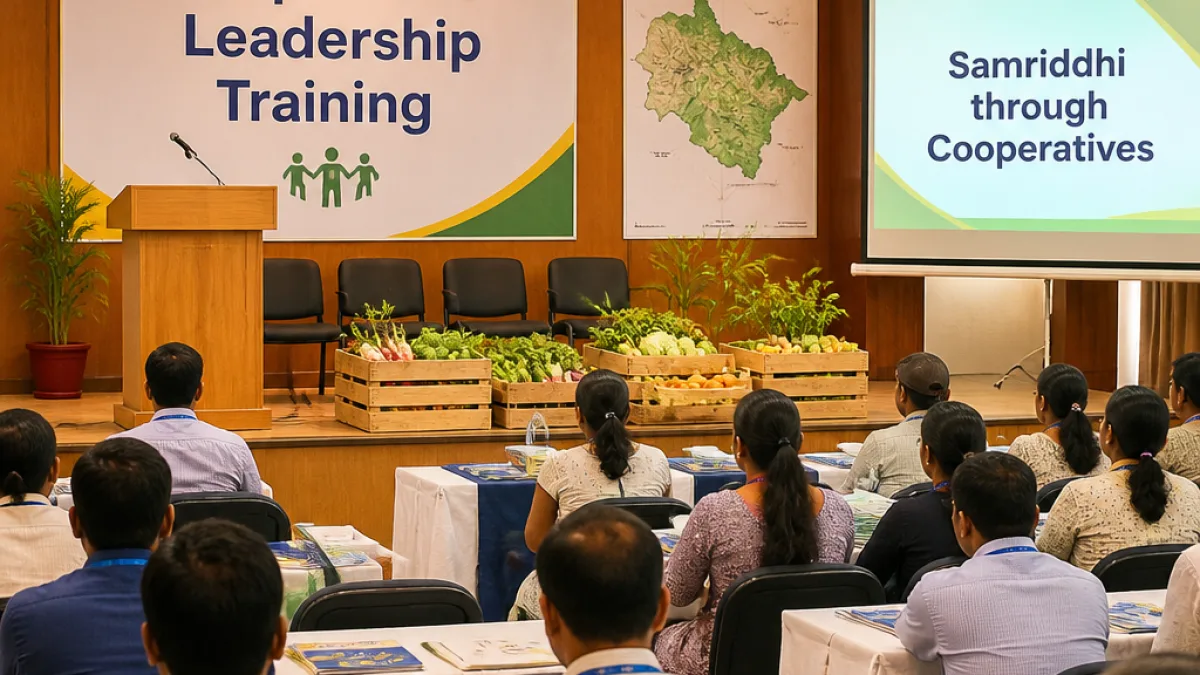
DEHRADUN / PANTNAGAR: Uttarakhand Chief Minister Pushkar Singh Dhami on Monday called for bolstering cooperatives and converting primary agricultural cooperative societies (PACS) into stronger, more capable M‑PACS to revitalise the hill state’s rural economy, support mountain agriculture and generate employment opportunities for youth.
Training, leadership and new initiatives
Addressing the inaugural session of the Shri Laxmanrao Inamdar Second Cooperative Leadership Training Programme virtually from Pantnagar, Dhami emphasised the need for skilled leadership to make cooperatives an effective instrument of economic empowerment. The programme was organised by Sahakar Bharati Uttarakhand at Govind Ballabh Pant University of Agriculture and Technology, Pantnagar.
"Strong leadership will strengthen M‑PACS, strong M‑PACS will strengthen villages, and strong villages will make Uttarakhand prosperous," Dhami said.
He listed several recent measures launched from Pantnagar that, he said, would give fresh momentum to the cooperative sector. Those include the release of the Sahakar Granth, the State Cooperative Federation’s Devbhoomi Sarathi initiative, new cooperative sector courses and a social media reels campaign aimed at connecting youth with cooperatives. Dhami also highlighted the M‑PACS leadership training programme as part of the push.
Policy aim: 'Samriddhi through Cooperatives'
The chief minister said the state government is committed to advancing Uttarakhand towards the vision of "Samriddhi through Cooperatives". He argued cooperatives can address long‑standing challenges in the hill state — including migration from villages, the need to strengthen mountain agriculture, creating market linkages for local products and boosting the rural economy.
Dhami described primary agricultural cooperative societies as a key pillar of the state's cooperative system and said they are being strengthened as M‑PACS to make them more capable and responsive to changing local requirements.
What the stated initiatives involve
- Sahakar Granth — a publication launched at Pantnagar intended to support cooperative knowledge sharing (as announced at the event).
- Devbhoomi Sarathi — an initiative of the State Cooperative Federation referred to by the chief minister as part of the new push.
- New courses — academic or training programmes in the cooperative sector introduced to improve skills among cooperative leaders and youth.
- Social media reels campaign — a youth‑targeted outreach to connect younger people with cooperative opportunities.
- M‑PACS leadership training — part of the training series organised by Sahakar Bharati Uttarakhand to professionalise cooperative management.
Administration perspective and expected outcomes
By underscoring leadership development and targeted outreach, the chief minister framed the cooperative revival as a means to create local markets and slow rural outmigration — a chronic problem in Uttarakhand’s hill districts. The government’s stated aim is to make PACS more effective at meeting farmers’ needs and to convert them into M‑PACS capable of providing broader services, including marketing and value‑addition for local produce.
The event also paid tribute to Sahakar Bharati founder Shri Laxmanrao Inamdar on his birth anniversary, reflecting the organisers’ focus on cooperative legacy and leadership. No further operational details such as timelines, funding allocations or implementation agencies for specific schemes were announced in the address reported from the programme.
Context: cooperative movement and mountain agriculture
Uttarakhand’s cooperative movement has historically been seen as a vehicle for collective action in remote rural areas, offering smallholders access to credit, inputs and marketing. Proponents say stronger cooperatives can leverage local produce, encourage agro‑processing and create non‑farm work locally, thereby addressing seasonality of income and migration.
While the chief minister highlighted expected benefits, concrete delivery will depend on steps such as capacity building at the grassroots, administrative reforms within existing PACS, transparency in management and effective linkages with markets and credit providers. The training programmes and academic courses announced aim to build human capital, but outcomes will be measurable only over time.
Organisers at Pantnagar described the training as the second edition of their leadership programme; the state government and cooperative bodies will need to publish implementation plans and timelines if the stated vision of "Samriddhi through Cooperatives" is to translate into measurable economic gains in the state's villages.













