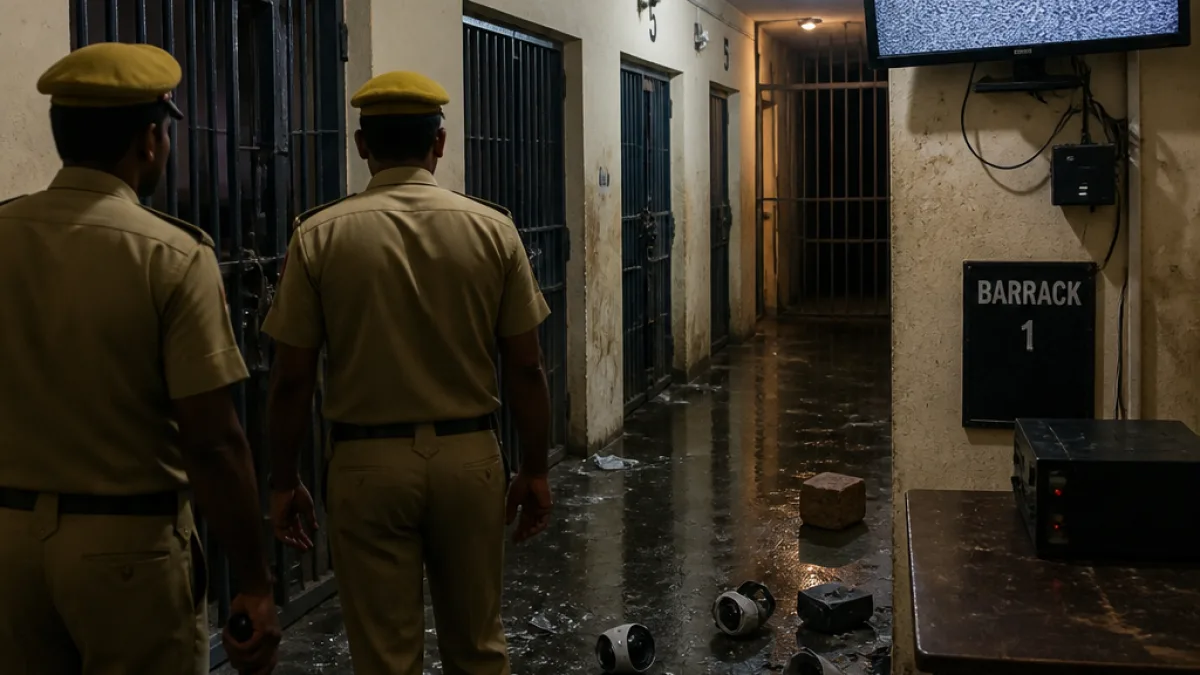
Surveillance breached at Ajmer high-security prison; FIR registered
Ajmer prison authorities have lodged an FIR with Civil Lines police after discovering that two closed-circuit television (CCTV) cameras inside the high-security jail had been deliberately damaged, officials said. The incident was discovered during a routine night round in barrack number 1, where guards found cameras missing from cells 3 and 5 and broken parts on the roofs.
Jail superintendent Paras Jangid said footage from the control room showed one prisoner in cell 3 climbing onto the wall and removing a camera, while a prisoner in cell 5 was captured using a stone to smash a camera. The two accused have been identified as Sumit Kumar and Rambeer, and reportedly claimed affiliation with the Lawrence Bishnoi gang, according to the superintendent.
- What happened: CCTV cameras in cells 3 and 5 of barrack 1 were found missing; broken pieces were recovered from roofs.
- Who is accused: Inmates Sumit Kumar and Rambeer, who allegedly admitted gang links.
- Action taken: FIR registered with Civil Lines police for damaging government property.
The jail administration said the last available footage from the damaged cameras showed the two men committing the acts. After confirming the damage, officials approached Civil Lines police and a formal complaint was lodged against the inmates for allegedly damaging government property.
| Detail | Information |
|---|---|
| Location | High-security jail, Ajmer — barrack number 1 (cells 3 & 5) |
| Accused | Sumit Kumar; Rambeer |
| Alleged motive | Not stated; accused claimed gang affiliation (Lawrence Bishnoi) |
| Action | FIR registered with Civil Lines police for damaging government property |
"The footage showing them damaging the cameras was the last available footage from those cameras," said superintendent Paras Jangid.
Implications for security and monitoring
Damage to CCTV cameras inside a high-security facility raises immediate concerns about internal surveillance, inmate movements and the ability to investigate incidents. Closed-circuit systems are a primary tool for monitoring prisoner activity and ensuring staff safety; any impairment can hamper routine checks and post-incident reconstructions.
Prison officials will need to examine whether the damage was opportunistic or part of a planned effort to create blind spots. The administration's decision to involve Civil Lines police reflects the seriousness with which the incident is being treated: the offence is registered as damage to government property and may attract additional charges depending on the police probe.
Local residents and observers of Ajmer's correctional system said the episode highlights the continuing challenge of maintaining secure surveillance inside prisons that house high-risk inmates. Modern correctional practice emphasises redundancy in monitoring — multiple cameras, centralised recording and regular audits — to prevent single-point failures.
What next
Authorities have preserved copies of the control-room footage showing the two prisoners and forwarded evidence to the police. Civil Lines police will lead the criminal investigation and determine whether further departmental or legal action is warranted, including possible prosecution beyond the FIR for damaging public property.
Meanwhile, prison management is expected to assess the CCTV network across barracks, repair or replace the damaged units, and review night-round protocols. Strengthening physical protection for cameras — such as tamper-resistant housings or elevated positioning — and improving staff patrol patterns may be among measures considered to prevent recurrence.
As Ajmer's jail administration navigates the immediate investigation and remedial steps, the episode serves as a reminder of the constant vigilance required to maintain security within custodial institutions and protect public trust in their operation.