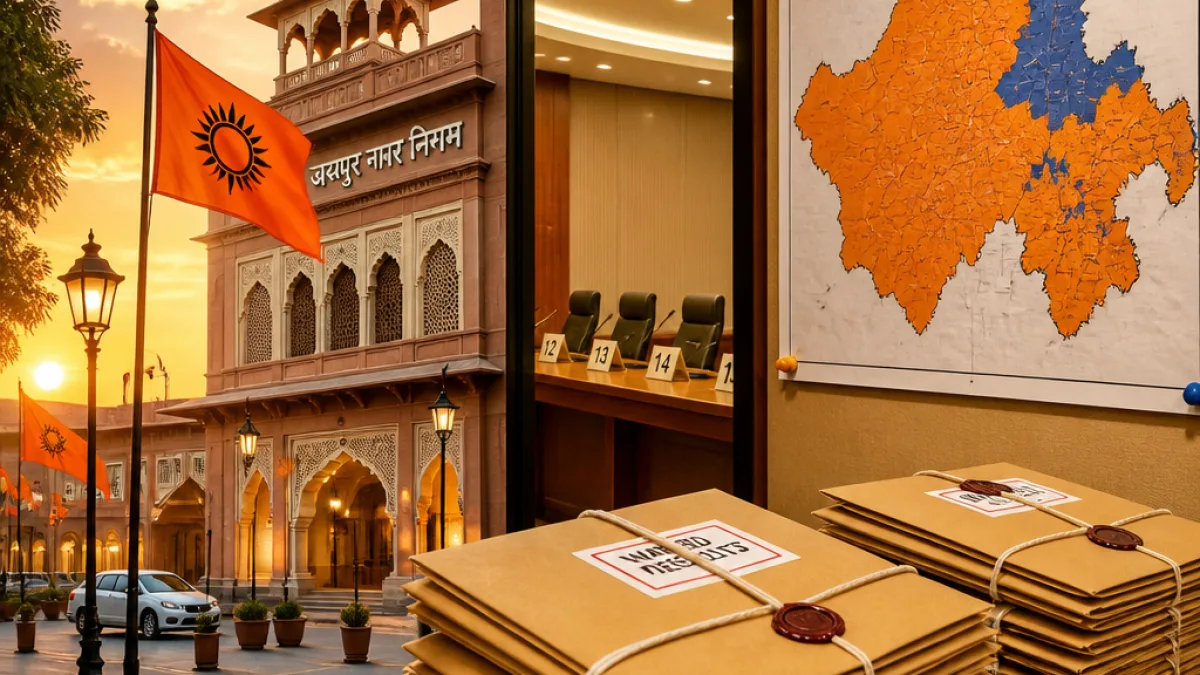
Jaipur: The recent round of municipal elections across Rajasthan has delivered a clear advantage to the Bharatiya Janata Party (BJP), which now controls the mayor’s chair in nine of the state’s 10 municipal corporations, leaving the Congress with a lone mayoralty in Bikaner. The outcome comes amid reports of cross‑voting, rebel candidates and intense post‑poll manoeuvring to form boards in municipalities and municipal councils.
Numbers and immediate aftermath
Across local bodies, including municipal councils and municipalities, the BJP has constituted boards in 204 bodies while the Congress has formed boards in 96. After the results were declared on September 14, both parties engaged in rapid consolidation efforts that included sequestering councillors to prevent defections.
| Party | Mayoralties (municipal corporations) | Local bodies where boards formed |
|---|---|---|
| BJP | 9 of 10 | 204 |
| Congress | 1 (Bikaner) | 96 |
Cross‑voting altered outcomes
Instances of cross‑voting and open rebellion played a decisive role in several contests. In Kota Municipal Corporation, the Congress had 39 councillors on paper but secured only 35 votes in a key election, prompting the party to boycott the subsequent deputy mayor poll in protest.
Perhaps the most striking episode occurred in Pali Municipal Corporation, where despite leading in ward counts, the Congress lost the mayoral contest as a rebel candidate split votes. In Mundwa municipality (Nagaur district), the chairperson election highlighted volatile allegiances: of 25 wards — BJP 10, Congress 3, RLP 7 and independents 5 — the BJP candidate reportedly did not receive any votes from the BJP councillors, and cross‑voting among non‑Congress blocs reshaped the result.
- Pali: Congress won 29 of 65 wards but failed to secure the mayor’s post.
- Mundwa (Nagaur): Cross‑voting among RLP and independents affected the expected outcome.
- Kota: Discrepancy between councillor numbers and votes cast led to a boycott by Congress.
What the results mean for state politics
The municipal results are likely to have implications for party organisation and strategy ahead of future elections in the state. The scale of cross‑voting and visible internal ruptures within the Congress have exposed organisational weaknesses that the BJP has exploited at the local level. For the Congress, the immediate task will be damage control: reconciling dissident councillors, strengthening whip systems and containing further defections.
For the BJP, the victories across corporations bolster municipal control and administrative reach in urban centres. Municipal majorities provide leverage over local governance, service delivery and development decisions, as well as a platform to showcase performance to voters.
Ground realities and governance
In Rajasthan’s arid landscape, municipal governance often intersects with pressing issues such as water distribution, sanitation, urban infrastructure and local revenue mobilisation. Control of municipal boards will shape how these priorities are addressed locally. Many citizens in urban centres will now expect visible improvements in civic services, and both ruling and opposition parties will be judged on delivery.
Political observers note that municipal elections frequently presage larger electoral patterns. While urban results do not automatically translate into state Assembly outcomes, sustained performance at the civic level can strengthen party narratives and voter trust.
Moving forward, party leaders in both camps are likely to intensify outreach to councillors and local influencers to consolidate gains and plug vulnerabilities. The coming weeks may see further realignments as coalitions and board formations are finalised across municipalities and councils.
Reporting from the state capital and regional centres indicates that the municipal verdict has underscored two concurrent trends: the BJP’s organisational advantage at the local level, and the Congress’s struggle to hold its elected representatives together in a competitive political environment.