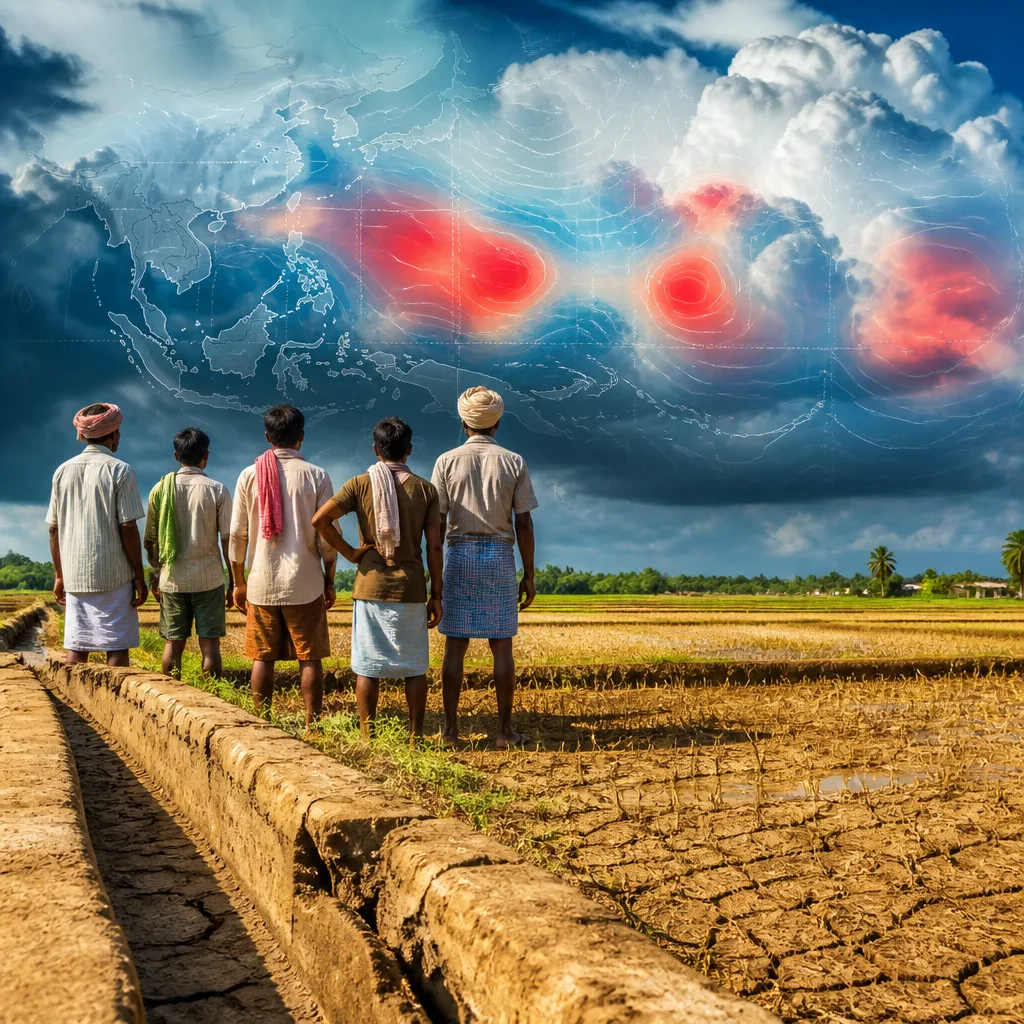
Scientists monitoring the tropical Pacific say the developing 2026 El Niño could become one of the strongest on record, raising fresh concerns for India because of the phenomenon’s capacity to weaken the southwest monsoon and affect harvests, water supplies and prices.
What researchers are saying
A landmark paper in the journal Science and current observations of Pacific ocean heat underpin the alarm. The study found that previous extreme El Niño events produced large, persistent economic losses — not just short-term weather disruptions — and warned that climate change is amplifying El Niño–Southern Oscillation (ENSO) variability.
The research cited in the study estimates the 1982–83 El Niño caused around $4.1 trillion in global income losses, while the 1997–98 event erased about $5.7 trillion. Under an emissions pathway consistent with current global pledges, researchers project cumulative ENSO-driven economic losses of roughly $84 trillion across the 21st century.
Timing and ocean signals
Forecasters report that sea surface temperatures in the tropical Pacific have already crossed thresholds associated with a “Super El Niño”, and a substantial pool of subsurface heat remains poised to surface over the coming months. Models indicate the event could peak by December 2026 and continue to influence global weather into 2027.
Why India is at particular risk
India remains unusually sensitive to ENSO because agriculture, while a smaller share of GDP than in earlier decades, still depends heavily on the southwest monsoon. The Science paper emphasises that extreme ENSO events can trigger droughts, crop failures, floods and infrastructure disruption — all of which have long-term economic consequences.
Early signs in 2026 already point to erratic monsoon behaviour: prolonged dry spells, shifting rain belts and uneven rainfall distribution. These patterns can reduce yields of key crops, strain water reservoirs and disrupt rural livelihoods — with knock-on effects on food prices and inflation.
- Agriculture: Reduced or poorly distributed rainfall can lower yields of staples and cash crops.
- Water security: Low reservoir levels and depleted groundwater during monsoon shortfalls.
- Prices and economy: Crop losses and supply disruptions can push up food prices and dent growth.
Quantifying the impacts
The Science study makes two linked points: that past major El Niño episodes produced very large global income losses, and that climate change is likely to increase the frequency and intensity of such shocks. Those twin findings mean the cost of a single event can be both immediate (crop and infrastructure damage) and persistent (reduced growth trajectories for affected economies).
| Event | Estimated global income loss |
|---|---|
| 1982–83 El Niño | $4.1 trillion |
| 1997–98 El Niño | $5.7 trillion |
| Projected 21st-century cumulative ENSO impact | $84 trillion |
Policy and preparedness implications
For India, the immediate policy priorities are clear: strengthen agricultural advisories and drought contingency planning; manage reservoirs and recharge groundwater where possible; and prepare supply-chain interventions to limit food-price shocks. Officials may also accelerate crop insurance payouts and targeted support for vulnerable households if monsoon performance deteriorates.
From a longer-term perspective, the findings underline the need to factor intensifying ENSO risks into national climate adaptation and economic planning. The Science paper stresses that without stronger mitigation and adaptation, El Niño-related shocks will likely grow costlier.
Researchers caution that while indicators point to a strong El Niño in 2026, uncertainties remain in the timing, spatial pattern and socio-economic outcomes. Forecasts provide a window of opportunity: early warning and targeted policy action can reduce human and economic costs even when extreme climate events cannot be prevented.
Reporting is based on current scientific publications and oceanographic forecasts; outcomes will depend on the event’s evolution and policy responses.