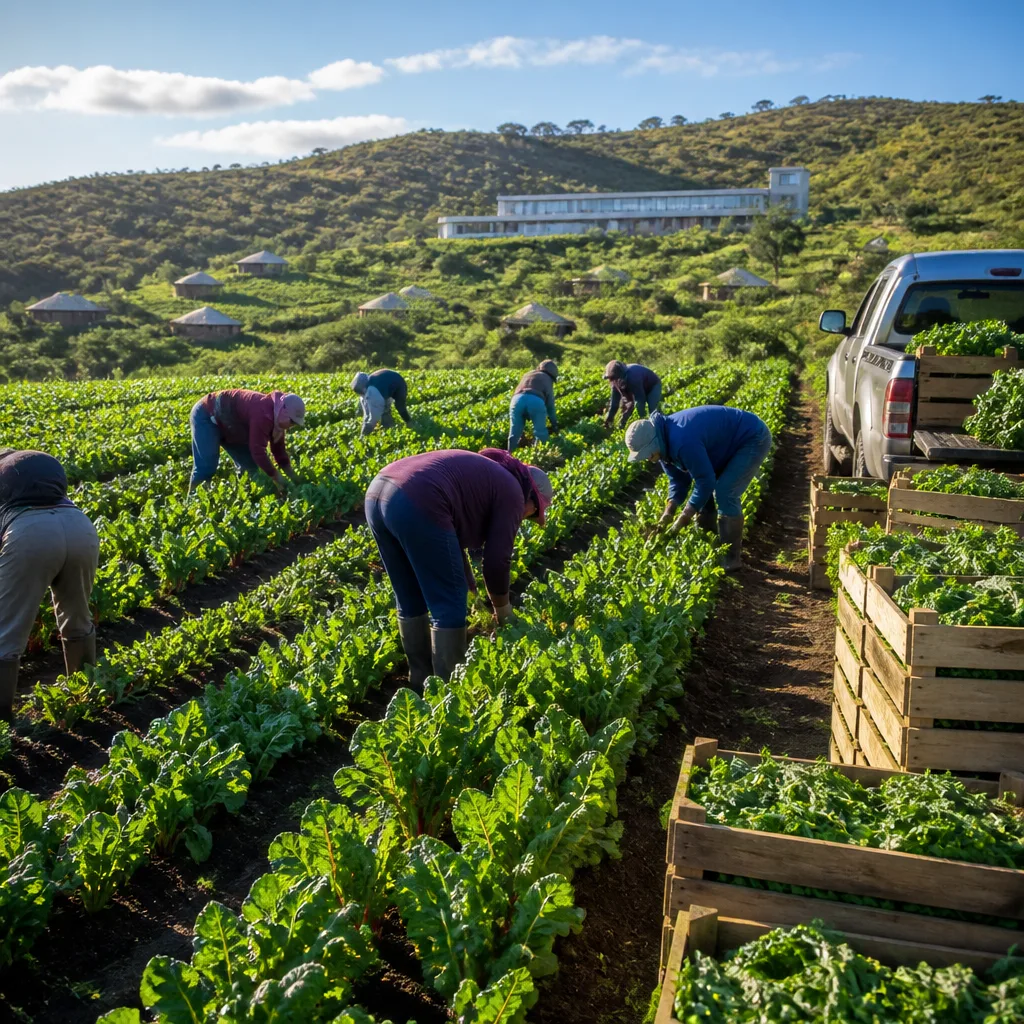
A one‑hectare start-up from the University of Fort Hare (UFH) has grown into a commercial agricultural enterprise that the founders say is creating seasonal employment for more than 50 families and demonstrating that smallholder farming can move beyond subsistence into viable business activity.
From laboratory to field: science and entrepreneurship combined
In the laboratory, the venture's co‑founder — a UFH PhD candidate in Microbiology — continues her research work. Outside the laboratory, through Ulibo Lokuqala Agricultural Enterprise, she and four partners operate a commercial vegetable production business based in Ncera Village, Alice (Dikeni).
The enterprise began as a one‑hectare agricultural operation and has since scaled to a commercial venture that offers seasonal employment opportunities for more than 50 families, according to the founders. The co‑founder said the project was built on the belief that practical, research‑informed solutions can create economic value for communities.
“My background is rooted in both science and entrepreneurship. I have always been interested in understanding how knowledge can be translated into practical solutions that create value for communities,”
The cooperative was founded by five entrepreneurs whose combined skills bridge science, social sciences and practical farming: a PhD candidate in Microbiology; a PhD candidate in Social Sciences and Communications; a UFH Master’s student in Sociology; and two other co‑founders who manage production and operations.
Recognition, markets and the international angle
Ulibo Lokuqala gained national recognition when it became a finalist in the EDHE (Entrepreneurship Development in Higher Education) Entrepreneurship Intervarsity in 2024. The founders see awards and competitions as validation of their model and a way to open market development and financing channels.
A few months ago, the enterprise achieved an additional milestone when one of the student founders was selected as a national student delegate for the Student Women Economic Empowerment Programme (SWEEP) Knowledge Exchange Visit to the United Kingdom. The trip is presented as part of the venture’s journey to broaden exposure to international practices and networks.
Why this matters for rural economies and household budgets
While the enterprise's scale is still modest — a one‑hectare origin and seasonal rather than permanent jobs — the model points to several practical implications for rural livelihoods:
- Employment multiplier: seasonal work for more than 50 families signals that small commercial farms can provide meaningful income streams in rural areas.
- Value of applied research: having founders with academic backgrounds in microbiology and social sciences suggests production and market strategies are being informed by evidence rather than ad hoc practice.
- Pathway to scale: national recognition and international exchange opportunities can help unlock markets, mentorship and possible finance that small agri‑enterprises need to move beyond seasonal work to more stable employment.
The founders emphasise disciplined planning across production systems, market development, financial management and execution as central to shifting agriculture from subsistence to a commercially viable and scalable sector.
| Founder | Background |
|---|---|
| Ms Amahle Bokveld | UFH PhD candidate in Microbiology; co‑founder and international delegate (SWEEP UK) |
| Ms Mandlakazi Nkunjana | UFH PhD candidate in Social Sciences and Communications; co‑founder |
| Sihle Nongauza | Co‑founder |
| Ms Xolelwa Macilikishi | UFH Master’s student in Sociology; co‑founder |
| Thando Sixaxa | Co‑founder |
For policymakers and funders focused on rural job creation, the enterprise illustrates a lower‑risk route to impact: support for university‑linked agribusinesses that combine scientific know‑how with market‑oriented management. For households, converting seasonal work into more regular income will require further investment in cold chains, processing or market contracts — steps the founders are seeking through exposure and recognition.
The venture’s progress is a reminder that student entrepreneurs in higher education can be a source of commercially oriented solutions for rural economies, particularly when academic knowledge is deliberately translated into practical business systems.
Note: This report is based on material provided by the University of Fort Hare about Ulibo Lokuqala Agricultural Enterprise and its founders.