
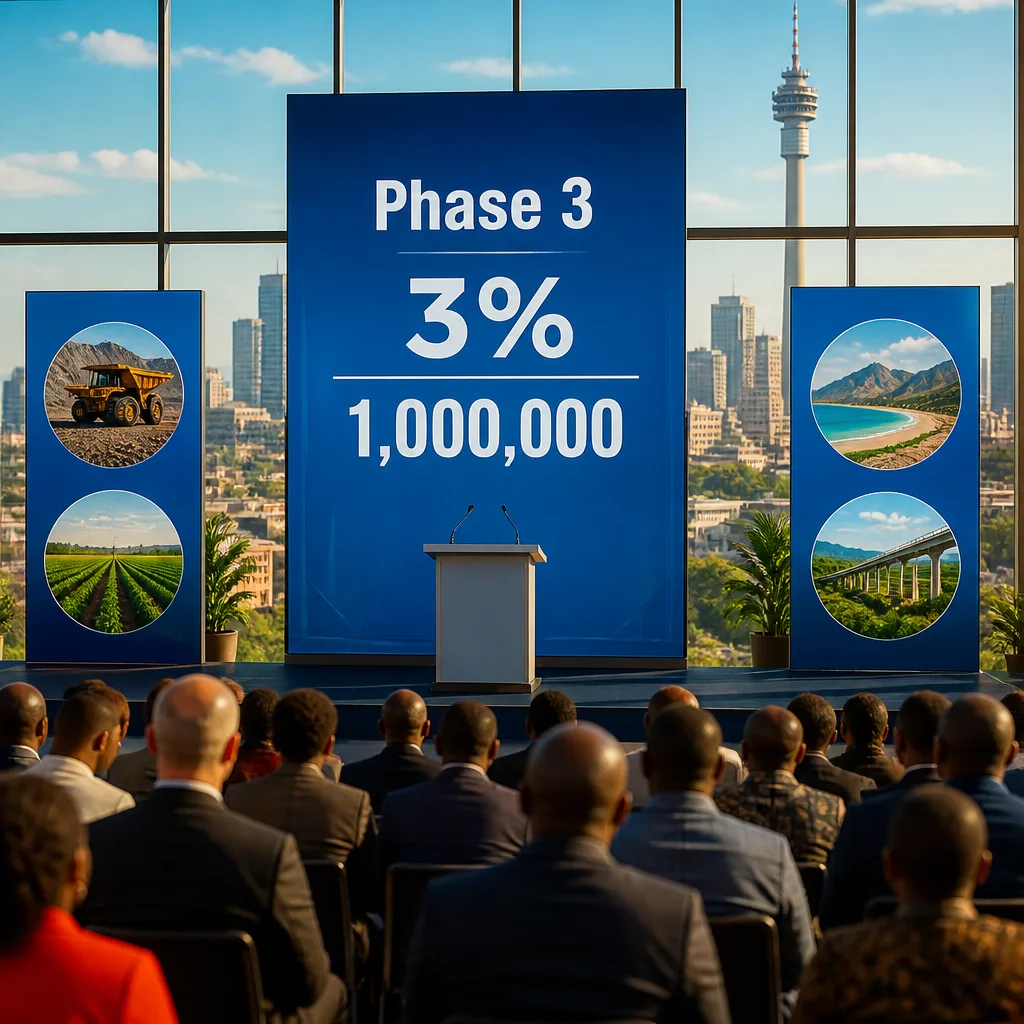
President Cyril Ramaphosa and business convenors unveiled Phase 3 of the Government–Business Partnership in Johannesburg on 20 August, signalling a shift from removing constraints to actively driving growth in selected sectors.
The partnership has set a headline target of achieving 3% economic growth and creating one‑million new jobs by 2030. The new phase identifies four primary growth drivers — mining, agriculture, tourism and infrastructure — while retaining earlier priorities such as energy, logistics and tackling crime and corruption.
What Phase 3 will focus on
Phase 3 bundles ten focus areas into three themes. Government and business said this structure is intended to move the economy from stabilising measures to sectoral expansion where South Africa can compete globally.
- Growth enablers: energy and logistics;
- Growth drivers: mining, agriculture, tourism and infrastructure;
- Confidence multipliers: crime and corruption, the City of Johannesburg, the country narrative and youth employment.
“A deliberate step change from removing the constraints holding the economy back, to actively driving growth in the sectors where South Africa can genuinely compete globally, grow and create jobs,”
Discovery CEO Adrian Gore, a key business convenor since the partnership began in 2023, used that phrase to describe the new phase.
Why 3% matters — and its limits
Business leaders framed 3% growth as a minimum threshold at which unemployment would begin to stabilise. The partnership highlighted the stark scale of joblessness: unemployment reached 33.6% in the last quarter, leaving 8.5 million people without work. The economy also faces a steady supply of new labour market entrants — about 300 000 people each year.
| Indicator | Value |
|---|---|
| Unemployment (latest quarter) | 33.6% |
| Number unemployed | 8.5 million |
| Annual entrants to labour market | 300 000 |
Speakers cautioned that 3% cannot be the summit of ambition. The partnership noted that growth above 5% would be needed to materially reduce unemployment and absorb the annual influx of jobseekers.
Continuity and new emphasis
Phase 1 of the partnership focused primarily on averting an economic slide amid severe loadshedding, rail and port crises, and entrenched crime and corruption. Energy, logistics and governance reform remained on the agenda as Phase 2 added youth unemployment to the list of priorities.
Phase 3 retains those strands but places greater emphasis on directly expanding activity in sectors judged capable of generating growth and jobs. The City of Johannesburg was singled out for targeted attention in the new phase, but only once business can be assured of a credible municipal partner.
Officials said the partnership would also address South Africa’s international investment narrative — a priority they describe as a confidence multiplier that shapes investor perceptions alongside governance and public safety reforms.
Implications and outstanding questions
The announcement signals a closer co‑operation between government and private sector actors on implementation rather than diagnostics. Key questions remain open and will shape the partnership’s impact:
- How the partnership will translate sectoral ambitions into financed projects and measurable milestones;
- What guarantees or accountability mechanisms will be applied to municipal engagement, notably in the City of Johannesburg;
- How persistent constraints such as loadshedding and logistical bottlenecks will be resolved quickly enough to support near‑term growth.
The partnership’s leaders framed Phase 3 as a strategic pivot: from removing economic constraints to pursuing active, sector‑based growth. Implementation details, financing plans and measurable timelines were not set out in full at the launch and remained under development.
Further announcements from government and private partners are expected as the partnership moves from planning to delivery. These will determine whether the selected sectors can generate the sustained growth needed to ease the country’s high unemployment rate.














