
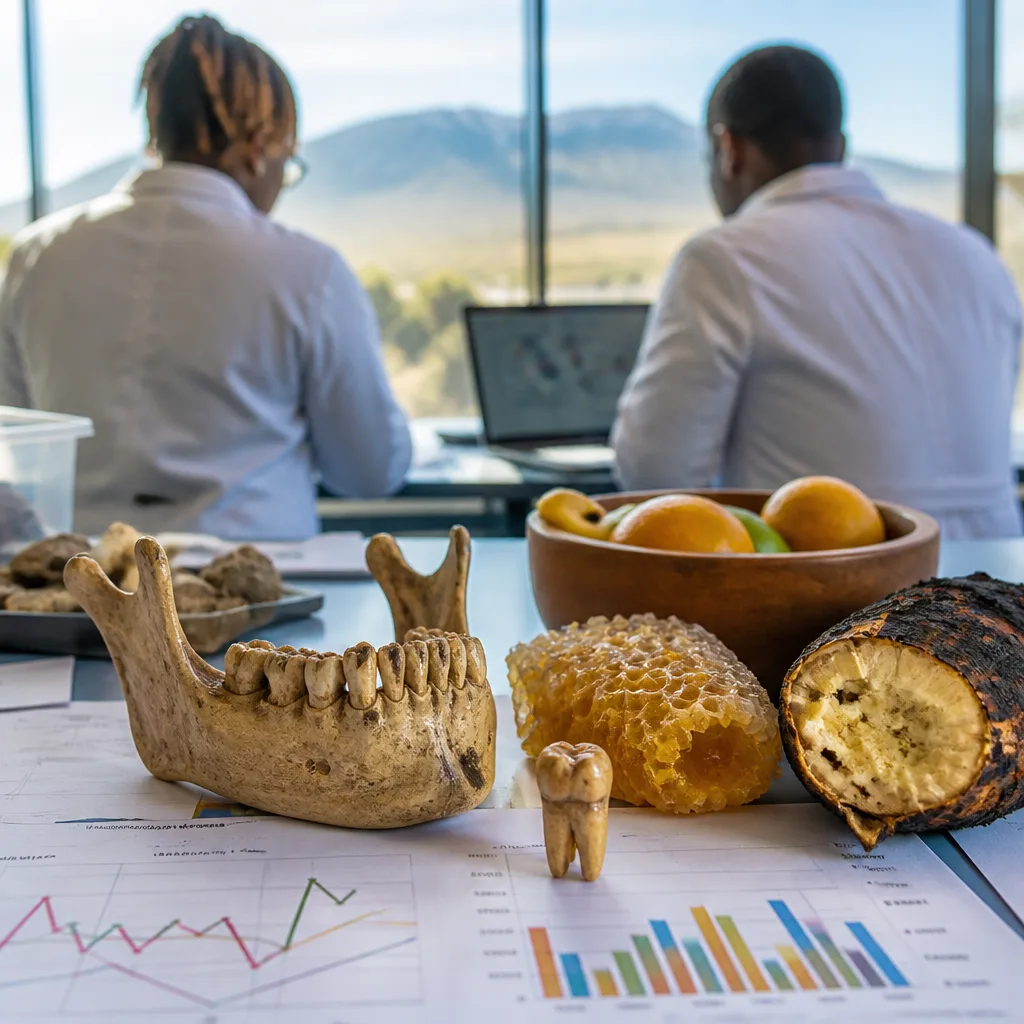
A team of researchers argues in a paper published in Science that the long-standing idea that meat alone powered human brain expansion needs re-evaluation. Their models suggest that reliable sources of glucose — initially fruit and honey, and later cooked starchy plants — could have supplied much of the energy required for growing brains through hominin evolution.
Glucose as the evolutionary fuel
The paper tracks brain evolution from early australopiths to modern humans and emphasises the energetic demands imposed by larger brains. The authors note that, despite representing about 2% of an adult body mass, the human brain consumes roughly 20% of resting energy and up to 66% in young children. They argue that meeting these demands would have required steady carbohydrate supplies.
Using dietary modelling across six stages of human evolution, the researchers propose that early hominins relied heavily on sweet plant foods. In their scenarios, fruit and other sugars provided more than 65% of energy for those ancestors. As control of fire and cooking became common, the team suggests that starchy plants became a stable and efficient glucose source, supporting larger brains as well as reproduction and child development.
What the study used to reach its conclusions
The authors combined dietary models with palaeontological and biochemical lines of evidence. The paper references fossil tooth evidence and stable isotope studies — methods that help reconstruct ancient diets — to argue for a shift from primarily sugary fruits to greater reliance on starchy plants with cooking.
| Hominin stage | Representative brain weight |
|---|---|
| Australopithecus afarensis | ~300 g |
| Homo sapiens (modern) | up to 1,500 g |
Implications and limits
The paper does not deny the importance of animal foods. Meat and other animal products supplied essential nutrients — for example, certain fatty acids, vitamins and minerals — that also influenced brain development. What the authors contest is the dominant narrative that meat was the sole or primary driver of encephalisation (brain enlargement).
Key implications the study raises include:
- That access to rapid, reliable glucose sources could have alleviated energetic constraints on brain growth.
- That behavioural changes — notably control of fire and cooking — changed the nutritional landscape by making starchy plants more digestible and energy-rich.
- That dietary reconstructions of human evolution should integrate multiple lines of evidence, including plant availability, hominin dental anatomy and isotope chemistry.
The authors modelled dietary scenarios rather than presenting direct archaeological proof that particular groups routinely ate the foods modelled. As with most deep‑time research, models rely on assumptions about food availability, foraging behaviour and hominin physiology. The paper draws on fossil teeth and stable isotope data to support its scenarios, but reconstructions of diet in the deep past remain open to revision as new evidence appears.
How to read the findings
Readers should see the study as a reassessment of energetic pathways that could have supported brain growth rather than a definitive replacement of one single explanation with another. Evolutionary change is rarely driven by a single cause; it is more often the result of interacting ecological, technological and social factors.
For South African readers, the study emphasises two practical points. First, reconstructing past diets requires combining diverse evidence — from fossil anatomy to chemical signatures and ecological modelling. Second, the role of plant foods in human evolution merits attention equal to that already paid to meat, especially where fire use and food processing altered nutrient availability.
Future work will need to refine the models with improved data on plant availability in palaeoenvironments, more detailed isotope records and closer study of hominin tooth wear patterns. Until then, the new paper offers a useful corrective: glucose availability — from fruit, honey and cooked starches — deserves a central place in our account of how the human brain grew so large and so metabolically costly.









