
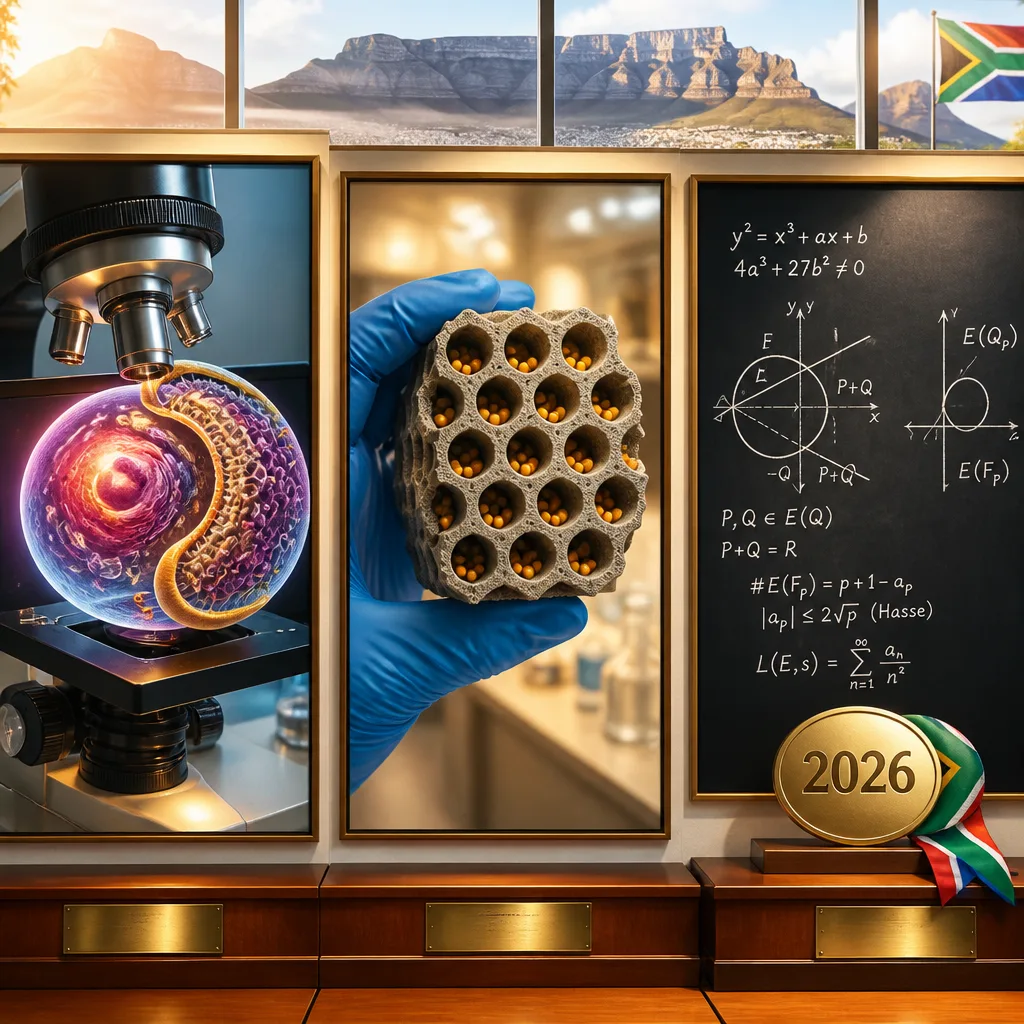
Three scientists have been awarded the 2026 Future Science Prize, organisers announced on 14 August 2026, recognising work that spans cellular biology, materials science and pure mathematics with potential applications in medicine, energy and computing.
Winners and their work
The laureates are:
- Zhang Hong — Institute of Biophysics, Chinese Academy of Sciences (life sciences).
- Zhao Dongyuan — Fudan University (physical sciences).
- Yuan Xinyi — Peking University (mathematics and computer science).
The prize citation highlights distinct contributions from each winner. Zhang is credited with discovering mechanisms and functions unique to autophagy — the cell’s process of breaking down and recycling components — in multicellular organisms. Zhao is recognised for pioneering methods to synthesise and understand mesoporous materials, solids that contain very small pores and are used in catalysis, energy conversion and storage, and biomedical applications. Yuan received the award for fundamental advances in arithmetic geometry, a branch of mathematics important to number theory and theoretical computer science.
What the Future Science Prize is
The Future Science Prize was established in 2016 and is a privately initiated award supported by scientists and entrepreneurs. According to the organisers, it aims to honour original, fundamental research. With the 2026 recipients, the prize has recognised 49 winners in total since its inception.
Why these discoveries matter
Each winner’s work addresses different layers of the research ecosystem:
- Life sciences: Improved understanding of autophagy can illuminate cellular responses to stress, ageing and disease, and may inform therapies for neurodegeneration, cancer and metabolic disorders.
- Materials and energy: Advances in synthesising mesoporous materials enable more efficient catalysts and energy devices, and open pathways for targeted drug delivery and biomedical engineering.
- Mathematics and computation: Progress in arithmetic geometry strengthens theoretical foundations that can underpin cryptography, error-correcting codes and algorithms used in advanced computing systems.
| Name | Institution | Field | Primary contribution |
|---|---|---|---|
| Zhang Hong | Institute of Biophysics, Chinese Academy of Sciences | Life sciences | Mechanism and function of autophagy in multicellular organisms |
| Zhao Dongyuan | Fudan University | Physical sciences | Synthesis, mechanism and application of mesoporous materials |
| Yuan Xinyi | Peking University | Mathematics & computer science | Fundamental contributions to arithmetic geometry |
Context for South African researchers and institutions
Prizes such as the Future Science Prize spotlight areas where fundamental research later translates into practical technology and policy. For South African scientists and research funders, the announcement underscores several priorities: strengthening basic biology to inform health interventions, investing in materials research for cleaner energy and industrial applications, and supporting mathematics and theoretical computer science that feed into data security and advanced computing.
While the prize itself is internationally focused, its emphasis on both discovery and application mirrors national research agendas that seek to balance curiosity-driven science with societal impact. Collaboration across disciplines — for example between materials scientists and chemical engineers, or between mathematicians and cryptographers — remains vital to convert fundamental advances into usable technologies.
The Future Science Prize continues to add to a landscape of awards that recognise high-impact fundamental work. Observers say such prizes can accelerate visibility for emerging fields and help attract talent and investment, but they are only one part of a broader research ecosystem that includes universities, public research councils and industry partnerships.
Organisers reported the three winners for 2026 and noted the prize’s ongoing mission to reward original, fundamental science since its establishment in 2016.









