Two decades after abandoning a Mechanical Engineering degree, an entrepreneur in Limpopo has built a diversified macadamia business that spans farming, consulting, agro-processing and export markets, the Department of Trade, Industry and Competition (dtic) said this week.
From student pivot to 27-hectare macadamia farm
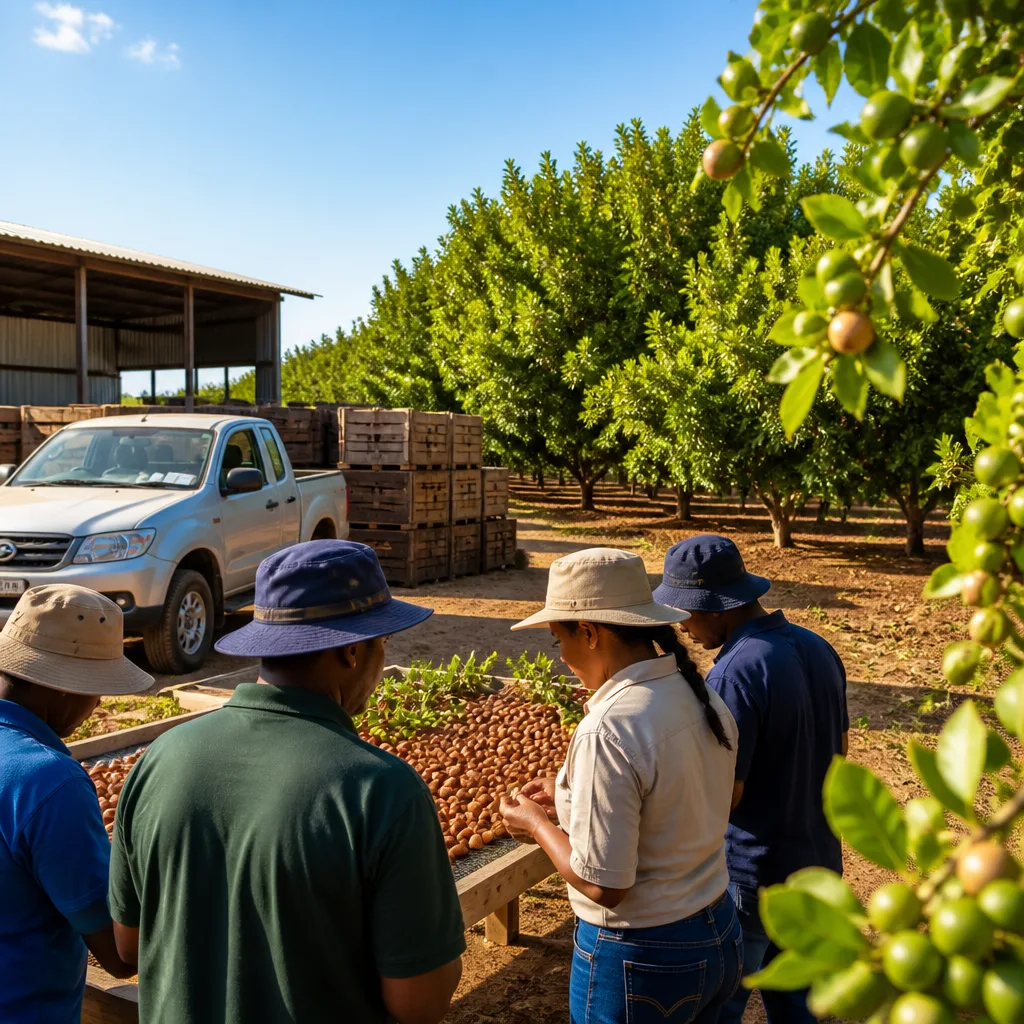
The dtic profile describes how Thiofhi Muthikhitha left Wits University shortly after starting a Mechanical Engineering course and later enrolled for Agricultural Engineering at the University of Venda. He now holds a doctorate from the University of KwaZulu-Natal, runs agricultural consultancy Agricre (short for Agriculture and Rural Engineers) and owns a 27-hectare macadamia farm near Makhado in Limpopo.
His business developments, the dtic said, include:
- Agricultural consulting that connects producers with markets;
- Commercial farming — a 27-hectare macadamia orchard;
- Agro-processing and export activities;
- Farmer training and sustainable production programmes.
“It has been a long journey, but I am grateful that everything I went through has been worth its while,” Muthikhitha said, according to the dtic profile.
Development partnerships and farmer training
A significant step for the business came in 2022, when Muthikhitha partnered with British conservation charity Rainforest Concern to establish a foundation aimed at training farmers in sustainable fruit-production methods. The foundation, the dtic said, brought together 53 subtropical fruit farmers across the Vhembe district for training on productivity and sustainability.
That combination of on-farm production, advisory services and capacity-building is the business model many policymakers favour because it supports smallholder inclusion while creating pathways to higher-value activity — agro-processing and exports — which pay better than raw-commodity sales.
What this means for household incomes and jobs
For household budgets in rural Limpopo, several implications flow from this model. First, value-added activity (processing and export) typically increases the rand earnings per kilogram of output compared with selling unprocessed nuts. Second, a consultancy that links smallholders to markets can raise farmgate prices by reducing information asymmetry and market access costs. Third, farmer training in sustainable production should, if effective, raise yields and reduce input losses, improving producer margins.
Those points are not speculative: they are implicit in the dtic description of the enterprise. Small-scale subtropical producers often lack the scale or market contacts to reach export chains; meeting those gaps can translate into higher, steadier cash flows for households and potential new jobs in processing, logistics and services.
| Metric | Figure |
|---|---|
| Farm size | 27 hectares |
| Farmers trained (Vhembe) | 53 |
| Partnership year | 2022 |
The enterprise’s trajectory also underlines a broader structural challenge in South African agriculture: turning technical skills and advisory capacity into scalable rural employment. A single 27-hectare orchard will not absorb large numbers of labour, but an expanded cluster of such operations, plus local processing facilities, could create meaningful rural work and bolster incomes.
Policy actors including dtic have signalled support for models that combine production, training and market access because they align with industrialisation and rural development objectives. For farmers, the immediate yardstick is the rand value returned to the household each season — whether through higher prices, reduced losses or paid work in processing.
For now, the story of this engineer-turned-farmer illustrates how individual entrepreneurship, targeted partnerships and skills can reshape the fortunes of producers in subtropical corners of South Africa, turning tree crops into livelihoods and export revenue.
WE NEWS does not provide financial advice.