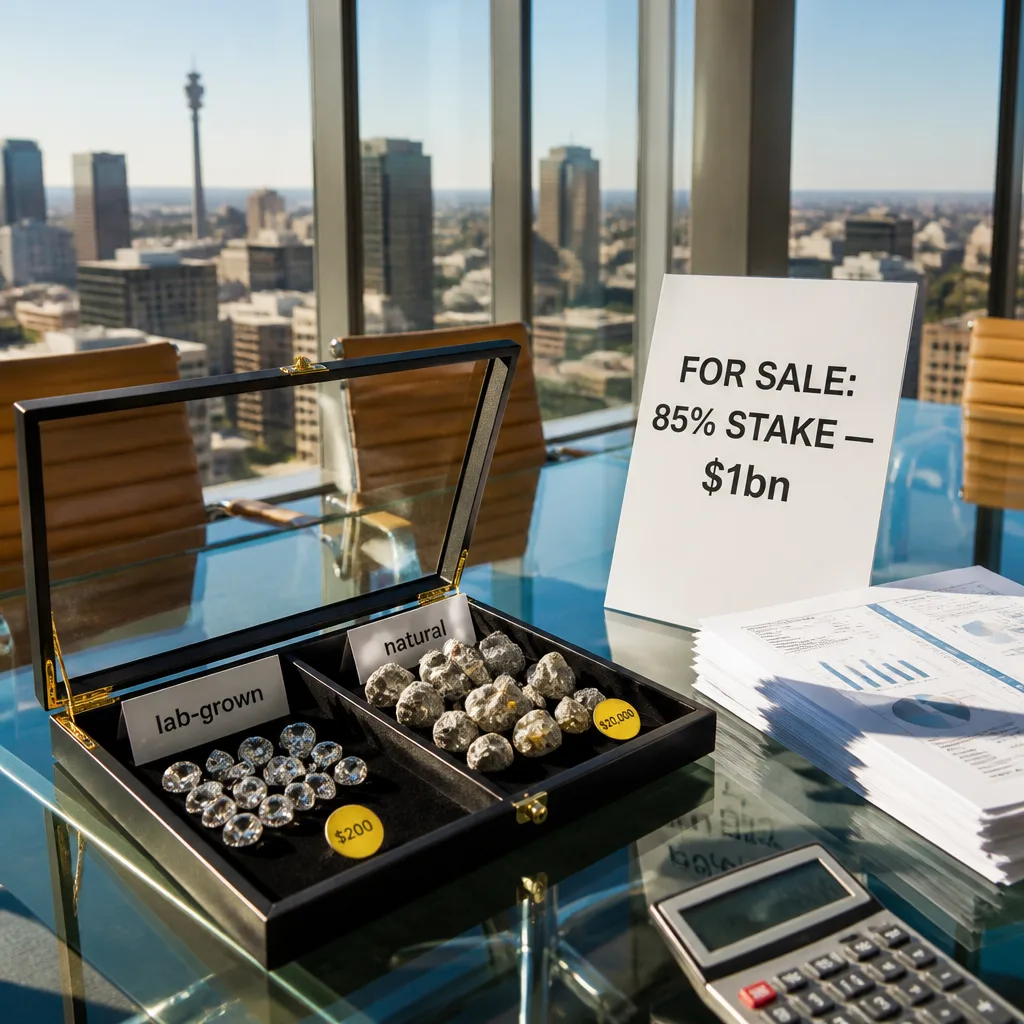
Anglo American’s decision to seek about $1 billion for its 85% stake in De Beers has crystallised a stark reality for the diamond sector: the rapid rise of lab-grown stones is eroding the price and demand for natural diamonds, and that shift is now forcing major strategic recalculations by companies that once dominated the market.
Valuations collapse as lab-grown supply surges
The figure Anglo is reportedly asking — around $1 billion — is a fraction of De Beers’ former value. That compares with an estimated $18 billion valuation in 2001 and the implicit near-$13 billion valuation implied when Anglo bought the Oppenheimer family’s 40% stake fifteen years ago for $5.1 billion, according to reporting. The steep decline in market value is framed by Anglo CEO Duncan Wanblad’s own admission that the company underestimated the structural impact of lab-grown diamonds.
“Hindsight would probably show that we might have wanted to have been a little bit more aggressive on the signals we were getting,” Wanblad said, according to the reporting.
Industry data cited in the reporting paints a rapid shift in consumer behaviour and pricing:
- Lab-grown stones accounted for 61% of engagement ring purchases among more than 10,000 US couples surveyed in 2025.
- Wholesale prices for lab-grown diamonds have fallen an estimated 96% since 2018, as documented by market analysts.
What this means for South Africa
For South Africa, where natural diamonds have been a notable export and a source of regional employment, the De Beers sale and the broader structural change raise immediate questions about jobs, revenues and provincial economies that host diamond mines and cutting-and-polishing operations.
Although the reporting does not provide South African-specific job or revenue figures, the collapse in valuations and the rapid market share gains by lab-grown stones suggest lower realised prices for rough diamonds and potential pressure on downstream industries that depend on natural-stone premiums. That effect can translate into smaller margins for producers and, ultimately, less income available to sustain local operations and employment.
Industry dynamics — quick reference
| Year / Transaction | Reported value |
|---|---|
| De Beers valuation (2001) | $18 billion |
| Anglo purchase of Oppenheimers’ stake (circa 2011) | $5.1 billion (Anglo bought 40% stake) |
| Anglo asking price for De Beers (2026) | $1 billion |
Those numbers illustrate the scale of value erosion in the sector over roughly a quarter-century. For households connected to mining towns, that value decline matters: lower company valuations often precipitate cost-cutting, reduced investment and weaker demand for local services.
Broader commercial implications
Several commercial pressures are evident from the shift to lab-grown stones. First, rapid declines in wholesale prices for lab-grown products make them an affordable alternative for many consumers, especially younger buyers of engagement rings. Second, if natural-stone producers are forced to accept lower prices for rough diamonds, the economics of mining — already capital-intensive — are further strained.
Anglo’s strategic choice to offload or significantly reshape its exposure to the diamond business highlights another consequence: large miners are reassessing portfolio allocations in favour of assets with clearer demand trajectories. For South Africa, which competes in a global market, that raises the policy question of how to support value retention in mineral supply chains — whether through beneficiation, diversification of local processing or targeted investment incentives.
Investors and policymakers will be watching closely how the sale process unfolds, and what buyers — if any — are willing to pay for a legacy brand in a market that is visibly changing. For workers and towns dependent on diamond revenues, the outcome will determine whether the next phase is managed decline, restructuring or a search for new industrial opportunities.
While the reporting underscores the scale of disruption, it does not foretell the sector’s precise future. What is clear is that the advent of lab-grown diamonds is no mere cycle: it is reshaping demand and price formation in a way that has real consequences for companies, communities and national export earnings.
WE NEWS does not provide financial advice; this report sets out the facts as reported and considers likely economic implications for households and the industry.