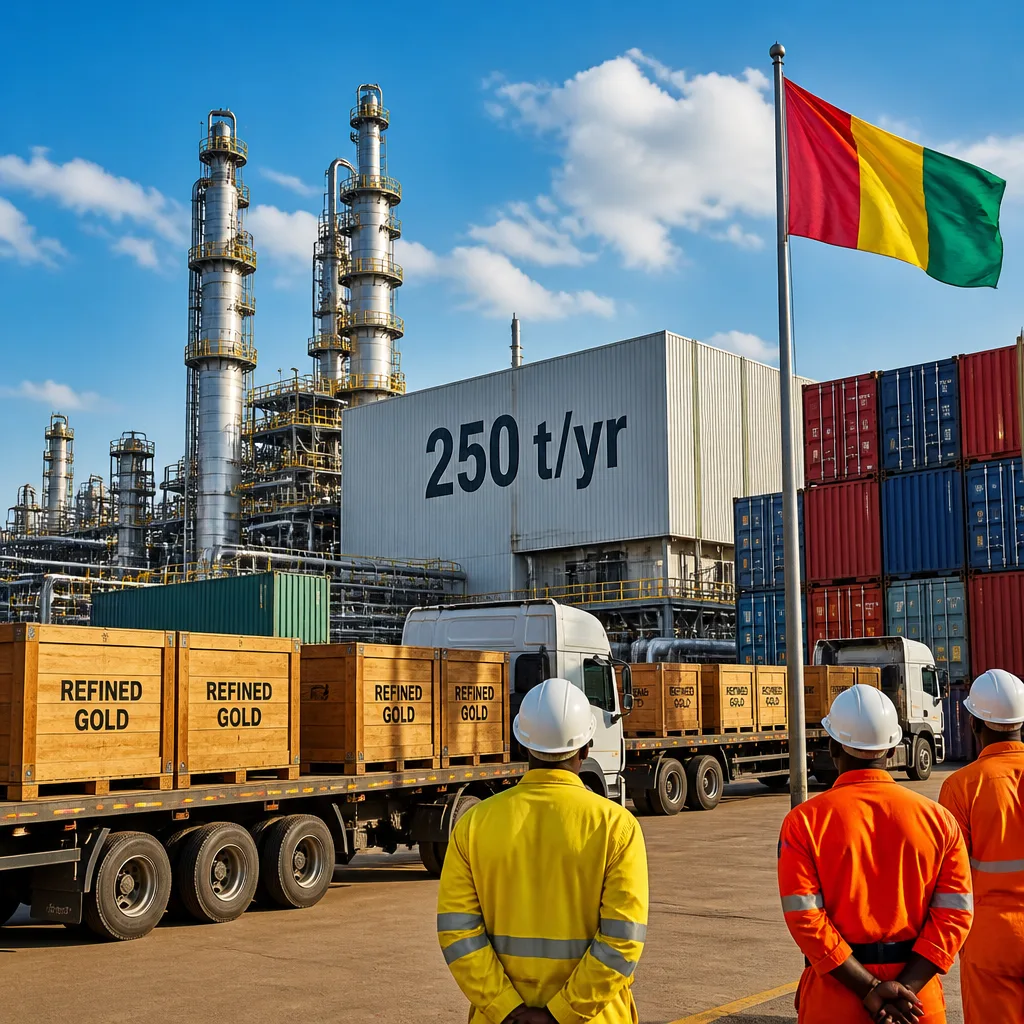
Guinea has banned the export of raw gold and is pressing mining companies to process metal domestically as it seeks to retain more resource rent at home. The move, announced at the end of June by President Mamady Doumbouya’s government, coincides with the construction of a new gold refinery in Conakry with a capacity of 250 tonnes per year.
Policy shift aims to capture more value
The policy forms part of a broader effort to extract greater benefit from Guinea’s mineral wealth. The country hosts large deposits of iron ore, bauxite, diamonds and gold, and has recently moved the long-delayed Simandou iron ore project into production, the government says. Historically, large volumes of minerals left the country in unprocessed form, limiting local value addition and jobs.
Under the new rules, companies that fail to comply face heavy sanctions: the government has warned it may revoke licences or terminate mining contracts. Guinea has previously acted against foreign operators in other mineral sectors, including the takeover of a local bauxite unit last year, signalling it is prepared to enforce tough measures.
Production, capacity and prices
The size of the Conakry refinery is large relative to recent output. In the first quarter of 2025 Guinea exported 22 tonnes of gold. That means the plant’s 250‑tonne annual capacity would far outstrip current official export volumes, at least initially.
| Indicator | Value |
|---|---|
| Conakry refinery capacity | 250 tonnes/year |
| Guinea gold exports (Q1 2025) | 22 tonnes |
| Gold price peak (late Jan 2026) | US$5,600/oz |
| Gold price (mid‑2026) | ~US$4,400/oz |
Gold surged to record highs of about US$5,600 an ounce in late January 2026 amid geopolitical uncertainty and later eased to roughly US$4,400 an ounce. The higher prices have increased the stakes for governments seeking to capture more revenue from mining, while also raising the potential reward for firms able to refine and sell at higher value.
Implications for miners, revenue and jobs
Requiring domestic refining could lift the share of value retained in Guinea if processing is efficient, transparent and integrated into local supply chains. Governments typically argue that local refineries create jobs, stimulate downstream industries and raise taxable value. But several practical and commercial questions remain:
- Can the new refinery secure sufficient, consistent feedstock at commercial terms without disrupting existing operations?
- Will independent artisanal and small‑scale miners be able to access the facility, and under what controls?
- How will investors respond if licences are revoked or contracts terminated for non‑compliance?
Mining companies that have traditionally exported doré or other semi‑processed ore will face choices: invest to refine on‑site or in Conakry, sell to the new national refinery, or contest the measures. The government’s warning that licences could be revoked signals a hard line that could deter new investment even as it seeks to boost local industry.
Regional context and risks
Guinea joins a growing number of African countries pushing for domestic processing of raw commodities. The policy aligns with a regional trend aiming to capture more value from extractive sectors. However, success depends on governance, capacity and market access. Overcapacity at the new refinery relative to current exports raises questions about utilisation rates and the business model, while enforcement actions could provoke legal disputes and investor nervousness.
For households and local labour markets, the promise is more jobs and potentially higher tax receipts that could fund public services — but only if the refinery operates profitably, adheres to environmental and social standards, and integrates local suppliers. The balance between asserting sovereign control over resources and maintaining a favourable investment environment will determine whether the policy boosts long‑term development or simply displaces revenue and activity.
Guinea’s approach will be watched closely by mining investors and by other African governments considering similar measures. Enforcement, transparency and the practicalities of turning policy into sustainable local industry will determine whether the move achieves its stated aim of keeping more resource wealth at home.