The Emerging Africa & Asia Infrastructure Fund (EAAIF), a Private Infrastructure Development Group (PIDG) vehicle managed by Ninety One, has signed two private debt commitments totalling USD82.8 million to expand digital infrastructure in Africa, the fund announced on 8 August 2026.
What the money will fund
The transactions comprise two separate loans, according to EAAIF and PIDG statements:
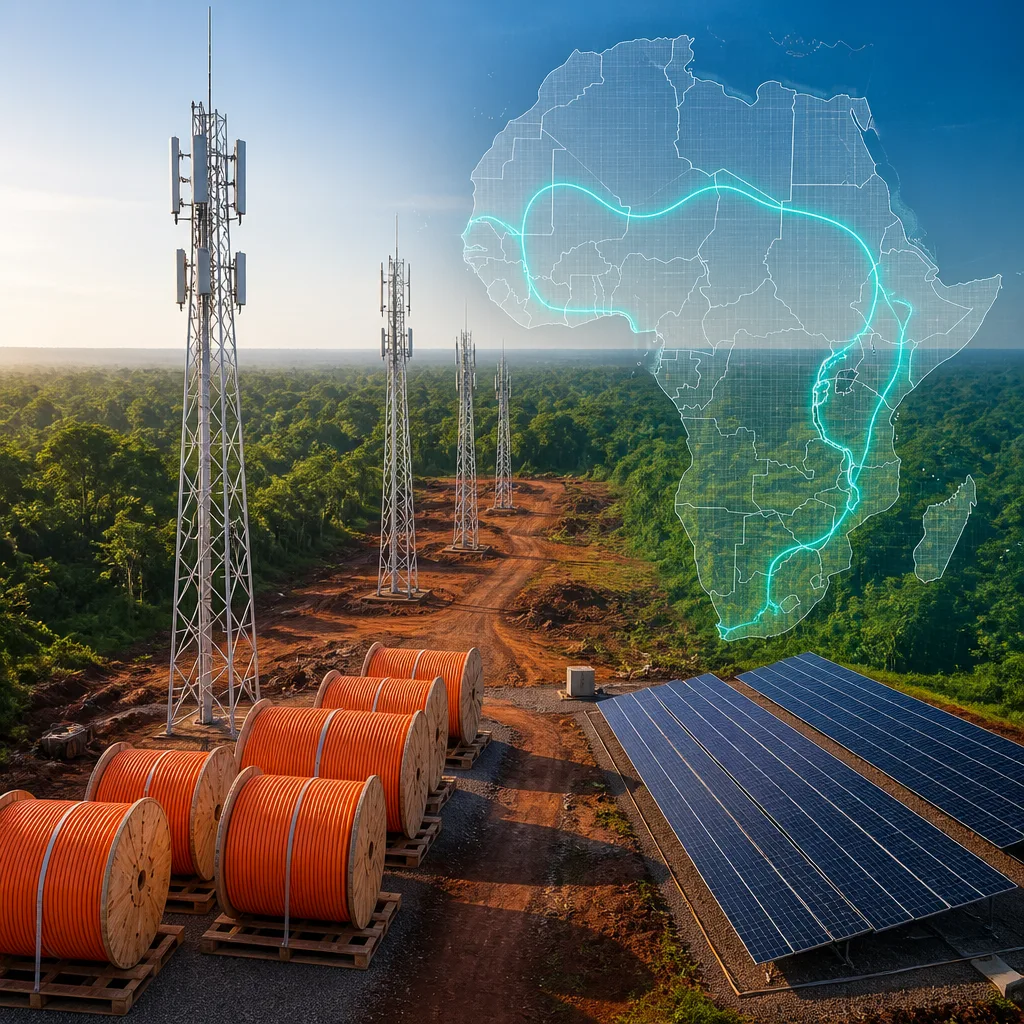
- USD32.8 million as a senior secured loan to Eastcastle Infrastructure DRC to support the construction of 728 new passive telecommunications towers, upsizing a broader USD179 million term loan and growth facility.
- USD50 million to Liquid Intelligent Technologies to refinance and future‑proof its 110,000‑kilometre pan‑African fibre‑optic network.
By targeting both last‑mile tower access in the Democratic Republic of Congo (DRC) and long‑haul fibre transport across multiple countries, EAAIF said the investments are designed to reduce risk for operators and scale the physical networks that underpin Africa’s digital economy.
Why this matters
Mobile internet penetration in the DRC is cited as roughly 17% in the fund’s materials, and tower density is extremely low — the announcement contrasts one tower per 15,000–20,000 people in the DRC with one per 600 people in the United States. EAAIF’s investment in Eastcastle will raise the company’s active tower count from 1,072 to 1,800, with about 70% of the new towers planned for rural and under‑served regions.
For households and businesses, the practical impact of more towers and more fibre is lower latency, higher data speeds and more reliable mobile coverage — prerequisites for digital services, e‑commerce, fintech, telemedicine and online education. For operators, denser passive infrastructure and strengthened fibre backhaul can reduce operating costs per subscriber and enable more competitive data pricing over time.
Energy resilience and sustainability
The Eastcastle transaction also includes funding for solar panels and lithium battery upgrades, intended to reduce reliance on diesel generators and improve uptime where grid power is unreliable. That element responds directly to a recurring constraint for telecom infrastructure on the continent: energy insecurity raises operating costs and undermines service reliability.
Policy and investment implications
PIDG and EAAIF framed the deals as aligned with efforts to mobilise private capital in support of the United Nations Sustainable Development Goals and socio‑economic development more broadly. For investors and policymakers, the packages are notable for two reasons:
- They pair local access expansion (towers) with long‑haul connectivity (fibre), recognising that both are needed to close Africa’s connectivity gap.
- They are structured as private debt, signalling appetite among development finance vehicles to use credit instruments to de‑risk commercially oriented infrastructure projects.
That approach can make projects more bankable for commercial lenders and attract follow‑on private investment — but it also places emphasis on sustainable cash flows from operators and predictable regulatory environments in host countries.
| Transaction | Amount (USD) | Primary purpose |
|---|---|---|
| Eastcastle Infrastructure DRC | 32.8 million | Construct 728 passive telecom towers; energy upgrades (solar, batteries) |
| Liquid Intelligent Technologies | 50 million | Refinance and future‑proof 110,000 km pan‑African fibre network |
For South African businesses that supply tower equipment, solar systems, batteries or fibre maintenance services, the deals may create regional procurement and contracting opportunities. For regulators and competition authorities, the rapid scale‑up of tower portfolios and fibre assets will raise questions about access, wholesale pricing and open‑reach arrangements to ensure smaller mobile network operators and new entrants can compete.
While the announcements focus on infrastructure build and refinancing, the broader test will be whether increased capacity translates into more affordable and reliable connectivity for consumers and small businesses — the ultimate determinant of whether such investments deliver measurable socio‑economic benefit.
WE NEWS does not provide financial advice.