The South African National Energy Development Institute (SANEDI) says the 12L tax incentive has already delivered roughly R20 billion in tax relief to manufacturers and reduced carbon emissions by about 20 megatons of CO2. The measure, designed to reward verified energy savings in industry, is available until 31 December 2030, giving companies a finite window to claim the allowance.
How the incentive works
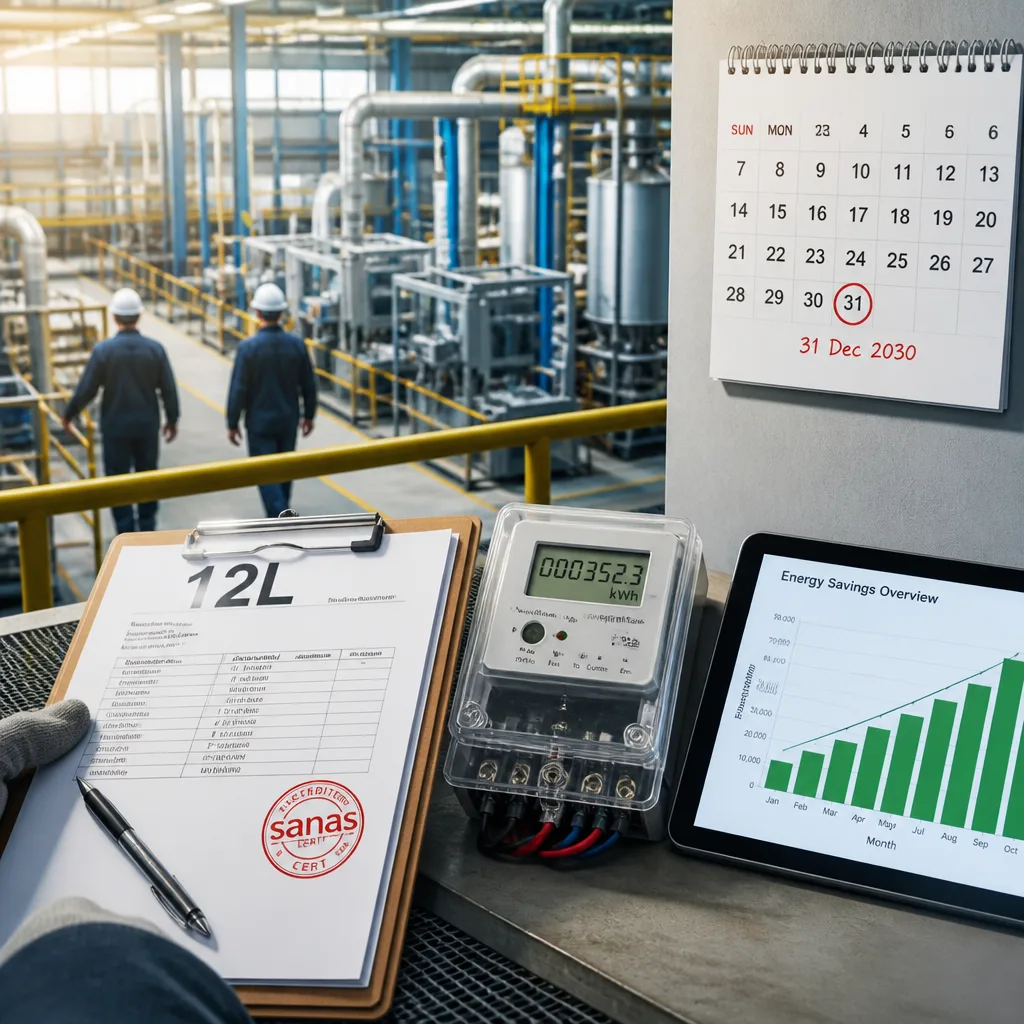
First launched in 2008 after the country’s initial load‑shedding crisis, the 12L allowance rewards documented reductions in energy consumption by allowing businesses to offset savings against taxable income. SANEDI administers the scheme and requires projects to be measured and verified by consultants accredited by the South African National Accreditation System (SANAS).
“So the regulation itself incentivises good behaviour in terms of energy efficiency, whereby companies implement energy projects and demonstrate energy savings, and they are awarded 95c per kWh saved,” said SANEDI Senior Advisor for Measurement and Verification, Stalin Ndlovu, at the Manufacturing Indaba.
The incentive operates alongside the national carbon tax, introduced in June 2019 at a rate of R120 per tonne of CO2, forming a twin policy to encourage cleaner production while pricing emissions.
Application and compliance steps
SANEDI sets out a staged process for companies to access the relief. The steps, as explained at the Manufacturing Indaba, are:
- Register the proposed energy‑saving project online with SANEDI;
- Appoint a SANAS‑accredited measurement and verification (M&V) consultant to assess baseline consumption and expected savings;
- Submit the baseline and project documentation for SANEDI review and approval;
- Implement the energy‑saving measures and have savings certified so the tax allowance can be claimed.
Expiry timetable and previous extensions
The incentive has been extended twice since its modern iteration. SANEDI notes the current window runs to the end of 2030, meaning manufacturers and other qualifying businesses must plan and act before the benefit lapses.
| Milestone | Effective to |
|---|---|
| First modern sunset clause | December 2022 (extended from January 2020) |
| Second extension | December 2025 |
| Current extension | 31 December 2030 |
Implications for business and households
The 12L allowance reduces effective tax liabilities for qualifying projects by awarding companies the equivalent of 95c for each kilowatt‑hour saved. For manufacturers that invest in energy‑efficiency upgrades, that can translate into sizeable cash flow improvements — the R20 billion figure cited by SANEDI is a measure of tax relief already realised by the sector.
Those cash savings can be redeployed into maintenance, wage bills or capital investment, providing a potential cushion against rising input and electricity costs. At the same time, reduced energy consumption eases demand pressure on the grid and can help moderate the frequency or severity of load‑shedding, which in turn affects production schedules and household incomes.
However, qualifying is conditional on following the prescribed M&V route. Companies that delay registering projects or fail to secure SANAS‑accredited verification risk missing out if the incentive is not extended beyond 2030.
What businesses should note now
- Time is limited: the benefit is currently scheduled to end on 31 December 2030;
- Strict compliance: SANAS‑accredited measurement and verification is mandatory;
- Financial calculus: at 95c per kWh saved, the allowance can materially reduce tax bills and improve cash flow, but businesses must weigh verification and implementation costs against the expected tax benefit.
SANEDI’s presentation at the Manufacturing Indaba underlined the policy intent: to use fiscal incentives to steer industry towards lower energy intensity and fewer emissions. For companies that have not yet engaged with the 12L process, the institute’s figures make clear there is a tangible fiscal prize — but it will require timely action and rigour in demonstrating energy savings to secure it.
WE NEWS does not provide financial advice; businesses should consult tax and technical advisers when considering whether to pursue the 12L allowance.