
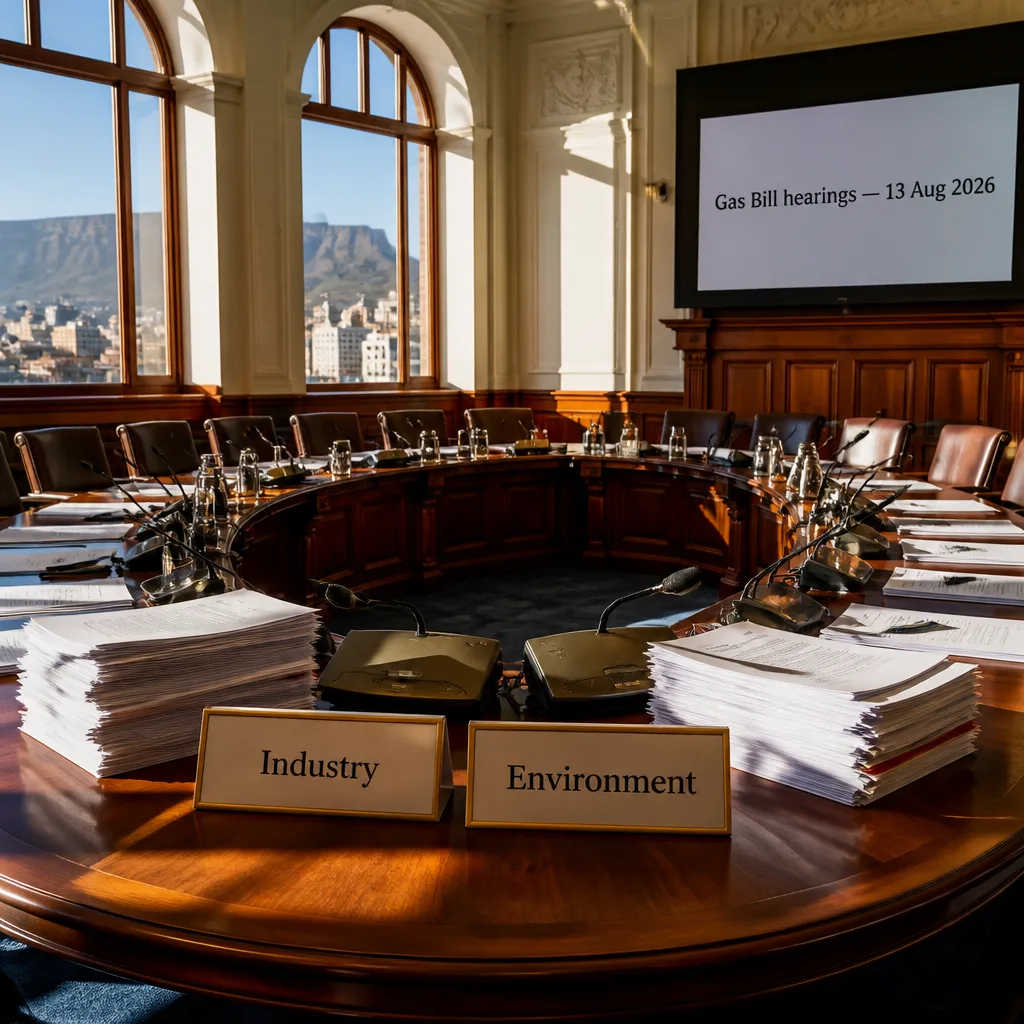
Parliament’s Portfolio Committee on Electricity and Energy has concluded public hearings on the Gas Bill, with stakeholders divided between calls for regulatory certainty to spur investment and warnings that the draft law lacks robust climate safeguards.
The hearings, held over several days and formally closed on 13 August 2026, were opened by committee Chairperson Ms Zama Khanyase, who urged meaningful public participation and stressed the committee’s intent to ensure the Bill meets South Africa’s energy needs while protecting community interests, the committee said in a statement.
Industry seeks certainty and investment
Industry presenters told the committee the Gas Bill could play a pivotal role in attracting investment, expanding energy infrastructure and supporting industrial development. They argued that a clear regulatory framework would provide the confidence investors need to commit capital to gas projects, including liquefied petroleum gas (LPG) supply.
Key issues raised by industry included:
- Regulatory certainty — stakeholders said clear definitions and predictable rules are essential to avoid duplication and reduce investor risk.
- Alignment with existing law — several presenters highlighted overlaps between the Gas Bill and the Upstream Petroleum Resources Development Act, 2024, and urged delineation of roles and responsibilities.
- Energy security — gas and LPG were flagged as potential contributors to stabilising supply and supporting industry while other energy transitions proceed.
Environmental groups demand stronger climate governance
Environmental organisations told the committee they were concerned the Bill, in its current form, could enable long-term investment in gas infrastructure without sufficient regard for South Africa’s climate commitments and long-term energy needs. They called for the completion of the Integrated Energy Plan prior to finalising the Bill and urged incorporation of stronger climate governance measures.
Environmental presenters also pressed for increased transparency and broader public participation in licensing and regulatory decision-making, saying those processes must be accessible and accountable to affected communities.
Areas of tension and next steps
Presenters identified several areas where the Bill and existing instruments may clash or leave gaps. The committee was told that without clearer role definitions, overlaps with the Upstream Petroleum Resources Development Act could create legal and administrative uncertainty.
The hearings also surfaced calls for:
- Completion of the Integrated Energy Plan to guide long-term policy alignment;
- Stronger climate-aligned conditions on licensing and infrastructure investment;
- Enhanced transparency in regulatory decisions and greater public access to information.
| Stakeholder group | Main points to the committee |
|---|---|
| Industry and gas suppliers | Need for regulatory certainty, clear roles, investor confidence; role for LPG in energy security |
| Environmental organisations | Bill risks locking in gas infrastructure without climate safeguards; call for Integrated Energy Plan and stronger climate governance |
| Committee leadership | Emphasised public participation and committee commitment to balancing energy needs, economic development and community interests |
The committee will now consider submissions from the hearings as it prepares its report and possible amendments to the Bill. The timing for tabling the final version to the National Assembly was not specified in the statement and may depend on further consultations and internal committee processes.
Observers say the outcome will have consequences for South Africa’s energy mix, investor appetite for gas projects and the country’s ability to meet its climate obligations while managing current energy shortages. The balance the committee strikes between enabling investment and safeguarding climate commitments will be closely watched by industry, environmental groups and communities likely to be affected by gas infrastructure developments.
Details remain subject to clarification and the committee may announce follow-up meetings or additional opportunities for input as it refines the Bill.














