
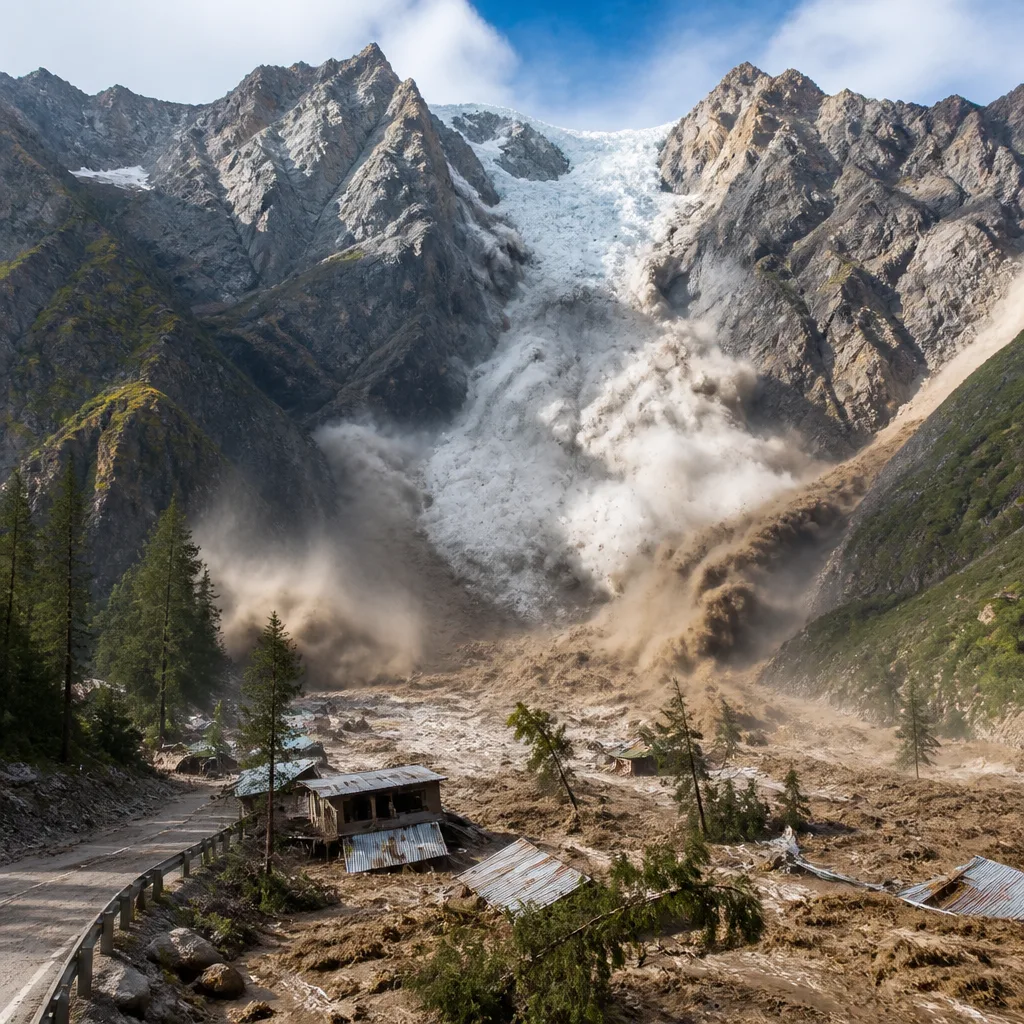
A peer-reviewed analysis released this month concludes that climate warming probably weakened the glacier that collapsed on Aug. 26, triggering a catastrophic avalanche and flood that killed more than 1,300 people and left over 5,000 people missing across Nepal and Tibet.
Unusually warm conditions preceded collapse
Researchers identified unusually warm conditions in the period before the glacier’s collapse, a factor they say likely reduced the stability of the ice and rock. The fallen mass — a fragment of overhanging glacier and rock — measured roughly 200,000 square meters and plunged about 1,400 meters from Langtang Lirung mountain into the valley below.
The avalanche converted to a high‑energy flood that the researchers describe as nearly unprecedented. The moving mass was estimated at about 110 million cubic meters of snow and ice, and it accelerated down the valley at speeds exceeding 110 mph, liquefying ice and carrying rock, sediment and water in a destructive surge that registered as an earthquake.
“Communities in Nepal are paying with their lives for a crisis driven by fossil fuel emissions thousands of miles away,” said Dr. Friederike Otto of Imperial College London, a lead author on the study.
The study warns that such large rock‑ice avalanches are rare under historical conditions — with frequency estimates of roughly one event of this size every 1,000 to 10,000 years — but that warming glaciers may reduce those odds, producing disasters that local adaptation cannot fully prevent.
Scale of destruction and limits to adaptation
Officials and researchers say the flood’s scale overwhelmed riverside communities, sweeping away homes, infrastructure and lives without warning. The study’s authors emphasize that when warming affects high mountain glaciers — sometimes termed the “roof of the world” — downstream communities are exposed to hazards they cannot easily adapt to.
- Deaths: More than 1,300 reported killed.
- Missing: More than 5,000 still unaccounted for after the event.
- Event size: ~200,000 square meters of glacier/rock fell, dropping ~1,400 meters.
The report frames the disaster as an illustration of how a warming climate, driven by global fossil fuel emissions, can destabilize mountain cryosphere systems and increase the likelihood of extreme, low‑probability events.
Implications for policy and research
Scientists involved in the analysis say the finding underscores the international dimensions of climate risk: emissions generated far from the Himalayas can alter conditions at high altitude and intensify hazards for vulnerable downstream populations. The authors caution that without much faster action to cut fossil fuel emissions, similar disasters are likely to recur.
Beyond emissions policy, the study raises questions for disaster planning, early warning systems and the limits of engineering and local adaptation in mountain regions. The researchers suggest that while some local measures may reduce exposure, they may not be sufficient when warming undermines the physical stability of glaciers and surrounding rock.
| Metric | Reported |
|---|---|
| Estimated fallen mass | 110 million cubic meters (snow and ice) |
| Area of collapse | 200,000 square meters |
| Vertical fall | 1,400 meters |
| Flow speed | Exceeding 110 mph |
The study marks the first scientific attribution analysis of the Langtang Lirung collapse and attendant floods. Its authors say the event demonstrates the need for accelerated global mitigation to reduce the long‑range drivers of high‑mountain glacier destabilization, and for investment in hazard mapping and resilient response capacities for downstream communities.
As the planet warms, the researchers contend, the margins of safety for populations living below glaciers are narrowing — a reality that, they warn, will produce more events of this scale unless emissions decline rapidly.















