
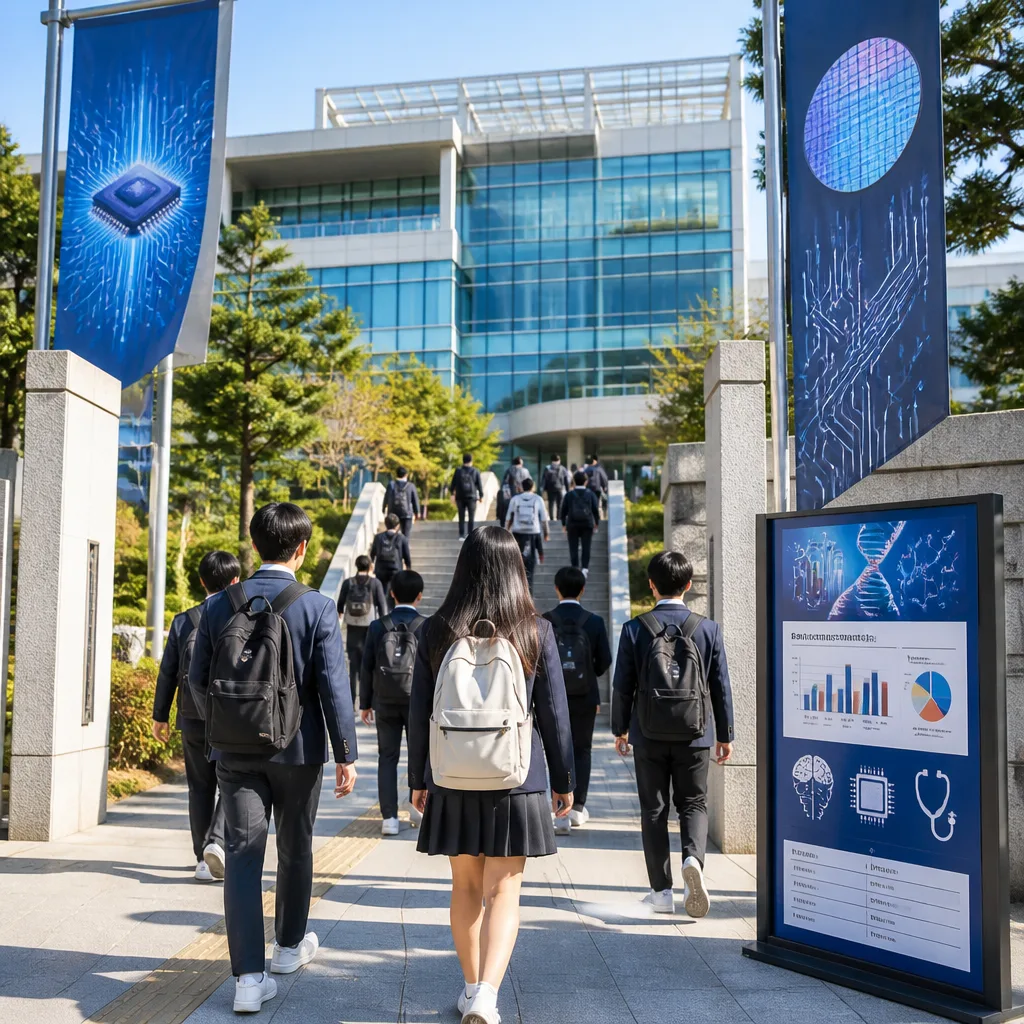
South Korea’s network of elite science high schools will enroll a record number of freshmen for the 2027 academic year as the country responds to growing demand for specialists in artificial intelligence, semiconductors and medicine.
More spots to meet rising industry and university demand
The country’s 22 science high schools will recruit 1,858 freshmen, a 13.2 percent increase from this year’s 1,642, according to data compiled by private education institute Jongro Academy. It is the largest incoming class since the first science high school opened in 1983.
The expansion is driven primarily by openings and capacity increases in Gyeonggi Province: two new institutions — Bucheon Science High School and Bundang Jungang Science High School — will admit 100 students each, while Jeonbuk Science High School will raise its intake from 80 to 96.
"The math and science curricula at science high schools can give students an advantage in applying to specialized science and engineering universities," said Lim Seong-ho, head of Jongro Academy.
Pipeline into top universities and competitive fields
The selective schools, designed around advanced mathematics and science, have long served as a major route into the nation’s top science and engineering universities. Data from the 2026 admissions cycle show concentrations of science high school alumni at elite institutions:
| University | Number of science high school graduates (2026 cycle) |
|---|---|
| Korea Advanced Institute of Science and Technology | 449 |
| Sungkyunkwan University | 193 |
| Pohang University of Science and Technology | 131 |
| Seoul National University | 110 |
Those enrollment patterns underscore how science high schools act as feeders for institutions that train specialists who then enter industry research labs, semiconductor fabrication, AI development teams and medical programs.
Changing choices as universities and companies compete
Experts say the decision landscape for high-achieving students is becoming more complex. Universities and major corporations are creating specialized programs in semiconductors, artificial intelligence and other advanced technologies, including industry-linked departments that can provide a more direct path to employment with firms such as Samsung Electronics.
Medicine remains a powerful competitor for the same pool of top students. In a new policy change, the government will launch a regional doctor admissions program beginning with the 2027 university cycle to address physician shortages outside the Seoul metropolitan area. Students selected through the program will receive government support for tuition and other expenses in return for committing to work in underserved regions after graduation.
That initiative creates an alternative pathway for high-performing students weighing long-term career prospects, public service obligations and financial incentives against lucrative opportunities in technology industries.
Implications for future talent and policy
The enrollment increase reflects a national effort to broaden the supply of students with advanced STEM preparation at a time when global competition for talent is intensifying. Expanding capacity at elite secondary schools can help universities and businesses tap into a deeper pool of candidates who have early exposure to rigorous math and science curricula.
- Record intake: 1,858 freshmen across 22 science high schools for 2027.
- New schools: Bucheon and Bundang Jungang Science High Schools each to admit 100 students.
- University destinations: KAIST received the most graduates in the 2026 admissions cycle (449).
How these changes translate into long-term workforce shifts will depend on whether university and corporate programs retain graduates in domestic industries, and on the effectiveness of initiatives such as the regional doctor admissions program to redistribute medical talent beyond the capital region.
For now, the expansion marks a notable investment in pre-university STEM education as South Korea positions itself to produce more highly trained candidates for AI, semiconductor manufacturing and medicine.















