
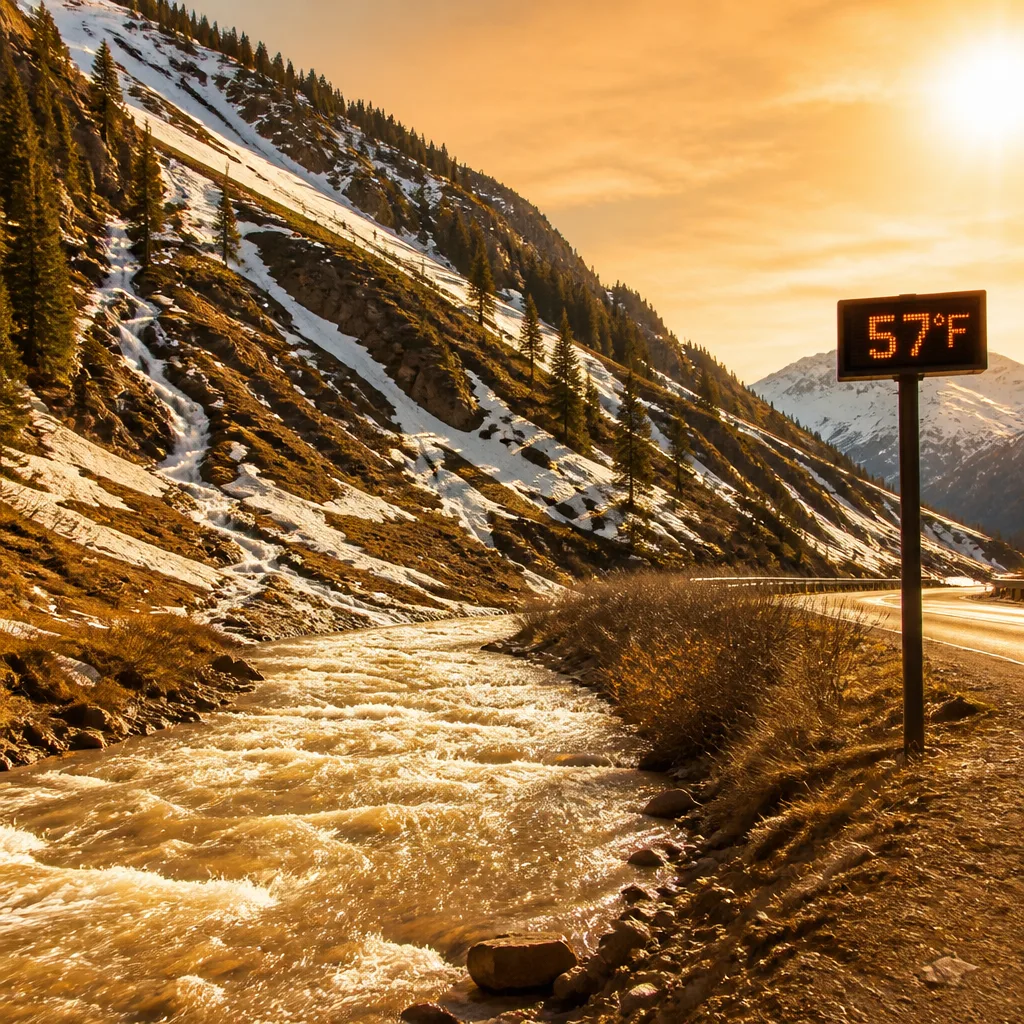
Researchers have defined a distinct class of spring and early-summer heat wave they call “snow eaters”, events that can sharply accelerate snowmelt by keeping temperatures above freezing through both day and night for multiple days. A study published in Science Advances finds these episodes substantially change the timing and intensity of runoff across the Western United States, with implications for flood risk and water management.
What makes a ‘snow eater’
Scientists analyzed the characteristics of unusually warm spells that rapidly reduce snowpack and determined that snow eaters differ from ordinary warm periods in two key respects: persistence and minimum temperature. The events typically last about three to five days and maintain temperatures above freezing around the clock. Under those conditions, melt rates can approximately double, producing rapid runoff that can contribute to flooding and complicate reservoir operations.
Matthew LaPlante, a journalist and climate scientist at Utah State University and one of the study’s authors, described the phenomenon in everyday terms from his home in the mountains above Salt Lake City:
"It feels like a monster came and just in the middle of the night, took a bite out of a snowpack."
Trends and historical context
The research focused on the Western U.S. and found evidence that snow eater events are becoming more extensive and earlier in the year as the climate warms. Since the 1850s, the area affected by these heat waves has increased by about 40,000 square miles per century, and the first snow eater of the season has been arriving roughly one month earlier per century.
The label “snow eater” is grounded in long-standing regional language. Accounts dating to at least the 1880s used “snow-eating” to describe rapid melt associated with warm mountain winds called chinooks. The study’s authors say reviving a vivid term could help communicate the particular risks and dynamics of these events.
- Duration: Typically 3–5 days.
- Melt impact: Roughly doubles snowmelt rate during events.
- Spatial trend: Area affected has risen ~40,000 sq. miles per century since 1850s.
- Timing trend: First seasonal occurrence arriving about one month earlier per century.
Implications for water and hazard management
Rapid, concentrated melt changes the pace and volume of runoff entering rivers and reservoirs. Water managers rely on snowpack measurements and melt forecasts to time releases, control reservoir levels and plan for irrigation and municipal supply. When snowmelt doubles over a few days, systems designed for more gradual runoff can be strained, increasing the risk of downstream flooding and complicating allocation decisions.
The study examined only the Western United States, but its authors note the phenomenon’s wider recognition when an early heat wave in March generated headlines after quickly erasing snowpack across the Colorado Rockies and California’s Sierra Nevada. Because snow eater conditions hinge on a sustained absence of subfreezing nights, they are sensitive to the broader warming trend that raises nighttime lows as well as daytime highs.
| Metric | Study finding |
|---|---|
| Typical event length | 3–5 days |
| Change in melt rate | About 2× |
| Spatial increase since 1850s | ~40,000 sq. miles / century |
| Seasonal timing shift | ~1 month earlier / century |
Authors of the paper say the term’s accessible language could focus attention on a type of heat wave that behaves differently than typical warm spells. They also emphasize there is more to learn: the study was regional, and researchers want to better understand how snow eater events interact with atmospheric patterns, land surface conditions and evolving climate dynamics.
As the Western United States continues to experience warmer springs and fewer persistently cold nights, managers and communities will likely face more frequent episodes that can rapidly alter the season’s water supply and hazard profile. The study provides a framework to detect and describe those episodes, offering a new tool for scientists and decision-makers confronting a changing mountain hydrology.















