
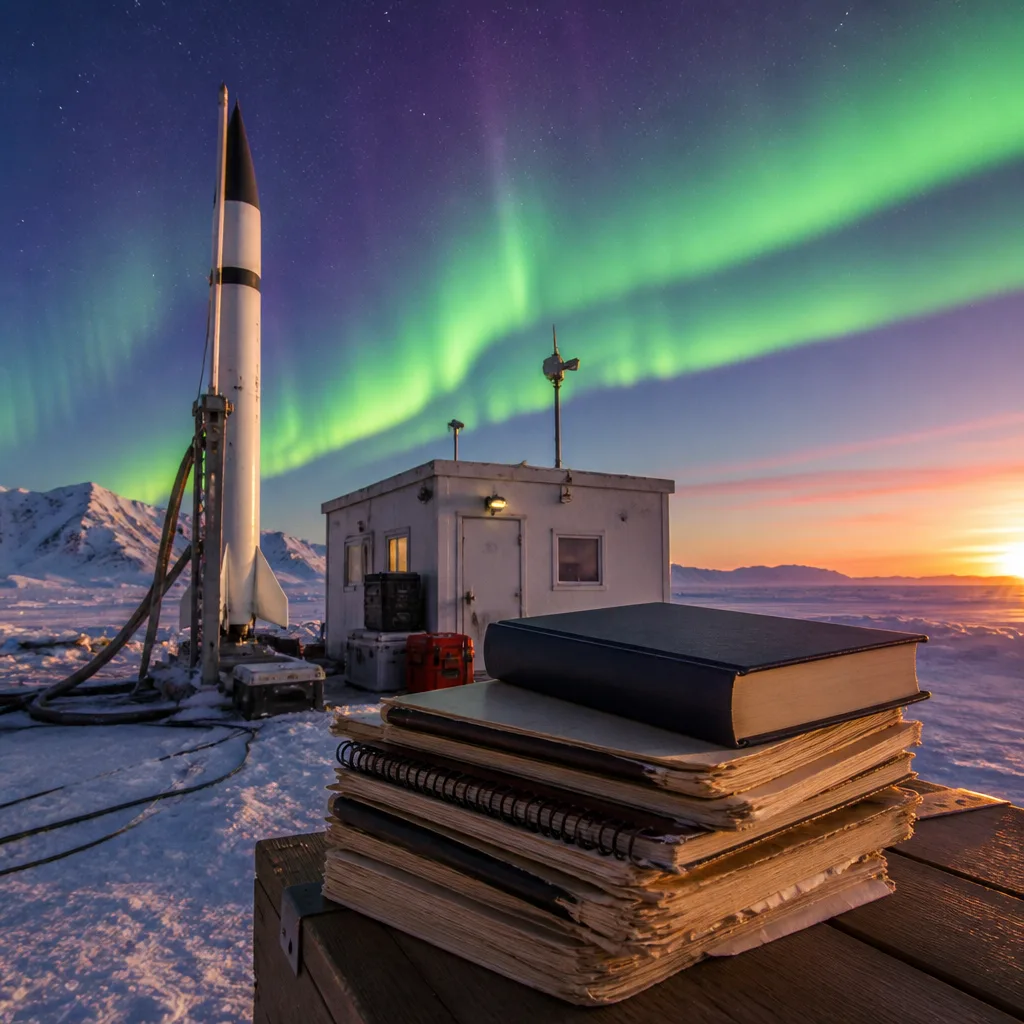
Neal B. Brown’s decades of work at the Poker Flat Research Range and his firsthand recollections of NASA, auroral science and Arctic research are now available in a memoir published by Springer. Discovered after Brown’s death in 2021, roughly 1,100 stories and notes were edited into a roughly 270-page book that offers an insider account of how Alaska grew into a consequential hub for space and atmospheric studies.
From NASA recruit to Alaska rocket range leader
Brown, who began his career with NASA in 1961, moved to Fairbanks in the mid-1960s, drawn by his interest in the aurora borealis. Over more than four decades at the University of Alaska Fairbanks Geophysical Institute, he helped build and lead what the memoir describes as the world’s only university-owned rocket range. Working with the Brown family, collaborator Sue Mitchell distilled the large archive of notes into "Northern Lights and Rocket Flights: My Years at Poker Flat Research Range," a personal history of people, experiments and launches that supported fundamental research into the upper atmosphere.
The memoir arrives amid renewed scientific and strategic attention to the Arctic, providing a narrative that ties individual ingenuity and institutional development to broader national programs in space and atmospheric science.
"What we had were a bunch of experienced hooligans with Alaska homesteader personalities who had a hunch they could do it better and cheaper than 'those NASA guys,'" the book quotes Brown writing, a line that captures the memoir’s mix of practicality and frontier humor.
Why Poker Flat matters
Poker Flat Research Range, based near Fairbanks, has been a platform for sounding-rocket launches and auroral studies that probe processes in Earth’s upper atmosphere. Brown’s account focuses on the people and pragmatic solutions that allowed researchers to launch experiments into the auroral zone and collect data critical to understanding phenomena from charged-particle precipitation to atmospheric coupling.
The memoir chronicles how a university-operated facility contributed to national research efforts and educated generations of scientists and students. Brown’s career, as depicted in the book, reflects the smaller-scale ingenuity that complemented larger federal programs and helped expand observational capabilities in the Arctic.
- Archive material: Approximately 1,100 stories and notes found on Brown’s computer after his death.
- Published length: About 270 pages, edited by Sue Mitchell and released by Springer.
- Career highlights: Brown began at NASA in 1961, moved to Fairbanks in the mid-1960s and dedicated more than four decades to the Geophysical Institute.
Context and consequences
The release of Brown’s memoir comes at a time when policymakers, researchers and defense planners are paying renewed attention to the Arctic for scientific, economic and security reasons. Firsthand accounts like this one provide historical context for how field facilities were established and operated, the kinds of improvisation and local expertise that enabled research, and the personnel networks that sustained long-term observational programs.
By documenting the human side of building and operating a specialized research range, the book potentially serves multiple audiences: historians of science, atmospheric and space researchers, university administrators and anyone interested in how regional capabilities feed into national science priorities. It also highlights the role of university-led infrastructure in supplementing federal programs, an angle relevant to ongoing discussions about research funding and facility stewardship.
For scientists and students who trained or worked at Poker Flat, the memoir offers a personal record of routines, challenges and successes. For the broader scientific community and the public, it provides a narrative thread linking grassroots innovation in Alaska to the evolution of American upper-atmosphere research.
| Item | Detail |
|---|---|
| Unpublished notes found | About 1,100 |
| Memoir length | Roughly 270 pages |
| Career span at Geophysical Institute | More than four decades |
Springer’s publication of the memoir ensures wider availability of Brown’s recollections, preserving an archival and personal account of a formative era in Arctic space science. The book may inform current debates about how to sustain and expand specialized research platforms in remote regions as scientific interest in the Arctic continues to grow.















