
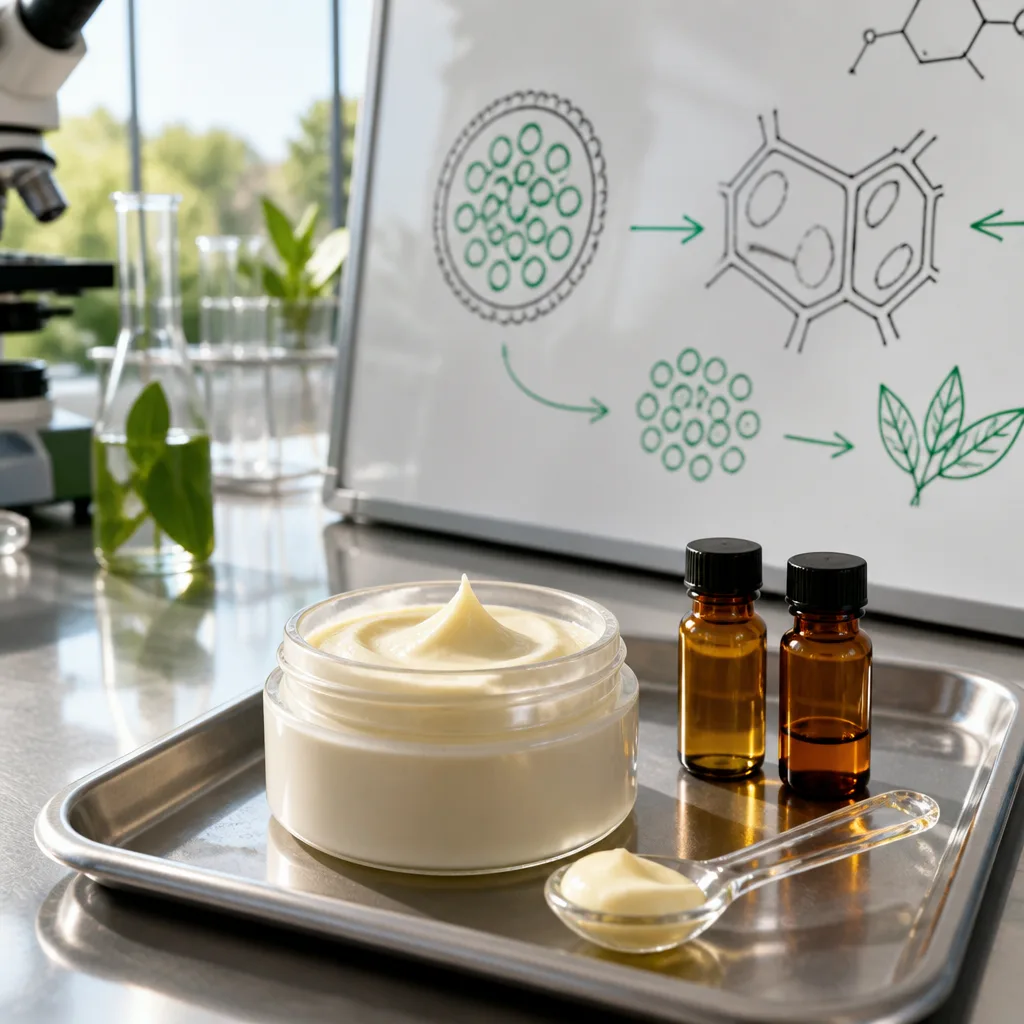
Core Biogenesis and Italian partner Faravelli are pitching a simple argument: advanced biotechnology that has reshaped facial skincare can be reformulated and scaled to treat the rest of the body. The companies unveiled a demonstration jar in Strasbourg called Skin Longevity Butter to illustrate that point.
From face-specific actives to full-body formulations
Facial skincare has in recent years incorporated lab-produced growth factors, barrier-repair peptides and other clinically tested actives. Body care, by contrast, often remains focused on basic moisturization and fragrance. Core Biogenesis says its new product line, developed with Faravelli, is meant to change that split by bringing biomimetic growth factor technologies into body formulations.
The two proprietary actives at the center of the project are called Peauforia and Peauvita. According to the companies, both are engineered to replicate the behavior of growth factors that skin naturally uses in repair and maintenance. They are produced on Core Biogenesis’s plant-based production platform and packaged within tiny lipid capsules known as oleosomes, which the developers say help transport the compounds to where they are needed in the skin.
Designing for efficacy and use
Developers stress that clinical-grade actives alone do not ensure public adoption; the product also has to feel acceptable to consumers. To that end, the Skin Longevity Butter combines the actives with Illipe butter and a supporting lipid blend to create a texture intended to be rich but familiar—something users would be willing to apply widely across the body.
“As skincare routines extend beyond the face, biotechnology offers an opportunity to create body care that supports skin quality, resilience and longevity,” said Tony Abboud, chief commercial officer at Core Biogenesis. “Skin Longevity Butter provides a glimpse into what that future could look like.”
The Skin Longevity Butter is presented as part of a broader Longevity Concepts collection the companies developed together. The range reportedly includes small-format items such as a Lip Longevity Gloss and an Eye Longevity Shadow, indicating a strategy that links advanced actives across multiple categories rather than a single novelty product.
- Peauforia — a biomimetic growth factor technology produced on a plant platform.
- Peauvita — a second proprietary biomimetic growth factor technology.
- Oleosome delivery — lipid capsules intended to carry actives into the skin.
- Illipe butter and lipid blend — chosen to create a consumer-friendly texture.
| Element | Role |
|---|---|
| Actives (Peauforia, Peauvita) | Mimic growth factors to support skin repair |
| Delivery (Oleosomes) | Transport actives into skin lipids |
| Base (Illipe butter, lipids) | Moisturization and sensory profile |
Implications and open questions
The demonstration underlines two trends: commercial cosmetics increasingly rely on biologically derived actives, and companies are looking to broaden applications from the highly scrutinized face market to larger, less-explored body categories. If such technologies prove effective and safe on larger surface areas, they could shift product development and marketing across mass and prestige skincare lines.
But several practical considerations remain. Wider use of potent biologic actives across large body areas raises questions about dosing, safety profiles when applied over greater surface area, long-term effects and regulatory scrutiny. The companies have emphasized formulation and delivery as part of the product concept, but public data on clinical trials, safety testing and regulatory clearances was not presented in the materials shared with reporters.
For now, the jar on the bench in Strasbourg functions as a visual argument more than a commercial launch: a case study aimed at persuading formulators, retailers and consumers that body care does not have to lag behind facial skincare in scientific innovation. Whether that will change product pipelines, clinical evaluation standards or consumer expectations remains to be seen.
The emergence of plant-based production platforms and encapsulation technologies suggests a route for scaling biologic actives beyond face creams, but broader adoption will likely depend on transparent safety data, regulatory pathways and cost-effective manufacturing that can support larger-volume applications.















