A damaged moth in the Natural History Museum’s collection that had been summarily dismissed nearly a century ago has become the pivotal reference for a newly defined genus after modern analysis of its labels and DNA. The specimen, collected in Borneo in the 1850s and linked by a previously overlooked label to Alfred Russel Wallace, underpinned a 2025 taxonomic revision that recognised a genus of 14 species, of which 11 are new to science.
From “better neglected” to type anchor
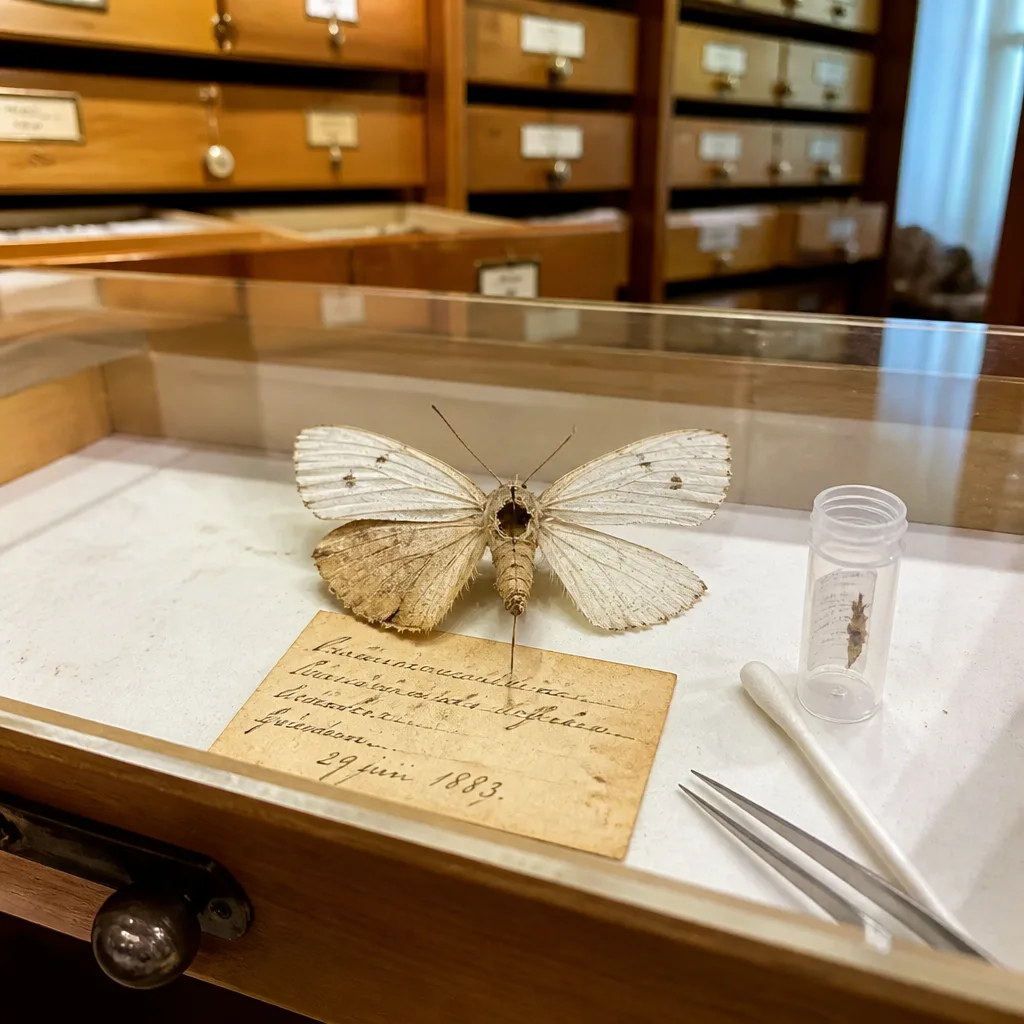
When the eminent lepidopterist Edward Meyrick inspected the small white moth in 1927 he found it in poor condition and declared it “better neglected”. At that time the specimen had lost its head and abdomen and had been clumsily repaired with hindwings from another moth. That assessment, made with the era’s morphological tools, left the specimen sidelined for decades.
Modern researchers revisited the material. A 2025 revision published in the journal ZooKeys combined careful label study, comparative anatomy and genetic evidence extracted from a fragment of one remaining leg to resolve the moth’s identity. The work was carried out by Mark Sterling, Ben Price and David Lees, who compared numerous similar snow-white moths from southeast Asia and multiple lines of evidence before arriving at the revised taxonomy.
“better neglected”
Why a single old specimen still matters
The moth was originally described by Francis Walker in 1863 as Topiris candidella. Because Walker’s description was based on a single specimen, that individual is the holotype — the name-bearing reference every later taxonomist must be able to compare with other material. Over time the specimen deteriorated to a state in which only part of the thorax, the forewings, two middle legs and the base of a hind leg remained.
Despite its battered state, the specimen carried crucial historical information. Labels placed it among Alfred Russel Wallace’s Bornean collections, specifically material from Sarawak thought to date from around 1855. Removing incorrect repairs — those Hindwings later shown to belong to a Yponomeuta species — and applying DNA techniques to the surviving leg fragment provided the bridge linking Walker’s 19th-century name to intact, more recently collected moths.
What the revision found
The ZooKeys revision established a genus now comprising 14 species, with 11 described as new to science. The old Wallace/Walker specimen served as the historical anchor that permitted taxonomists to anchor names correctly and to delimit species using morphological and molecular characters.
- Holotype: single specimen described by Francis Walker in 1863.
- Condition: only forewings, part of thorax, two middle legs and base of one hind leg remained.
- Key techniques: label study, removal of incorrect repairs, DNA from a leg fragment.
- Outcome: genus of 14 species, 11 newly described.
| Item | Value |
|---|---|
| Original description | 1863 (Francis Walker) |
| Meyrick’s assessment | 1927: “better neglected” |
| Revision published | 2025 (ZooKeys) |
| Genus species total | 14 (11 new) |
The case is a neat demonstration of why natural history collections remain scientifically invaluable. A specimen apparently too degraded for useful comparison still provided both a historical link and genetic material sufficient to resolve taxonomic questions that had persisted for more than a century.
Broader implications
The study highlights several points of wider relevance for national and international science. First, it underlines the continuing importance of meticulous label curation: historical annotations tied the specimen to Wallace’s Bornean collecting and gave context to the genetic data. Second, it shows how targeted DNA recovery from tiny fragments can be decisive even when classical morphology is compromised. Finally, the work emphasises the latent biodiversity in museum drawers — material collected in the 19th and 20th centuries that can still yield new species when re-examined with contemporary methods.
For museum scientists and taxonomists, the finding is both a vindication of careful conservation and a prompt to re-examine overlooked material. For the wider public, it is a reminder that specimens in national collections are not merely relics but active data sources that continue to inform our understanding of life’s diversity.