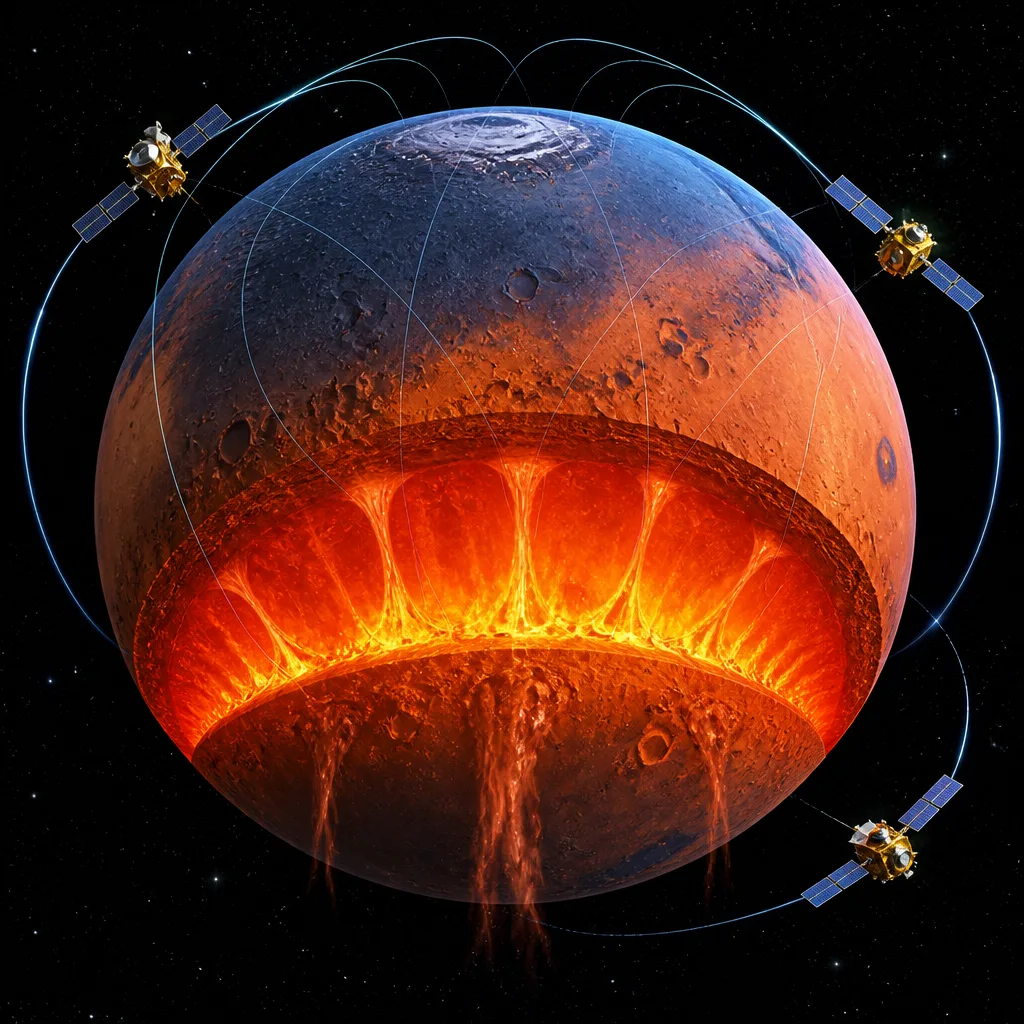
Researchers have detected a substantial thermal divide deep inside Mars: the planet’s southern interior appears to be roughly 200–400°C hotter than the northern half and could be partially molten. The result, published in Nature on 27 August, uses decades of spacecraft gravity tracking to produce a three‑dimensional picture of Mars’s interior and promises to alter our understanding of Martian geology and its ancient environment.
How the anomaly was found
The work was led by Alexander Berne, a recent Caltech PhD (’26) now a postdoctoral associate at the University of Arizona. The team combined subtle variations in the gravity field of Mars recorded by three orbiting missions — Mars Global Surveyor, Mars Odyssey and Mars Reconnaissance Orbiter — and applied a technique known as tidal tomography.
Tidal tomography exploits the way the Sun’s gravitational pull on Mars changes with the planet’s slightly elliptical orbit and axial tilt. Those seasonal and orbital variations produce tiny, measurable changes in spacecraft velocities. By modelling how Mars deforms in response to that varying tidal force, the researchers inferred contrasts in stiffness, temperature and phase (solid versus partially molten) within the mantle.
"Scientists usually assume that the interiors of planetary bodies are generally spherically symmetric, but this is not necessarily true,"
As the authors note, the approach moves beyond the usual assumption that planetary interiors are layered like concentric shells. Instead it recovers three‑dimensional structure — a crucial advance that allows the team to pinpoint a north–south dichotomy in the deep mantle rather than just surface differences.
What the numbers mean
The central quantitative finding is a temperature contrast of roughly 200 to 400°C between the southern and northern deep interiors. In planetary mantles that amount of excess heat is sufficient to lower rock viscosity and, in places, to produce partial melt — a state in which some fraction of the mantle material has melted while the remainder remains solid.
| Parameter | Value / data |
|---|---|
| Measured temperature contrast | 200–400°C |
| Orbital missions used | MGS, Odyssey, MRO |
| Technique | Tidal tomography (gravity tracking) |
Consequences and open questions
The presence of a substantially hotter, possibly partially molten southern mantle could help explain several long‑running mysteries about Mars:
- Magnetic anomalies: Variations in remnant magnetism observed in the crust may reflect early dynamo behaviour influenced by heterogeneous mantle heat flow.
- Seismic behaviour: The way seismic waves travel through Mars — now probed by landers such as InSight — depends on temperature and melt distribution; a hotter south alters expected wave speeds and attenuation.
- Hydrothermal and habitability windows: Elevated temperatures increase the potential for long‑lived hydrothermal systems, which could have produced transient environments favourable to life in Mars’s past.
The authors emphasise that the inference relies on the gravity signal extracted from spacecraft tracking and on models that translate mechanical response into temperature. Those steps carry uncertainty: the reported range of 200–400°C reflects modelling and data limitations rather than a single, precise measurement. Nonetheless, the result is robust enough to demand a rethink of Mars’s thermal evolution and to inform the design of future missions.
Looking ahead
By producing a blueprint of internal temperature heterogeneity, the study offers practical guidance for where to target seismic stations, heat‑flow experiments and sample return efforts. Future missions that combine seismic networks, heat probes and higher‑precision gravity and orbital tracking would tighten constraints on melt fraction and the spatial depth of the anomaly.
The work also illustrates how long‑running spacecraft programmes continue to yield fresh discoveries: careful reanalysis of existing datasets, married to improved inversion techniques, can reveal previously hidden structure in planetary interiors. For Mars, the newly revealed thermal gulf between north and south is likely to be a focal point for research into the planet’s past dynamics, magnetic history and habitability potential.