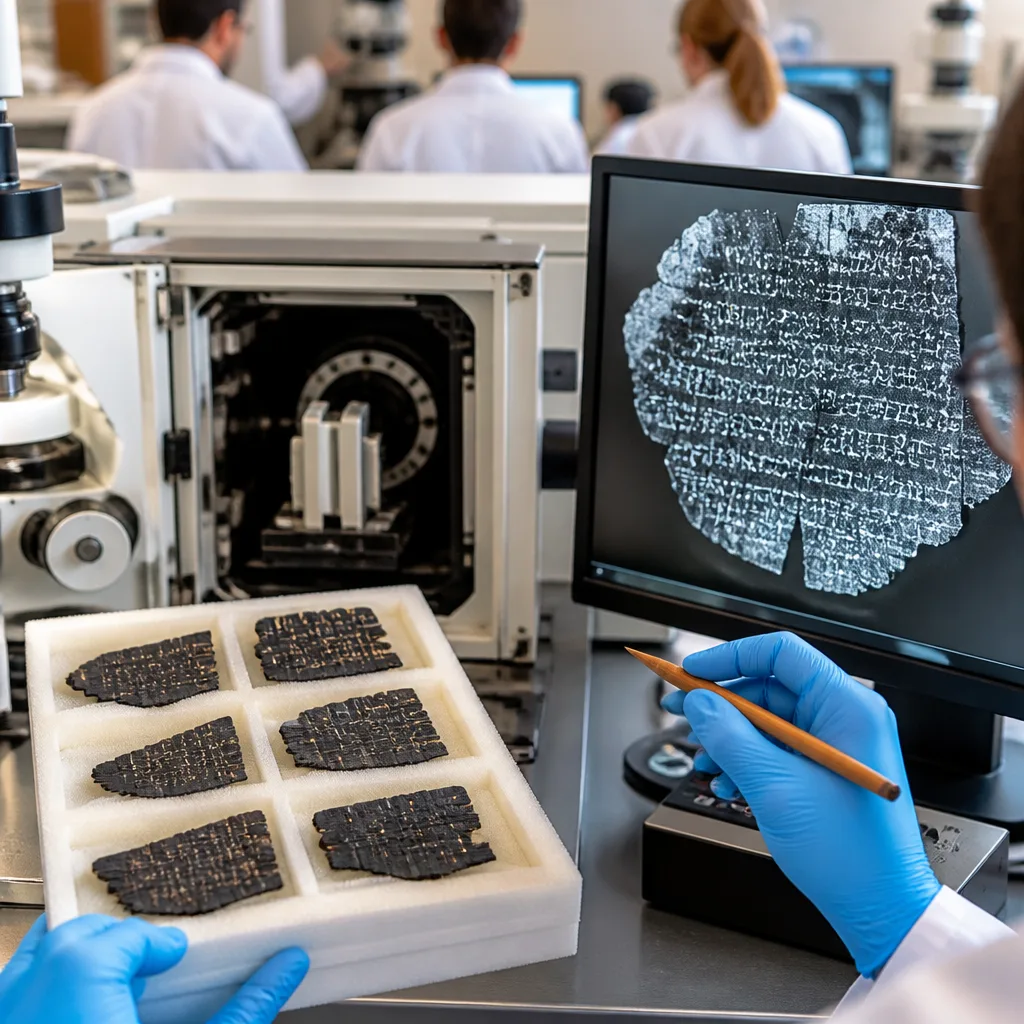
Scientists have demonstrated that minute quantities of lead in historic inks can make writing inside carbonised papyrus far more visible to X‑ray computed tomography (CT), offering a new route to read scrolls sealed by the eruption of Mount Vesuvius in 79 C.E. without physically unrolling them.
Recreating a 2,000‑year‑old catastrophe in the lab
The work grew out of an experiment designed to mimic the fate of the Herculaneum library, the only largely intact classical library to survive from antiquity. Researchers prepared papyrus, reed pens and traditional lampblack inks, then had volunteers inscribe passages before deliberately carbonising the rolls in a high‑temperature furnace until the sheets were reduced to brittle, blackened material.
Crucially, the team investigated the chemical composition of inks. Their hypothesis was simple: if ink contains elements that absorb X‑rays more strongly than the surrounding carbonised plant matter, those elements will create contrast in CT scans and reveal the writing without any mechanical unrolling.
When the lab scrolls contained even very small amounts of lead, the contrast was striking. Lead absorbed far more X‑rays than the burned papyrus and made the strokes of letters highly visible to image reconstruction techniques, enabling the authors to virtually unwrap and read the text.
"With lead in the ink, you would get a huge friggin'"
How the method works — and what it found
The team applied X‑ray tomography, a non‑destructive imaging method that records differences in attenuation of X‑rays through an object from many angles. Computer algorithms then reconstruct the three‑dimensional structure and can computationally flatten the rolled sheets to present the written surface as if unrolled.
Lead proved to be the critical contrast agent. In the experimental material, regions with lead in the ink absorbed up to 25 times more X‑rays than the surrounding carbonised papyrus. That order‑of‑magnitude difference is what allows software to distinguish marks from background carbonisation and render individual characters legible.
| Material | Relative X‑ray absorption |
|---|---|
| Carbonised papyrus | 1 (baseline) |
| Ink containing trace lead | Up to 25 |
The proof‑of‑concept used a range of sample texts and deliberately recreated inks. After imaging, the researchers used computational processing to virtually flatten the rolls and visualise the writing — showing that the approach can retrieve letters where lead is present.
Why this matters for Herculaneum and beyond
- Preservation without contact: Many of the Herculaneum scrolls are too fragile to unroll by hand; a non‑invasive imaging route would protect irreplaceable artefacts.
- Recovering lost literature: The Herculaneum library is thought to hold works otherwise lost; accessing even fragments could reshape classical scholarship.
- Guiding conservation decisions: Knowing which scrolls contain lead‑rich inks could prioritise scans and limit risky interventions.
However, the authors emphasise important qualifications. Not all ancient inks contain lead; many classical inks were carbon‑based and would not provide the same contrast. The technique’s success therefore depends on the chemistry of the original writing. The distribution of lead within inks may vary and could be uneven or present only in certain texts or epochs.
Furthermore, the study was performed on experimentally carbonised modern papyrus samples and not on the original Herculaneum scrolls themselves. While the experiment intentionally simulated conditions of severe thermal degradation, differences in burial chemistry and long‑term diagenesis could alter X‑ray behaviour in archaeological material.
Nevertheless, the demonstration is a substantial step forward. It converts a chemical suspicion — that some inks carried heavy metals — into a practical imaging strategy. If similar lead signals exist in the Herculaneum corpus, scholars may soon read texts that have lain silent for two millennia without physically opening a single brittle roll.
The work also illustrates a broader lesson for heritage science: sometimes the key to unlocking the past lies not in finer mechanical tools but in recognising the invisible trace elements that betray human behaviour. In this case, lead — almost a contaminant by modern lights — might become a friend to philology.