
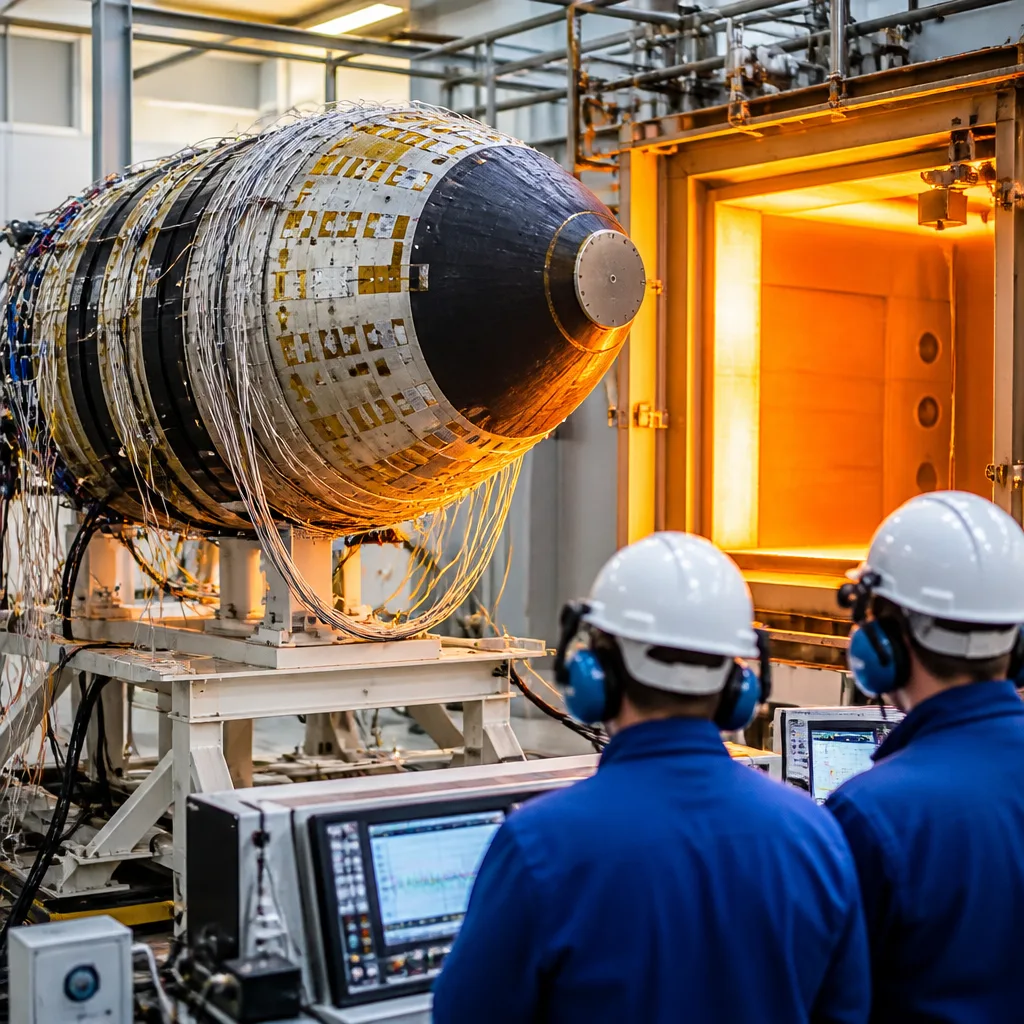
NASA’s DAVINCI engineering model endured repeated rapid heating to 465°C, validating a thermal-protection approach intended to keep instruments alive during the probe’s blistering descent through Venus’s atmosphere.
Rapid heating to Venus temperatures
Engineers took an instrumented mock-up of the DAVINCI (Deep Atmosphere Venus Investigation of Noble gases, Chemistry, and Imaging) probe to a specialised thermal facility in Bedford, Pennsylvania, where it was subjected to a series of furnace runs designed to mimic the pace and peak temperatures the vehicle will face during descent. The test campaign ran from 28 August to 10 September and included six thermal cycles, each heating the model to about 869°F (465°C) over roughly an hour — the same heating rate the descent probe is expected to experience.
During each run more than 100 thermal sensors monitored simulated hardware inside the vessel to record temperatures and verify that the internal environment would remain within tolerances for the scientific instruments. The engineering model emerged from every run intact, an outcome NASA describes as a major step forward for the mission.
“The experiment was a rousing success, with six runs to Venus’ surface temperature on our descent timeline of 55–60 minutes with full internal instrumentation,”
The comment came from Jim Garvin, principal investigator for DAVINCI at NASA’s Goddard Space Flight Center. He noted that the United States has not carried out such a comprehensive spacecraft-scale thermal assessment at Venus temperatures since the mid-1970s, underlining the technical challenge represented by that world’s brutal environment.
Why the test matters
Venus presents one of the most hostile environments in the inner Solar System: extremely hot surface temperatures, a dense carbon-dioxide atmosphere and corrosive clouds. DAVINCI’s science objectives include determining whether Venus ever possessed oceans and a more Earth-like environment in its deep past. To pursue those questions the mission must deliver a probe that can survive a near-hour-long plunge while collecting chemical and imaging data.
That combination of high peak temperature and rapid heating rate places severe demands on materials, seals and instrument enclosures. The test team replicated the expected thermal timeline and instrument load to ensure that not only the external structure but also delicate internal components will remain functional during the descent.
What was tested
The campaign used an engineering model — a full-scale representation equipped with heating and temperature-sensing hardware rather than flight-certified instruments. Tests included:
- Rapid temperature ramping to approximately 465°C in about 60 minutes to match descent heating rates.
- Six complete cycles to assess repeatability and cumulative effects on materials.
- Continuous monitoring with over 100 thermal sensors to map the internal thermal environment.
| Parameter | Value |
|---|---|
| Peak temperature | 869°F / 465°C |
| Heating duration (per run) | ~55–60 minutes |
| Number of cycles | 6 |
| Thermal sensors | More than 100 |
Kristen Brown, the DAVINCI probe manager at Goddard, highlighted the scale of the engineering problem — creating a system that shields instruments from rapid heating in a toxic atmosphere — and the test results provide tangible evidence that the approach is viable.
Context and next steps
DAVINCI is designed to release a descent probe that will sample Venus’s lower atmosphere and gather high-resolution chemical and imaging data down to near-surface levels. The successful furnace campaign reduces a key technical risk for the mission by demonstrating that an appropriately engineered vehicle can protect internal sensors long enough to collect meaningful data during the descent.
While the engineering-model tests do not substitute for flight hardware qualification, they represent a thorough systems-level verification of thermal behaviour under realistic conditions. Such tests are essential in planetary missions where long-term on-surface survival is impossible and all data must be captured during the brief entry and descent phase.
The results will feed into final design reviews and inform subsequent qualification tests on flight hardware. By proving the concept on a complete mock-up, the DAVINCI team has taken a concrete step towards answering fundamental questions about Venus’s history — including whether the planet might once have had oceans and been, for a time, more hospitable than today.









