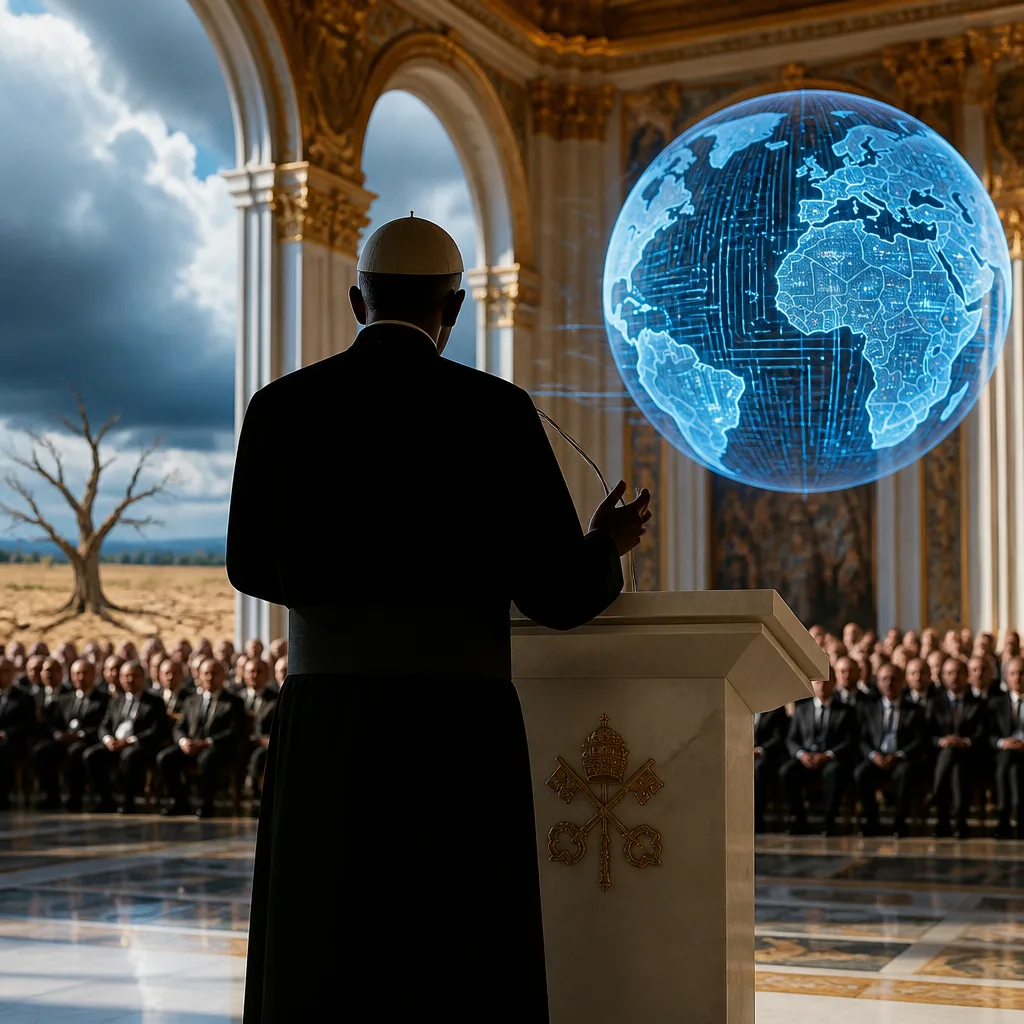
Pope Leo XIV told members of the Pontifical Academy of Sciences that scientific and technological advances deliver real gains for health, energy, agriculture and knowledge — but that they must be matched by an equal growth in responsibility to avoid serious harms.
Warnings on AI: promise, peril and the moral frame
Addressing the academy during its annual plenary assembly in the Apostolic Palace, the Pope linked the meeting’s theme, “The Future of Science in a Changing World”, to his recent encyclical Magnifica humanitas, which examines the social consequences of rapid digitalisation, robotics and artificial intelligence. He emphasised the constructive possibilities of these technologies while flagging concrete risks.
He observed that, although computing advances can “open new possibilities for human creativity and cooperation”, they can also be harnessed in ways that harm civil society, pointing to uses that enable surveillance, manipulation and discrimination.
“Artificial intelligence can be used for surveillance, manipulation and discrimination,”
Underlining his vantage as someone trained in mathematics, the Pope told the gathering that technological progress is not a neutral, purely technical affair; every tool embodies assumptions about the human person, communities and the future being shaped. He urged scientists and technologists to factor ethical and social reflection into their work rather than treating innovation as a strictly instrumental endeavour.
Climate shocks and unequal burdens
On climate, the Pontiff warned of a clear uptick in extreme weather events and natural disasters. He cited the increased frequency and intensity of heatwaves, droughts, floods, storms and wildfires, and warned that the impacts of these shocks fall most heavily on those with the fewest resources.
His remarks stressed that responses which wait until after catastrophe have already failed the most vulnerable, and that anticipatory science, early warning systems and equitable planning must be central to policy responses.
What the speech means for scientists and policy
The Pope framed the responsibilities of researchers in two related areas:
- Anticipatory ethics — urging scientists to foresee harms from AI and digital systems and to embed safeguards in design and deployment.
- Climate resilience with equity — calling for science-driven measures that prioritise communities least able to cope with disasters.
Those prescriptions intersect directly with current policy debates in the UK and beyond: how to regulate powerful AI systems, how to ensure transparency and fairness in automated decision-making, and how to distribute resources for climate adaptation so that risks are not disproportionately borne by poorer communities.
Context and consequences
The Vatican’s Pontifical Academy convenes world-class scientists to reflect on broad ethical dimensions of science. By linking his encyclical to the academy’s work, the Pope has signalled a sustained engagement with technological governance rather than a one-off pastoral statement. For researchers, funders and policymakers the address is both a moral appeal and a practical reminder that technological design choices carry social consequences.
| Area | Pope’s focus |
|---|---|
| Artificial intelligence | Benefits for health, energy and knowledge; risks including surveillance, manipulation and discrimination |
| Climate change | Increasing extreme events; disproportionate harm to the poor and marginalised |
Whether and how scientific institutions, governments and technology firms respond to that dual call — to innovate and to shoulder responsibility — will determine the shape of public debate and regulation in the coming years. For national policymakers, the Pope’s intervention adds a prominent ethical voice to ongoing discussions on AI governance and climate justice.
As the academy proceeds with its plenary meetings, its deliberations are likely to focus on practical ways to translate ethical exhortations into guidelines, standards and research priorities that protect human dignity while enabling scientific progress.