UK business confidence has fallen to its lowest point in 17 months, according to Lloyds Bank’s business barometer, piling pressure on the government as firms confront higher borrowing costs and rising input prices.
Markets restless after conference speech
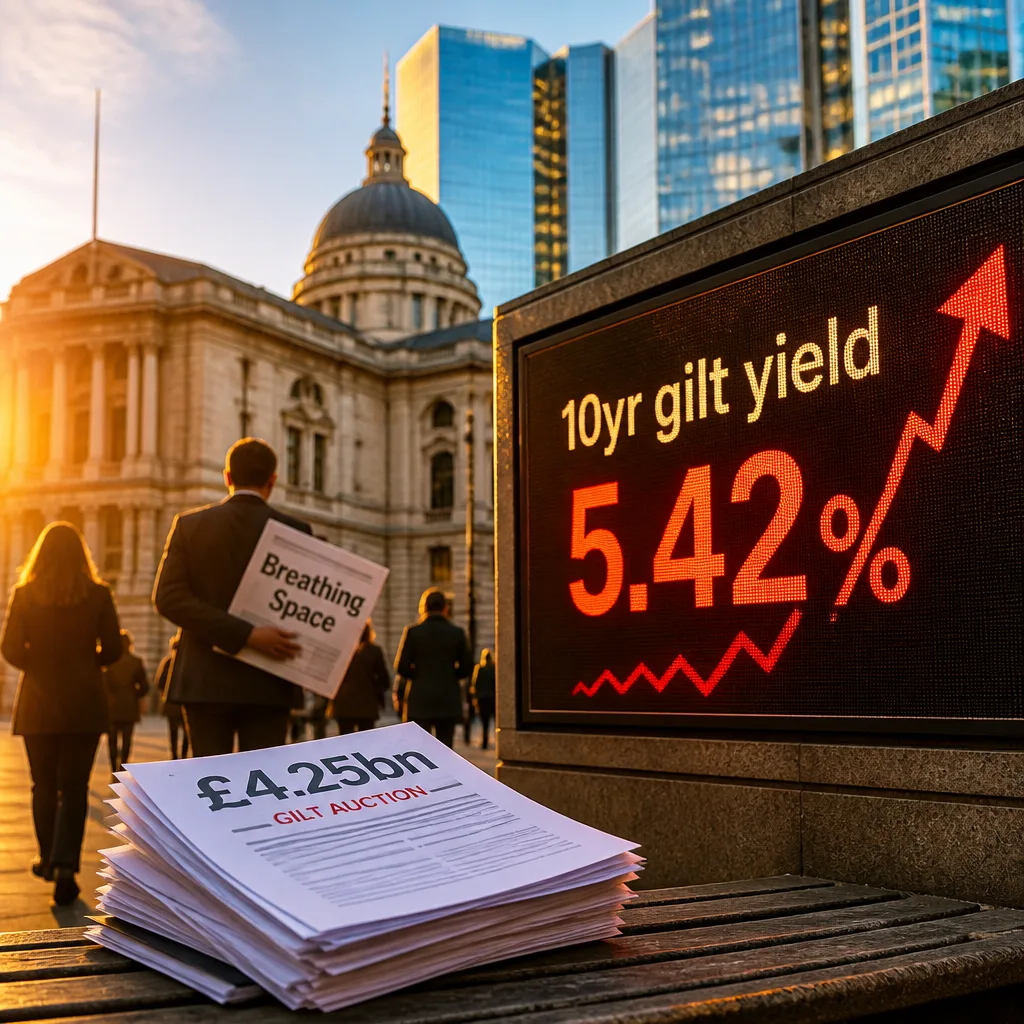
The drop in optimism coincided with jittery moves in the gilt market. Ten-year UK government bond yields spiked above 5.42% in recent trading, touching levels close to the 19-year highs seen a day earlier, while an auction sold £4.25 billion of ten-year gilts at the highest yield since 1999. The combination of political signals and global energy price pressure helped weigh on sentiment.
Hann-Ju Ho, senior economist at Lloyds Commercial Banking, said the fall in optimism was driven by rising global energy prices and increased global uncertainty. That concern was echoed across business groups, which welcomed the prime minister’s aspiration to restore growth but warned that firms need relief from mounting costs.
Firms and trade bodies call for relief
Executives and industry representatives were explicit in calling for measures that protect investment and employment prospects. The Confederation of British Industry's chief executive, Rain Newton-Smith, urged that companies be given "breathing space from the cumulative cost pressures holding back investment and hiring". Close Brothers’ boss Mike Morgan described the year as difficult for businesses, pointing to higher borrowing costs and uncertainty ahead of the Budget.
"It has been a difficult year for all businesses," said Mike Morgan, adding that "it would be good to get some pro-business growth ideas coming through."
City commentators were similarly underwhelmed by the policy signal from the conference. Kallum Pickering of Peel Hunt highlighted what he saw as a "total absence of market-friendly or genuinely pro-growth initiatives", a criticism that aligns with the market’s negative reaction to the speech.
What the numbers say
The Lloyds barometer reading — at its weakest since April 2025 — underlines how fragile confidence remains more than a year into the present economic cycle. While the data series captures sentiment rather than hard investment figures, sentiment shifts quickly feed through to hiring plans, capital expenditure and pricing decisions by firms.
| Indicator | Recent level / note |
|---|---|
| Business confidence (Lloyds) | Lowest in 17 months (since April 2025) |
| Ten-year gilt yield | Spiked above 5.42%; close to recent 19-year highs |
| Ten-year gilt auction | £4.25 billion sold at highest yield since 1999 |
Implications for households and firms
Higher gilt yields feed directly into the cost of borrowing for business and consumers. Banks and lenders typically reference government bond yields when pricing loans: sustained increases can raise mortgage costs and make credit more expensive for small and medium-sized enterprises. That matters because firms facing tighter margins are less likely to recruit, invest or absorb price shocks.
Business groups argue that existing domestic pressures — including higher employer National Insurance and increases in the minimum wage, which have already affected labour costs — compound the pain of rising borrowing costs and energy prices. With the Budget on the horizon, firms are pressing for targeted measures that support investment and preserve jobs rather than measures that would further depress growth.
- Confidence fall risks reducing hiring and capital spending plans.
- Higher gilt yields increase borrowing costs for both households and companies.
- Businesses want fiscal relief in the Budget to offset cumulative cost pressures.
The immediate policy test for ministers is how to reconcile pledges of boosting growth with the near-term need to reassure markets. For firms, the calculation is stark: without clearer signals that costs will be contained or offset, many will delay investment and hiring — a dynamic that will feed back into weaker economic growth and, potentially, a more difficult fiscal position for the government to navigate.
For now, businesses are asking for concrete, market-friendly steps rather than rhetoric — a request the markets appear to have amplified with their own vote of no confidence.