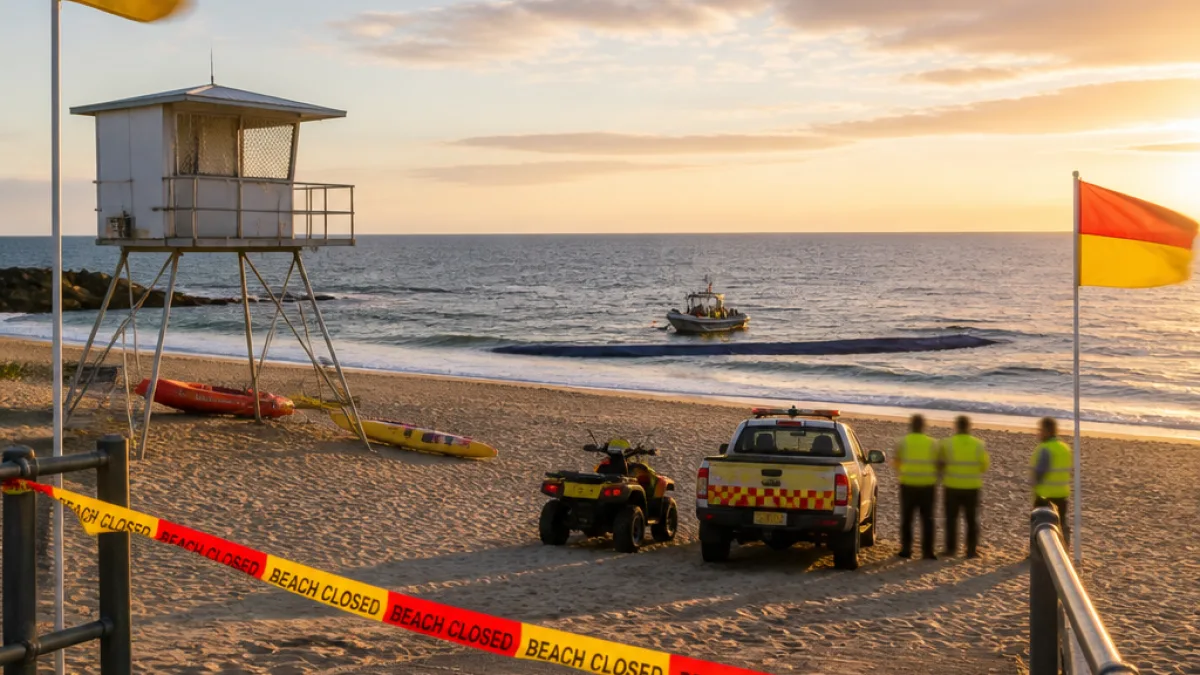
Authorities keep popular Perth beaches closed as sharks remain in area
Beaches across Perth's western coastline have been closed and water-based activities suspended after multiple shark sightings following the stranding and subsequent removal of a whale carcass at City Beach earlier this week. Lifesaving clubs and ocean swimming groups have halted normal programmes while authorities monitor the situation.
The City Beach incident prompted the closure of City Beach, Floreat Beach and Swanbourne Beach, and the City of Perth Surf Life Saving Club cancelled the Surf Life Saving WA Enduro Championship and suspended club-based training until further notice. Cottesloe's open-water swimming community also paused its daily morning swim, though Cottesloe beaches remain open for now.
- City Beach — closed after whale washed ashore and was later removed.
- Floreat Beach — closed following nearby shark sightings.
- Swanbourne Beach — closed amid increased shark activity.
- Cottesloe — beaches currently open; local swim group has paused activity.
| Location | Status |
|---|---|
| City Beach | Closed |
| Floreat Beach | Closed |
| Swanbourne Beach | Closed |
| Cottesloe | Open (group swims suspended) |
Marine researchers caution that removing the whale does not eliminate attraction for sharks. Curt Jenner of the Centre for Whale Research explained that whale blubber can break down rapidly into oil that soaks into sand and disperses in the water column, producing olfactory cues that sharks can detect at very low concentrations.
"Whale blubber can quickly break down into oil that enters the sand. Sharks can detect small traces of oils or blood and may continue responding to those traces for weeks," Curt Jenner said.
Shark detections and strandings are occurring at a sensitive time along the south-west coastline. Jenner noted that September to December is peak humpback migration season, when whales pass close to shore and carcasses may occasionally wash up. The seasonal movement also draws other predators and prey species, including bluefin tuna, which in turn can attract larger sharks.
Local surf life saving organisations have acted quickly to protect members and the public. The City of Perth Surf Life Saving Club took the precaution of cancelling a major event and pausing training, citing safety concerns while the situation evolves. Swimming groups such as Cottesloe’s PodSquad have also opted for caution; its founder Shane McGurk said members were divided between those eager to return to regular ocean activity and those who felt they needed time following recent local incidents.
Calls are growing among community groups for improved monitoring and technology to reduce risk. PodSquad has urged a broader shark-tagging programme and investment in AI-equipped drones that can identify shark species nearshore, measures proponents say would give early warning of potential threats without imposing long-term closures.
Local authorities have also expedited physical protection where feasible. The Town of Cottesloe has announced plans to install its shark barrier at Cottesloe Beach earlier than scheduled, dependent on favourable weather and seaweed conditions. The barrier installation, if completed as planned, would provide an additional layer of protection for swimmers in that area.
For Perth residents, the incident underlines the intersection of natural seasonal patterns and public safety. While the whale has been removed from the shoreline, experts stress that the risk period may persist for days or weeks as chemical traces disperse and marine food chains continue to draw large predators nearshore. Beach users should heed closures and official advice, and local clubs will review plans before resuming events or training.
Authorities will continue to monitor sightings and update the public on closures and safety measures as new information becomes available.