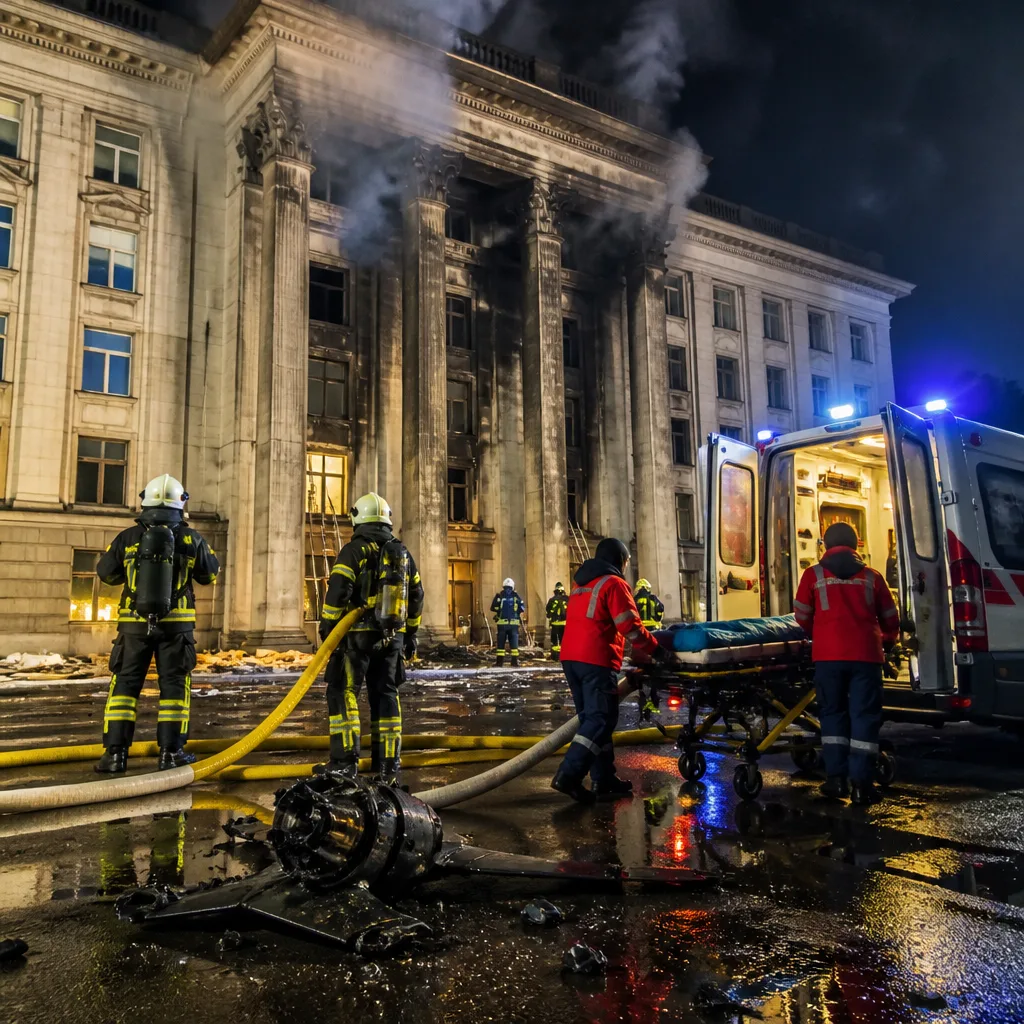
A Russian drone struck a building belonging to the National Academy of Sciences of Ukraine in central Kyiv’s Shevchenkivskyi district on 28 September, igniting a fire and triggering an immediate rescue and firefighting response, Ukrainian officials said.
Rescue efforts and conflicting early casualty reports
Emergency crews, including firefighters and medical teams, were deployed to the scene to extinguish the blaze and search for people who may have been inside the structure when it was hit. Ukraine’s president described the operation as ongoing and said that all relevant services were involved.
"A rescue operation is currently underway, the fire is being extinguished, and they are searching for people who may have been inside the building. All services are involved,"
The strike formed part of a wider wave of Russian attacks on Ukrainian civilian infrastructure, the president added, citing damage to a pharmaceutical company and gas stations in Kyiv, a business centre in Dnipro, and other civilian facilities and communications infrastructure elsewhere in the country.
Local officials provided varying early counts of casualties and injuries. Kyiv mayor Vitali Klitschko initially reported that an unmanned aerial vehicle had struck a non‑residential building in the city centre and that emergency crews were en route. He later said four people had been injured in the Shevchenkivskyi district and that three required hospitalisation.
The head of the Shevchenkivskyi district, Oleksii Sazanovych, told local authorities that the strike had caused both injuries and deaths among civilians. City military administration statements also indicated fatalities, though early reports were not consistent on the precise numbers.
What is known — and what remains uncertain
In the immediate aftermath of such strikes, information can be incomplete and sometimes contradictory. The facts established from available official statements are:
- Location: Shevchenkivskyi district, central Kyiv — building belonging to the National Academy of Sciences.
- Impact: Direct hit by an unmanned aerial vehicle with resulting fire.
- Emergency response: Firefighters, rescue teams and other services were dispatched and engaged in extinguishing the fire and searching the premises.
- Casualties: Officials reported multiple injured, with the mayor citing four injured and three hospitalised; district authorities reported civilian deaths, but exact tolls were not consistently reported across statements.
- Broader context: The strike was one of several on civilian and economic targets across Ukraine, according to presidential comments.
Implications for the scientific community
A direct strike on a building associated with the National Academy of Sciences raises immediate concerns about the safety of researchers, the continuity of scientific work, and potential damage to laboratories, equipment and archives. While the reports referred to a non‑residential building, many research institutions house valuable and often irreplaceable instruments, datasets and ongoing experiments. At this stage, no detailed assessment of damage to scientific infrastructure or of losses to research programmes has been released.
Beyond the physical harm, attacks on research institutions can have a chilling effect on scientific collaboration, disrupt graduate training and impede long‑term projects that depend on stable facilities and uninterrupted power and communications.
What to watch for next
Further, verifiable information is expected as rescue operations conclude and official damage and casualty assessments are published. Key developments to monitor include:
- Final casualty and injury figures from Kyiv authorities and national emergency services.
- Official damage assessments detailing whether laboratories, instrumentation or records at the Academy were affected.
- Statements by the National Academy of Sciences clarifying the status of staff, students and research programmes.
- Any claim of responsibility or additional context from Russian sources relating to the targeting of the site.
The president said that the Russian strikes would draw a response, underlining the continuing escalation in attacks on civilian and economic infrastructure. For now, Kyiv’s immediate priority remains the rescue operation and establishing an accurate account of casualties and losses in the heart of the capital.
| Item | Reported detail |
|---|---|
| Target | Building of the National Academy of Sciences, Shevchenkivskyi district, Kyiv |
| Incident | Direct hit by a Russian unmanned aerial vehicle; fire reported |
| Official response | Rescue operation; firefighting; multi‑agency deployment |
| Casualties (early reports) | Officials reported injuries (mayor: 4 injured, 3 hospitalised); district head reported deaths; figures remain to be confirmed |
As authorities provide updated briefings, reporters and analysts will seek verifiable detail on the extent of damage to scientific infrastructure and the human cost of this strike. For now, the scene remains an active emergency operation in a central part of Kyiv.