A market for unresolved science
A new platform has opened prediction markets on four of science’s most persistent unanswered questions, allowing eligible participants to buy and sell YES or NO positions on hypotheses that may not be settled for decades, if they are resolved at all.
Science Markets, which announced its launch on Tuesday, has chosen questions spanning particle physics, cosmology and theoretical computer science. The service publishes the precise wording of each hypothesis, together with the evidence that would be needed for either a YES or NO result, before trading starts.
That structure is intended to make the questions testable rather than merely speculative. A participant is not simply betting on a broad idea such as whether a theory is plausible; they are responding to a defined claim and to a stated standard for deciding its outcome. The approach treats the market price as one signal among several, rather than as a substitute for experimental or mathematical proof.
“There are people who spend years understanding a scientific question and have good reasons to disagree with the prevailing view.”
The statement, attributed to Conner Lambden, continues that such people now have an incentive to make their information public. The platform’s premise is that people with specialist knowledge may notice evidence, caveats or disagreements that are not immediately visible in the wider research conversation. Financial exposure is intended to encourage closer examination of published work and to bring overlooked evidence into view.
Four questions, no fixed deadline
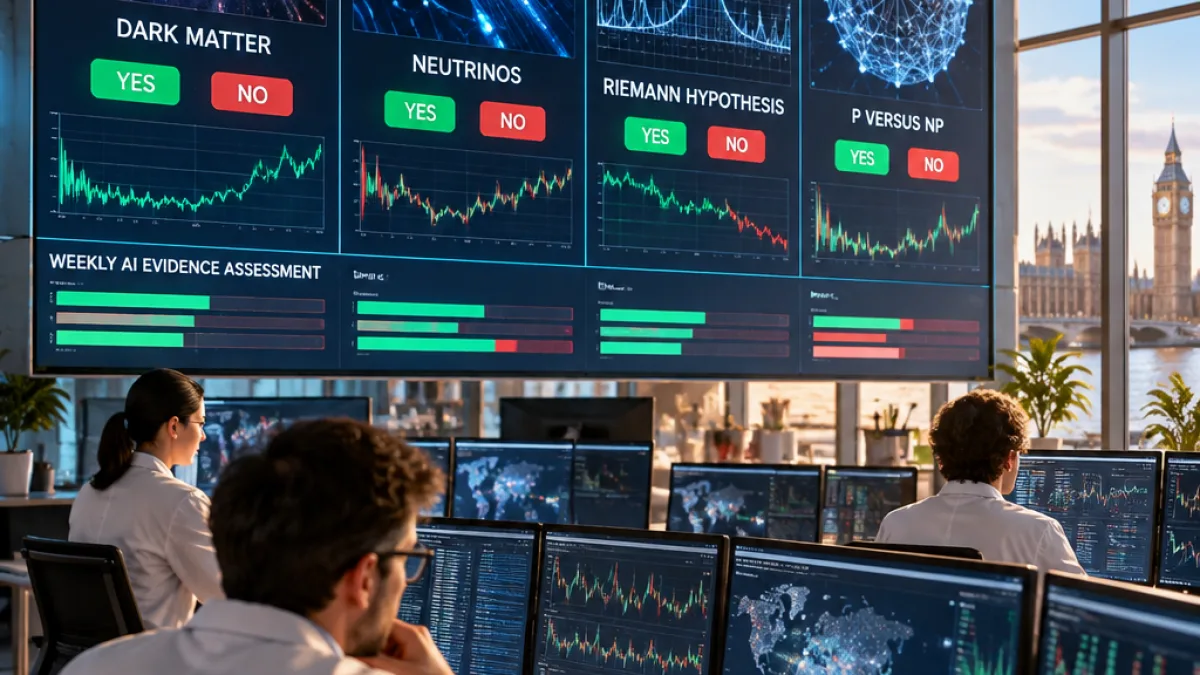
The first markets concern whether new particles account for most dark matter, what neutrinos are like, whether the Riemann hypothesis is correct and the long-running P versus NP problem in computer science.
| Market | Field |
|---|---|
| New particles and most dark matter | Particle physics and cosmology |
| The nature of neutrinos | Particle physics |
| The Riemann hypothesis | Mathematics |
| P versus NP | Computer science |
Unlike conventional prediction contracts, the markets have no scheduled end date. That is because there is no known timetable for resolving the underlying questions. New observations, experiments or mathematical results could change the assessment of a hypothesis, but the platform does not claim that such evidence will arrive within a set period.
When trading is available, users can respond to developments by buying or selling on a decentralised blockchain. Prices may therefore move as participants interpret new findings or reconsider existing evidence. A higher price would indicate the market’s current expectation, but it would not by itself establish that a proposition is true.
Artificial intelligence as an assessment layer
Science Markets also publishes weekly assessments from models developed by OpenAI, Anthropic and xAI. For each model, readers can see an estimate, an explanation and cited sources, along with the evidence that would cause the model to change its view.
That information is presented alongside the market price, allowing readers to compare the collective position of traders with three separate machine-generated assessments. The platform says the models also evaluate whether evidence satisfies the conditions required for a final outcome; the launch description indicates that final outcomes require agreement among all three frontier AI models.
This is a notable division of labour. Traders provide a continuously changing public signal, while the models are used to organise research, explain the basis for an assessment and identify what could alter it. Neither mechanism removes the central difficulty: a market can reflect the information available to its participants, but it cannot manufacture evidence that research has not yet produced.
Testing how scientific uncertainty is shared
The experiment will be watched not only for the direction of its prices, but also for whether it helps people understand why experts disagree. Each market’s published criteria give participants a common reference point, while the absence of a fixed closing date acknowledges that frontier research does not follow a trading timetable.
- Four initial hypotheses are available.
- The claims are described as well-defined and falsifiable.
- Weekly AI assessments draw on models from OpenAI, Anthropic and xAI.
- Final outcomes require agreement among the three models.
The project’s central proposition is therefore less that markets can solve science than that they can make disagreement more visible. By placing unresolved claims, evidence standards, model assessments and trading prices in the same public setting, Science Markets is attempting to turn the slow accumulation of research into a form that participants can follow as it develops.