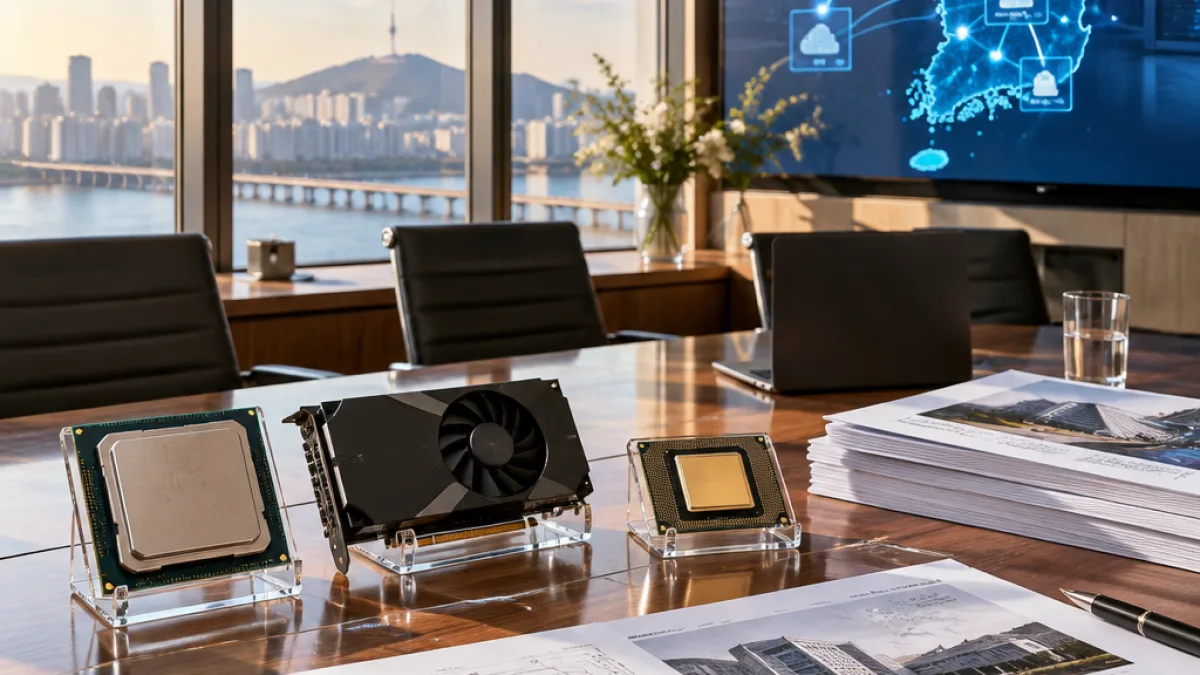
South Korea’s science ministry and US semiconductor company AMD have begun formal oversight of a partnership aimed at expanding the country’s artificial intelligence chip capabilities. The first steering committee meeting took place on Wednesday at the Westin Seoul Parnas hotel, alongside AMD’s Advancing AI World Tour Seoul 2026. The meeting marked the first regular review of a memorandum of understanding signed by the two sides in July.
Partnership moves from agreement to implementation
The committee is intended to monitor how the memorandum is being carried out and to examine progress on its main areas of work. Lee Do-gyu, head of the Ministry of Science and ICT’s Office of ICT Policy, met Keith Strier, AMD’s senior vice-president for global AI markets, for discussions on the partnership’s next steps.
Among the central proposals is an AI computing system combining AMD processors and graphics chips with neural processing units made by Korean companies. Neural processing units are specialised semiconductors designed to handle artificial intelligence workloads. The arrangement therefore covers more than the purchase or deployment of one type of hardware: it is intended to bring different categories of computing technology together within a Korean AI infrastructure programme.
Infrastructure, research and training
The memorandum also includes plans for an AMD AI research centre in Korea, support for universities and measures to train people in AI-related fields. At the meeting, the ministry and AMD discussed specific plans and timetables for these elements, although the source did not give details of the proposed location, investment or completion dates.
The partnership’s stated areas of work can be summarised as follows:
- Computing infrastructure: combining AMD central processors and graphics chips with Korean-made AI processors.
- Research: establishing an AMD AI research centre in Korea.
- Education: supporting universities and developing AI talent.
- Implementation: reviewing progress and setting practical plans and timelines through the steering committee.
| Element | Details reported |
|---|---|
| Agreement | Memorandum of understanding signed in July |
| First review | Steering committee meeting held on Wednesday |
| Companies and institutions | AMD, the Ministry of Science and ICT, Korean universities and technology companies |
| Event attendance | More than 1,300 people preregistered |
AMD signals interest in Korea
AMD also held its flagship artificial intelligence event in Korea for the first time. The ministry said more than 1,300 people preregistered, with registration closing early. Korean businesses involved in AMD-linked AI computing took part, including LG Electronics and the AI software start-ups Moreh and MangoBoost.
Lee joined a panel discussion entitled “Building Korea’s AI Nation”, while Ryu Je-myung, the second vice science minister, attended the event and toured exhibition booths with Strier. The appearance provided a public setting for the partnership, but the steering committee meeting was the more substantive mechanism: it was designed to test whether the commitments made in July are being translated into actions.
Commitment renewed after October talks
AMD chair and chief executive Lisa Su visited Korea on 7 October. During that visit, she met Ryu and the two sides reaffirmed their intention to co-operate on AI chips. The latest meeting follows that high-level contact by putting the partnership into a continuing review structure.
“AMD holding its flagship Advancing AI event in Korea for the first time shows that it sees Korea as an important AI partner,” Ryu said.
Ryu added that the ministry would work to keep the tasks agreed in the memorandum moving forward, with the aim of supporting Korean AI chip companies and making the country’s AI ecosystem more competitive. His comments describe the government’s intended outcome, rather than evidence that the infrastructure, research centre or training programmes have already been completed.
What the meeting establishes — and what remains open
The meeting establishes a process for checking progress, but the information released so far leaves several practical questions unanswered. No figures were provided for the size of the planned computing infrastructure, the number of universities involved, the scale of AMD’s proposed research centre or the timetable for deployment. Nor did the ministry identify the Korean neural processing units that would be included in the proposed system.
For now, the significance lies in the breadth of the agenda and the participation of government, an international chip manufacturer, Korean businesses and universities. The partnership places hardware integration, research and workforce development on the same schedule. Its success will depend on whether those separate strands can be converted into functioning infrastructure and sustained collaboration. The steering committee is intended to provide the regular check on that process.