Backlash over remarks
US Health Secretary Robert F. Kennedy Jr has been condemned after making a series of false claims about Arab scientific and cultural achievement, including the assertion that the world’s Arab population does not produce science, win major academic prizes or create literature.
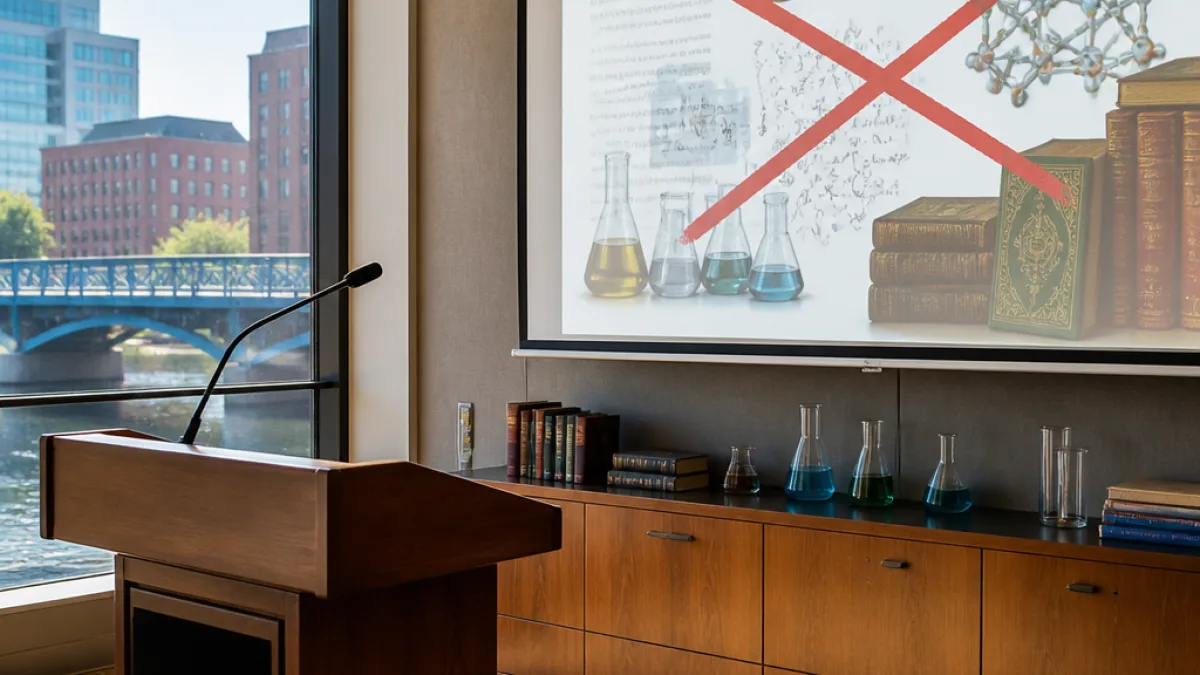
Speaking in Grand Rapids on Monday, Kennedy referred to “500 million Arabs” before arguing that they did not win the Nobel, Fields or Wolf prizes. He also stated that they did not produce literature. The remarks were made while he was discussing the Muslim Brotherhood, the Islamist political movement founded in Egypt in 1928.
“There's 500 million Arabs in the world, and yet they don't produce science. They don't win the Nobel Prize, they don't win the Fields Prize, they don't win the Wolf Prize. They don't produce literature.”
Kennedy’s comments drew accusations of bigotry, xenophobia and Islamophobia. They have also prompted journalists and commentators to point to Arab figures who have won major international prizes, directly challenging the factual basis of the health secretary’s argument.
A distorted account of history
During the speech, Kennedy initially acknowledged the Arab and Persian intellectual achievements associated with what is described as the Islamic “golden age”, spanning the ninth to the 14th centuries. Scholars during that period translated and developed ancient Greek work in fields including mathematics, medicine and philosophy.
He then claimed that this intellectual tradition had been destroyed by the Muslim Brotherhood. The source content describes that conclusion as ahistorical, since the organisation was established in 1928, long after the period Kennedy had been discussing. His explanation therefore connected a modern political movement with a historical decline that had taken place centuries earlier.
| Area mentioned by Kennedy | What the remarks asserted |
|---|---|
| Science | That Arabs did not produce science |
| International prizes | That Arabs did not win Nobel, Fields or Wolf prizes |
| Literature | That Arabs did not produce literature |
Political context
The intervention came as the United States approached its 3 November midterm elections, amid increasingly hostile rhetoric from some allies of President Donald Trump. Kennedy’s comments were particularly significant because they focused on Abdul El-Sayed, the Democratic candidate in Michigan’s closely contested Senate race.
El-Sayed would become the first Muslim US senator if elected, according to the source content. The remarks were therefore viewed by critics as part of a wider effort to target him on religious and ethnic grounds rather than engage with the issues of the campaign.
The episode also adds to scrutiny of Kennedy’s record as the country’s senior health official. He has previously been associated with dubious assertions about vaccines and vaccine safety, as well as occasional outright rejection of medical consensus on other public-health questions. In that context, critics have questioned the authority with which he speaks on evidence and expertise.
Evidence and consequence
The dispute is not simply about political language. Kennedy’s claims attempted to present the achievements of hundreds of millions of people as evidence of collective failure, while ignoring the historical record referenced in his own speech. The source specifically identifies Naguib Mahfouz of Egypt, regarded as the greatest Arab writer of the 20th century, among the Arab figures cited in response to Kennedy’s statement.
More broadly, the episode illustrates how a compressed claim can turn a complicated history into a misleading verdict. Scientific and literary achievement cannot be assessed by a single list of prizes, and the existence of major awards does not provide a complete measure of a society’s intellectual life. In this case, however, even Kennedy’s narrow test was challenged by the examples raised after his speech.