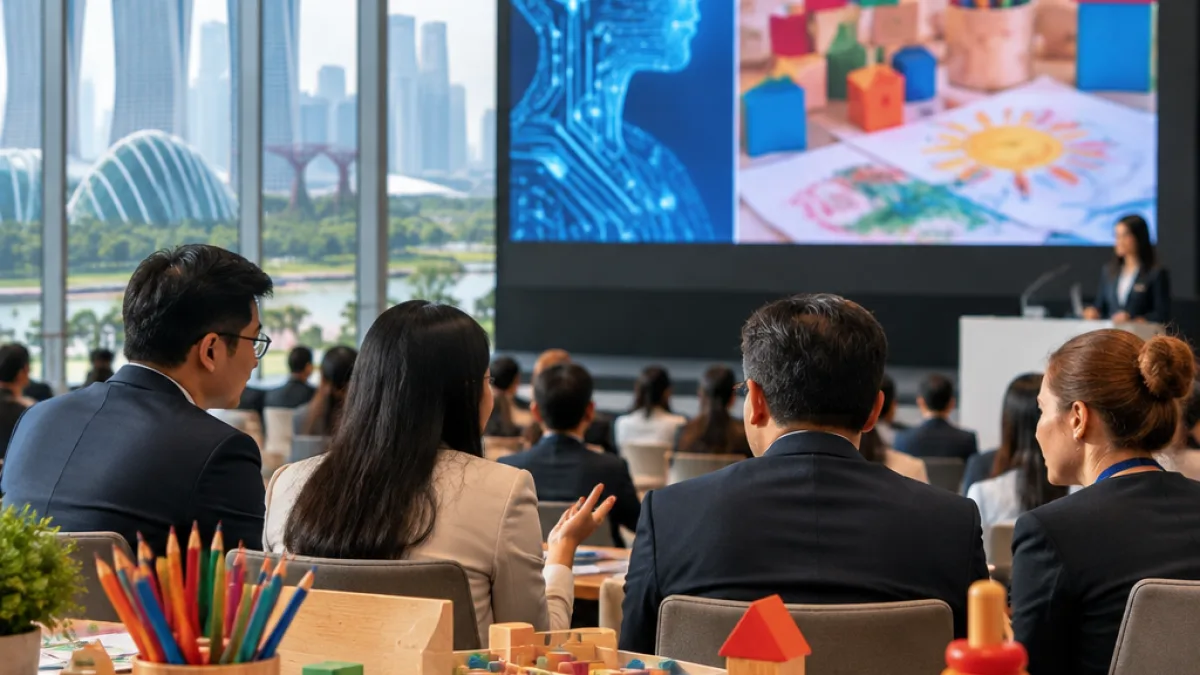
More than 400 education professionals, policymakers and researchers have gathered in Singapore for an international conference examining how early childhood education should respond to artificial intelligence and a rapidly changing world.
The two-day REACH Reggio Emilia Conference 2026 opened on 30 October under the theme Education in Complex Times. It brought together representatives from across Asia and beyond, including educators and sector leaders from Singapore, China, Hong Kong, Malaysia, Indonesia, India, Australia, the wider ASEAN region, South America, the Middle East and Italy.
The meeting has placed Singapore at the centre of a regional discussion about the future of infant care and early education. It also marked a new stage in cooperation between EtonHouse, E-Bridge and Reggio Children, the organisation linked to the municipal infant-toddler centres and pre-schools of Reggio Emilia in Italy.
A partnership focused on professional learning
Under the new arrangement, EtonHouse and E-Bridge will work with Reggio Children on continuing professional development in infant care and early childhood education. The collaboration is expected to include regular professional exchanges, research activity and learning opportunities connected with the experience of Reggio Emilia’s early-years settings.
The partnership gives the conference a practical dimension beyond its discussions about technology. Its focus is on how professionals working with very young children can share knowledge, examine their practice and draw on international experience. The source material does not set out specific programmes or targets, but it describes the agreement as an important milestone in the organisations’ continuing work together.
Singapore’s early-childhood sector was represented by participants from Anchor Operators, the Early Childhood Development Agency, the Ministry of Social and Family Development and the Ministry of Education. Educators, trainers and other leaders from across the sector also attended.
| Conference detail | Information |
|---|---|
| Location | Singapore |
| Dates | 30–31 October 2026 |
| Attendance | More than 400 delegates |
| Theme | Education in Complex Times |
Preparing children for technological change
Artificial intelligence was a central concern at the event. The conference description presents AI as changing the ways children learn, create and engage with the world, prompting a fundamental question about the kind of future education systems are preparing them for.
For early-years educators, that question is especially significant because the conference is concerned with the first stages of children’s development and learning. The material does not prescribe a particular approach to AI, nor does it announce a new curriculum. Instead, it frames the technology as part of a wider challenge for teachers, leaders and policymakers as they consider the purpose of education in times of rapid technological change.
That emphasis places professional judgement and dialogue alongside technology. The proposed work with Reggio Children is centred on people working in infant care and early education, with research and professional learning forming the basis of the collaboration. It suggests that the response to technological change will be discussed not only in terms of digital tools, but also through the daily work of educators and the environments they create for young children.
International and government participation
Senior Minister of State Goh Pei Ming, from Singapore’s Ministry of Home Affairs and Ministry of Social and Family Development, attended as guest of honour and addressed delegates. The event was organised by REACH, or Reggio Emilia in Asia for Children, which is part of the EtonHouse Group, in partnership with Reggio Children and with support from the Embassy of Italy in Singapore.
The breadth of participation reflects the conference’s stated ambition to connect global thinking with regional practice. Delegates from multiple education systems have been given a forum to consider how early childhood provision can respond to complex social and technological conditions, while the new partnership creates a structure for continued professional contact after the conference closes.
- Early childhood education is the main focus of the international meeting.
- Artificial intelligence is being discussed as a factor reshaping learning and children’s interaction with the world.
- Professional learning and research will underpin the EtonHouse, E-Bridge and Reggio Children collaboration.
The conference does not resolve the wider question of how education should change in response to AI. It does, however, bring together government representatives, researchers, school leaders and practitioners to examine that issue at an early stage of children’s education. For families and teachers, the continuing importance of that discussion will lie in how international ideas are translated into the experience of children and educators in real early-years settings.