A new focus for Holocaust teaching
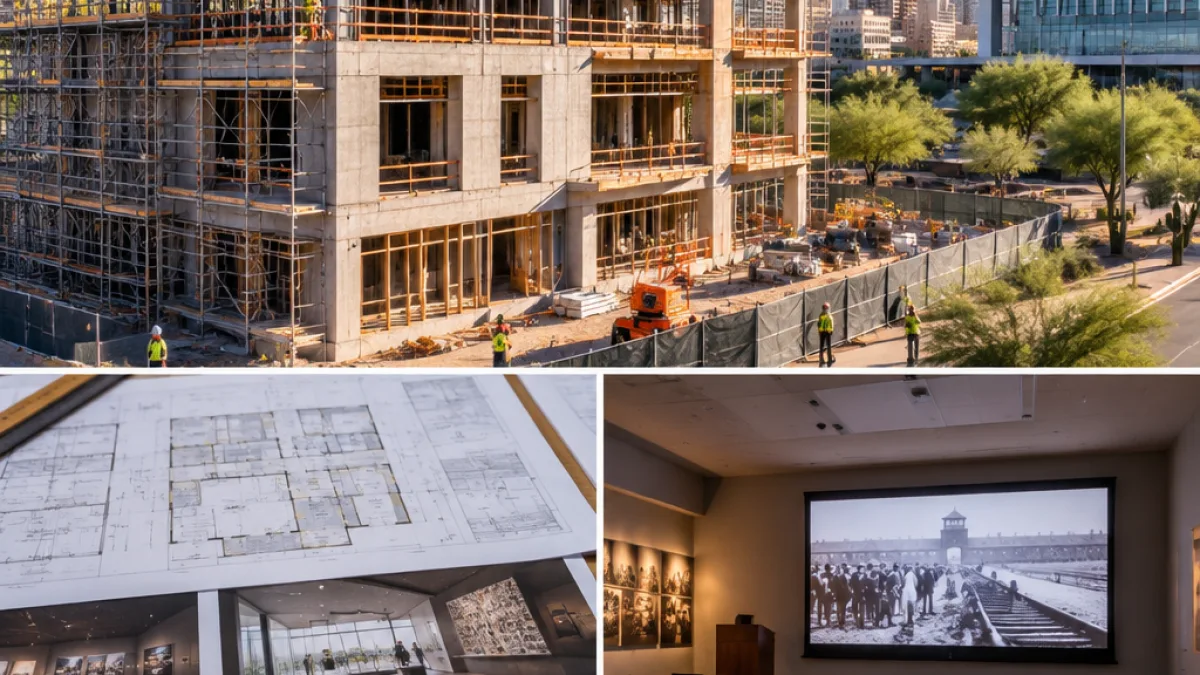
Construction has begun on a three-storey Holocaust education centre in central Phoenix, a project intended to give schools and the wider public a dedicated place to study the Nazi persecution and murder of Europe’s Jewish population. The 31,000-square-foot building, located near the Burton Barr Library, is set to become Arizona’s first facility devoted entirely to Holocaust history, the six million Jews who were killed and the survivors who lived through the atrocities.
The development comes five years after Arizona introduced a requirement for pupils in grades 7 to 12 to learn about the Holocaust and other genocides. The project began as a proposal for a conventional museum, but its purpose was later recast as an education centre. Supporters say that change reflects concern about how effectively the subject is currently taught and the need to connect historical knowledge with the choices people face in the present.
“We concluded that we weren’t doing a good job teaching Holocaust education.”
That assessment came from project chairman Steve Hilton, whose father, Sam, survived five concentration camps. The centre will carry the name Hilton Family Holocaust Education Center. Mr Hilton said the project could make a difference for schoolchildren in Arizona, even if it could not change the world as a whole.
Survivor accounts at the heart of the project
Among those involved is 100-year-old Oskar Knoblauch, who is due to turn 101 in November. He visited the construction site and described the importance of ensuring that people hear accounts from those who experienced the Holocaust directly.
“A lot of people don’t know the real story, unless you were there. I was.”
Mr Knoblauch recalled that he, his father, his brother and his sister were forced to work as slave labourers for the Gestapo at its headquarters in Krakow. His father was killed eight months before liberation. His testimony, which he has shared publicly for years, will be one of four survivor stories presented at the new centre.
The personal accounts are intended to place individual and family experience alongside the broader historical record. For pupils, that approach will offer a way to encounter the Holocaust through both documented events and the testimony of people whose lives were transformed by persecution, forced labour and murder.
Exhibits linking history with present-day choices
The centre is planned to contain six exhibits. Visitors will begin in a room designed around the intimate setting of a Jewish family’s dining room, before moving through displays on the Nazis’ rise to power and the progression from discrimination and persecution to mass murder. Another entire floor will be devoted to an “Upstander Lab”, where visitors will be asked to consider how historical lessons relate to their own response to antisemitism and hatred today.
| Feature | Details |
|---|---|
| Location | Downtown Phoenix, near Burton Barr Library |
| Size | Three storeys and 31,000 square feet |
| State education requirement | Holocaust and genocide studies for grades 7 to 12 |
| Planned content | Six exhibits, four survivor accounts and an Upstander Lab |
A resource for schools and future generations
The centre’s educational role is particularly significant as the number of Holocaust survivors able to speak publicly about their experiences continues to diminish with age. Mr Knoblauch’s participation gives the project a direct link to living memory, while the planned exhibits are designed to preserve testimony for pupils who will not be able to meet many survivors themselves.
For teachers, the building is intended to provide a structured setting in which pupils can examine the causes and consequences of genocide rather than treating the Holocaust as an isolated historical episode. For families and other visitors, it will offer a place to learn about the experiences of Jewish communities and the choices made by individuals and institutions during the period.
The project therefore sits at the intersection of statutory education and public remembrance. Its stated aim is not only to explain what happened in Europe during the Second World War, but also to encourage visitors to recognise and oppose antisemitism and hate in their own time. As construction continues in Phoenix, the centre’s organisers are placing survivor testimony and classroom learning at the centre of that effort.