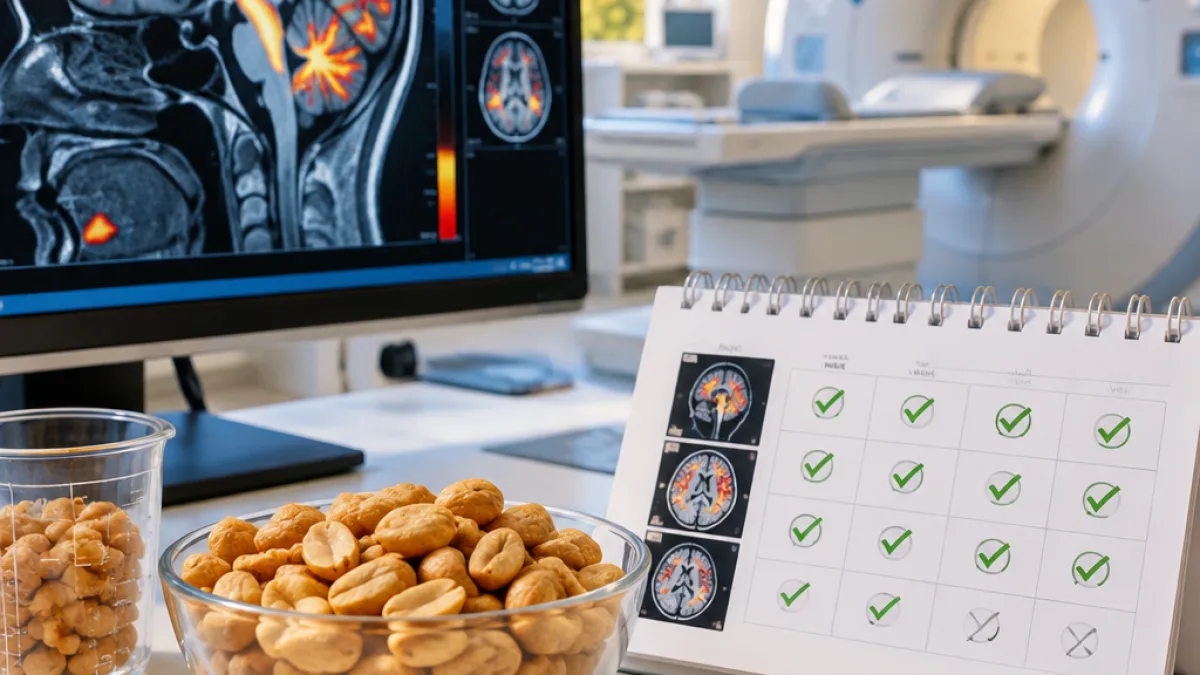
Eating a daily portion of unsalted, skin-roasted peanuts was associated with changes in the brain’s response to insulin in a small study of older adults, offering a possible clue to how diet might influence processes involved in memory.
The research involved 31 healthy people aged between 60 and 75, who consumed 60 grams of peanuts each day for 16 weeks. The participants then completed a control phase during which they avoided peanuts. Researchers used magnetic resonance imaging (MRI) to assess brain health and compared measurements taken under the two dietary approaches.
The results showed that the peanut-eating period was linked to an increase of about 4 per cent in overall blood flow in the brain. The investigators also reported a stronger insulin response in areas associated with memory, including the hippocampus, a brain region central to the formation of memories.
Why insulin matters in the brain
Insulin is most familiar as the hormone that helps control the amount of sugar in the blood. It also has functions within the nervous system, where it supports the growth, survival and communication of nerve cells. Those activities are important for memory and other cognitive abilities.
“The hormone insulin plays an important role in the brain, where it supports memory and other cognitive processes.”
Peter Joris, an author of the study published in the journal Food & Function, said that the brain can become less responsive to insulin as people grow older. The researchers link that reduced responsiveness with age-related cognitive decline, while earlier research has suggested that effective brain insulin signalling may help protect against biological processes associated with Alzheimer’s disease.
The new findings therefore concern a possible mechanism, rather than a demonstrated treatment or preventative effect. The scans indicate that the brain’s handling of insulin changed during the period when participants ate peanuts, but the study does not establish that the food prevents Alzheimer’s disease. Nor does the source report that participants were diagnosed with, or protected from, dementia.
What the study tested
| Measure | Study detail |
|---|---|
| Participants | 31 healthy adults |
| Age range | 60 to 75 |
| Peanut intake | 60 grams daily |
| Intervention length | 16 weeks |
| Assessment | MRI scans and brain insulin response |
| Reported blood-flow change | About 4 per cent overall |
The peanuts were supplied in pre-measured packets and were eaten in skin-roasted form. Participants could choose whether to have the portion in the morning or afternoon, and whether to eat it at once or divide it into smaller amounts during the day. During the comparison phase, they were asked to avoid peanuts altogether.
That design provides a direct comparison between a period of regular peanut consumption and a period without peanuts, while MRI allows researchers to examine the brain without surgery. But the small number of participants means the findings should be treated as an early signal rather than a definitive answer. A change detected in a scan is not, by itself, proof of a meaningful improvement in day-to-day memory or a reduction in disease risk.
Implications for diet and dementia research
The researchers say the results could eventually contribute to nutrition guidance for people at risk of Alzheimer’s disease. Before that happens, the relationship would need to be examined in broader and longer research. The present study involved healthy adults, lasted 16 weeks and measured brain responses rather than the development of Alzheimer’s disease.
- The study found a change in insulin responsiveness in memory-related brain regions.
- Brain blood flow rose by about 4 per cent during the peanut-consuming period.
- The findings suggest a potential biological pathway, but do not prove that peanuts prevent cognitive decline or Alzheimer’s disease.
For now, the most precise interpretation is that regular peanut consumption was associated with measurable changes in brain physiology among the participants studied. The result adds to evidence that insulin’s role extends beyond blood-sugar control, and that food may influence the brain through several biological routes. But the distance between a promising MRI finding and a new clinical dietary recommendation remains substantial.