Researchers have developed a modified carbon nanotube cathode that enabled an aqueous zinc-iodine battery to retain 89.34% of its capacity after more than 10,000 cycles, a result that could help address one of the principal weaknesses of this low-cost storage chemistry.
The work, carried out by scientists at Jilin University and the Changchun Institute of Applied Chemistry, focuses on the behaviour of iodine inside the battery. Aqueous zinc-ion systems use a zinc metal anode and a water-based electrolyte, giving them an inherent safety advantage over technologies that rely on flammable organic electrolytes. Zinc is also naturally abundant and has a high theoretical specific capacity.
Within that wider family, zinc-iodine batteries are attractive because they can offer strong rate performance and long cycling stability. Their progress has nevertheless been held back by several linked problems. Iodine conducts electricity poorly, the cathode changes volume as the battery is repeatedly charged and discharged, and dissolved polyiodide species can migrate towards the zinc electrode. This movement, known as the shuttle effect, can reduce efficiency and accelerate the loss of useful capacity.
A chemical trap for iodine species
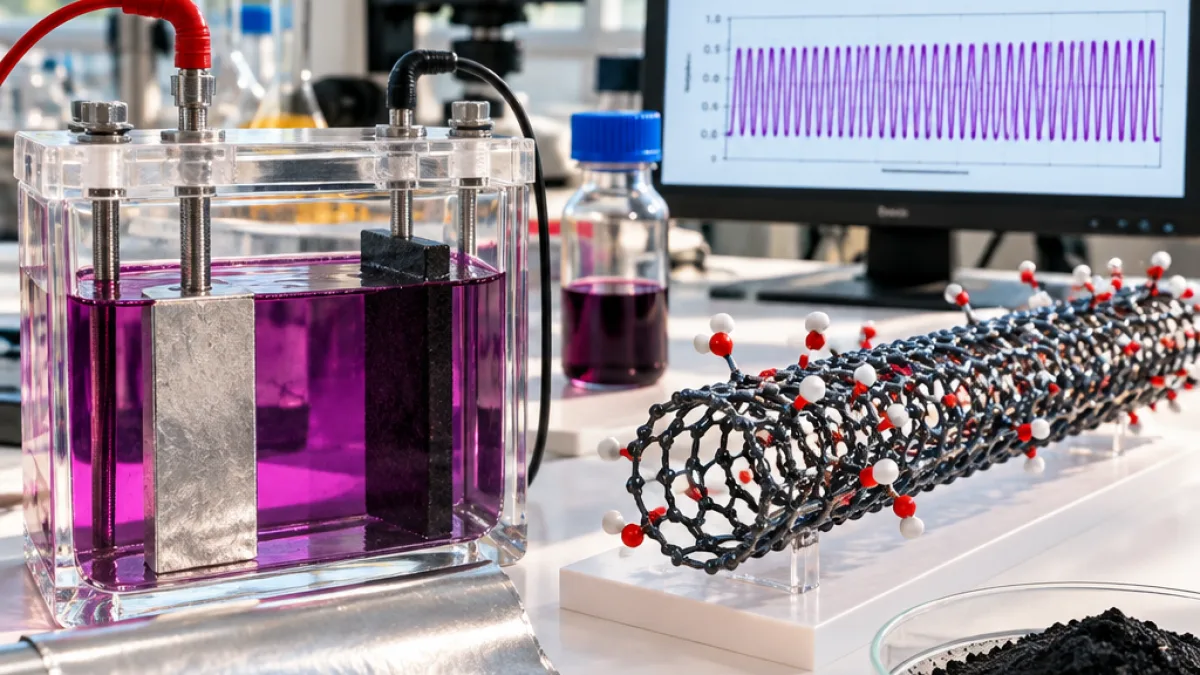
The researchers built self-supporting carbon nanotube cathodes and altered the chemistry of their surfaces. They compared unmodified nanotubes with versions carrying hydroxyl, carboxyl or amine functional groups. The objective was not simply to provide more conductive material, but to determine how the surface chemistry affected the iodine compounds involved in the battery reaction.
Calculations based on density functional theory indicated that the hydroxyl-treated nanotubes had the strongest attraction for iodine species among the materials tested. For triiodide, the calculated adsorption energy on the hydroxyl-modified surface was −7.42 electronvolts, while the interaction energy was −5.69 electronvolts. Both values were stronger than those calculated for pristine nanotubes and for the carboxyl- and amine-modified alternatives.
In practical terms, the hydroxyl groups appear to act rather like molecular anchors. They change the distribution of charge across the nanotube surface, helping to hold iodine compounds within the cathode and promoting their conversion during operation. That matters because a battery must repeatedly move the active material through its intended reaction pathway rather than allowing it to dissolve and wander elsewhere in the cell.
Measured performance
Experiments supported the computational picture. The hydroxyl-modified self-supporting carbon cathode had a specific surface area of about 1,005 square metres per gram. Its nanotube channels helped confine iodine, while spectroscopy and microscopy confirmed the presence of the functional groups and the even distribution of iodine in the material.
| Test condition | Reported result |
|---|---|
| Current density of 1 A/g | Initial reversible capacity of 175.5 mAh/g |
| Long-duration cycling | 89.34% capacity retained after more than 10,000 cycles |
| Duration of long cycling test | More than 3,500 hours |
| Current density of 10 A/g | Initial capacity of 120 mAh/g and a cycling life of 93,400 cycles |
The high-current test is particularly notable for the scale of the reported cycle count: at 10 A/g, the cathode delivered an initial capacity of 120 mAh/g and continued operating for 93,400 cycles. The figures describe laboratory performance rather than a commercial product, and they do not by themselves establish how the design would perform in a complete storage system or at larger scale. They do, however, show that the surface treatment remained effective under demanding repeated operation.
Why the mechanism matters
The researchers used in-situ Raman spectroscopy and ex-situ X-ray photoelectron spectroscopy to investigate the reaction mechanism. These methods allowed them to examine iodine-related changes during and after battery operation, rather than judging the cathode only from its final capacity. The resulting evidence linked the hydroxyl groups to charge redistribution, stronger iodine adsorption and faster, more complete conversion of iodine species.
The significance of the study therefore lies in both parts of the result: the reported endurance and the proposed explanation for it. Improving a battery by adding a functional group is useful only if the group survives the electrochemical environment and produces a repeatable benefit. Here, the calculations, material characterisation and cycling tests point in the same direction, although further work would be needed to establish the technology’s durability under broader operating conditions.
- Hydroxyl groups gave the tested nanotube cathode its strongest calculated affinity for iodine species.
- The modified cathode combined a high surface area with confinement of iodine in its nanotube channels.
- The battery retained 89.34% of its capacity beyond 10,000 cycles and reached 93,400 cycles in a high-current test.