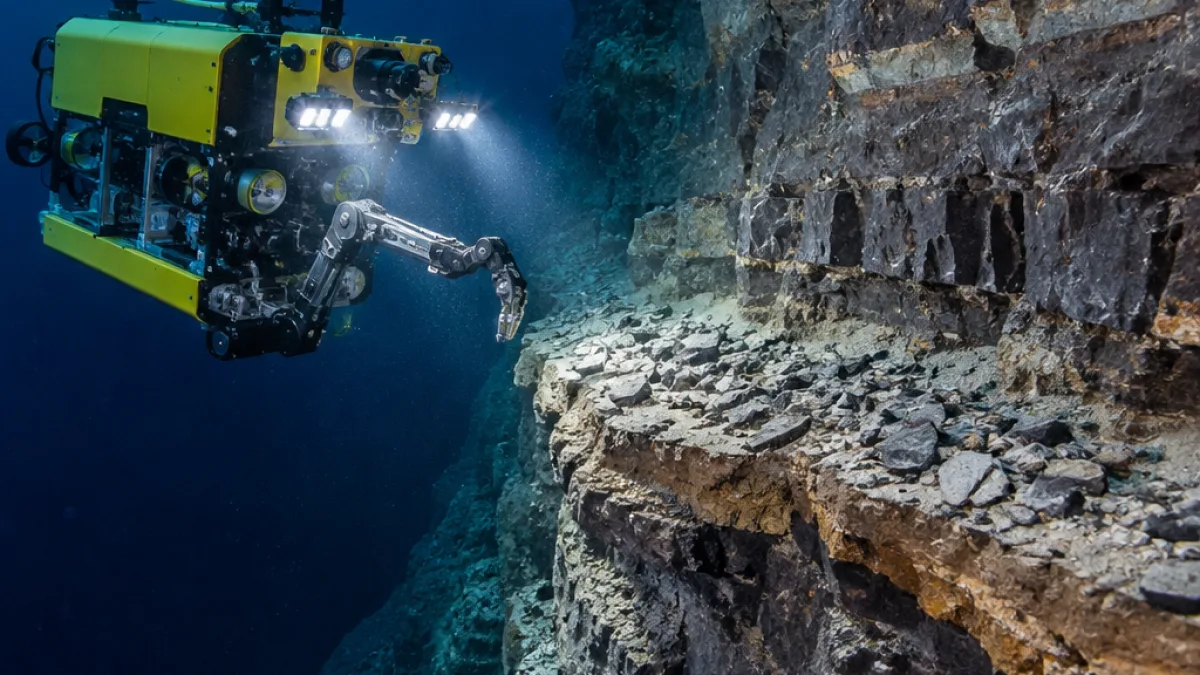
A robotic submersible has found evidence of explosive volcanic eruptions nearly 20,000 feet beneath the Pacific Ocean, in the Mariana Trench. The shattered material, known as pyroclastic rock, was recorded on a trench wall and is described by the researchers as the deepest such evidence yet documented in the ocean.
The discovery was made by the remotely operated vehicle Jason/Medea during an exploration near Challenger Deep, the deepest known point on Earth. The findings have been published in Frontiers in Earth Science. Researchers say the observation could help explain how the trench reached its extraordinary depth, although the discovery is evidence of a geological process rather than a complete explanation of the trench’s formation.
Fragments from violent eruptions
Pyroclastic rocks are formed from broken pieces expelled during powerful volcanic eruptions. In this case, the rocks appeared in a thin, level layer on the steeper western side of the section surveyed by the team. Their position on the trench wall offered the scientists a rare opportunity to examine material created by explosive volcanism in one of the most inaccessible environments on the planet.
Explosive volcanic activity close to ocean trenches is unusual, according to the researchers. Robert J. Stern, a geologist at the University of Texas at Dallas and a co-author of the study, said the team had been surprised by what it found.
“The deepest pyroclastic rocks documented from anywhere in the ocean.”
The significance of the result lies not only in the depth, but also in the setting. The Mariana Trench stretches for about 1,580 miles across the floor of the Pacific, while Challenger Deep descends more than 6.8 miles, or roughly 36,000 feet, below the ocean surface. At that scale, familiar comparisons become difficult: Mount Everest could be placed in the chasm without its summit reaching sea level.
How the expedition reached the trench
Jason/Medea is part of the National Deep Submergence Facility and is funded by the National Science Foundation. The system’s earliest version dates from 1988, and the robot used for the sampling work can operate to a maximum depth of 21,385 feet. It is connected to a surface ship by a fibre-optic cable about six miles long, allowing scientists to receive images and control the vehicle during its descent.
| Expedition detail | Reported figure |
|---|---|
| Depth of rock discovery | About 20,000 feet |
| Robot operating limit | 21,385 feet |
| Survey period | Late 2024 |
| Number of dives | Seven |
| Distance covered | About 186 miles |
Jason carries cameras for video and still images, as well as mechanical arms capable of collecting rocks and sediment. Medea operates slightly higher in the water and helps protect Jason from movement transmitted by the vessel at the surface. Together, the system gives researchers a way to work in a place where direct human access is exceptionally difficult.
A geological record at extraordinary depth
The team sent the robot down in late 2024 along a 341-mile section of the trench near Challenger Deep. Across seven dives, it travelled around 186 miles before the material was examined and interpreted. The work illustrates how remotely operated instruments can extend geological fieldwork far beyond the limits of divers and crewed submersibles.
- The rocks are pyroclastic fragments associated with violent eruptions.
- They were found on a trench wall at about 20,000 feet.
- The researchers regard them as the deepest ocean examples documented so far.
- The finding may contribute to understanding why the Mariana Trench is so deep.
For now, the rocks represent a new piece of evidence in the geological history of the Mariana system. Their discovery does not settle every question about the trench, but it places a record of explosive volcanism in an environment where such activity was not expected. At a depth approaching the robot’s operational limit, the finding also demonstrates the value of combining precise robotic sampling with observations gathered across a wide stretch of the ocean floor.