A package built for laboratory work
NVIDIA has unveiled a package designed to place artificial intelligence inside scientific workflows, rather than judge it solely by performance on conventional benchmarks. The collection combines an open model, a chemistry-focused evaluation dataset and post-training methods for connecting the system to CUDA-X accelerated scientific software.
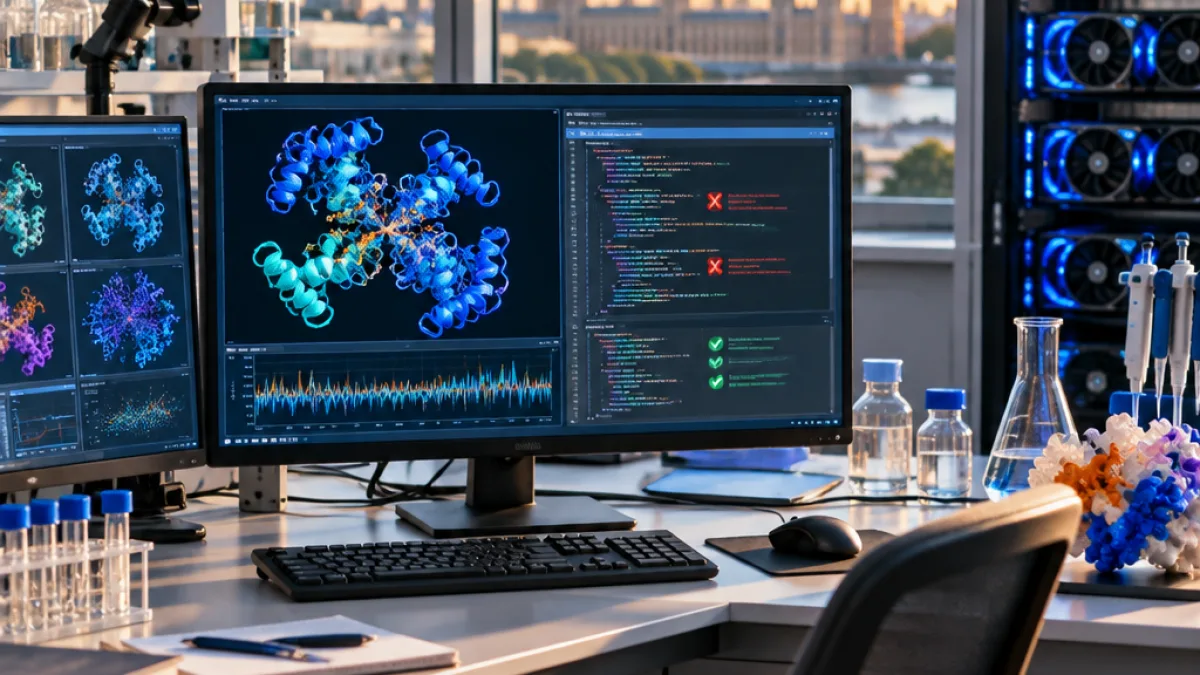
The announcement was made on 16 November 2026 at the SC26 supercomputing conference in Chicago through Ian Buck, NVIDIA’s vice-president of Hyperscale and High-Performance Computing. Its most striking result came from the KTH Royal Institute of Technology: an agent based on the system repaired 81% of deliberately damaged GROMACS molecular-dynamics setups during one overnight run on a single DGX Spark workstation.
That figure needs to be read carefully. It is not a general measure of scientific discovery, nor a score produced by the model assessing its own answers. Each proposed repair was checked by GROMACS, the molecular-dynamics software itself. The test therefore asks a practical question: can the agent alter a broken computational setup sufficiently for the established scientific programme to accept it? It does not show that every repair is scientifically appropriate, or that the system can replace expert oversight.
Three components, three different questions
NVIDIA’s release is easier to assess when its contents are separated. The model, dataset and software recipes have different purposes and, according to the source material, different levels of maturity and licensing detail.
| Component | What it contains | Purpose |
|---|---|---|
| Nemotron 3.5 Super VL | 120 billion parameters, with 12 billion active for each token | Multimodal scientific assistance |
| LitmusBench v0.2 | Approximately 50,000 chemistry questions | Evaluation of scientific reasoning |
| Post-training recipes | Methods linking the model with CUDA-X tools | Integration into computational workflows |
The checkpoint is a mixture-of-experts system combining Mamba-2 and Transformer components. It has 512 routed experts per mixture-of-experts layer, uses a C-RADIO vision encoder and supports a context window of up to one million tokens. Its stated inputs include text, images and MP4 video of up to two minutes, with text as the output.
The model is not itself new to this announcement. NVIDIA placed the repository online on 12 October, followed by its own announcement on 15 October. The newly emphasised element is the surrounding infrastructure: a named test set, recipes for adapting the model to scientific tools and partner accounts of what happens when it is used against working research software.
What the evidence establishes
The KTH result provides a concrete demonstration of workflow repair, with a clear external check built into the experiment. It also gives the result a useful scale: a single workstation and an overnight run, rather than an unspecified high-performance computing allocation. But the source does not provide the number of faulty setups, the types of errors introduced, or the conditions under which the remaining 19% failed. Those omissions make it impossible to calculate the result’s statistical uncertainty or determine how well it would transfer to other simulation packages.
For researchers considering the collection, the distinction between an open model and an open end-to-end system will be important. NVIDIA identifies the checkpoint as being released under OpenMDW-1.1, with commercial and non-commercial use permitted and the weights hosted on Hugging Face. The source describes the dataset and recipes as part of the package but does not set out their individual licence terms. Users will therefore need to examine those terms separately before building the components into a research or commercial pipeline.
A promising bridge, not an autonomous laboratory
The package’s significance lies in that bridge between a general-purpose multimodal model and software that can reject an invalid computational instruction. In a scientific workflow, that feedback loop is more meaningful than a model-generated explanation: the code either runs under the programme’s rules or it does not. Yet successful execution remains only one layer of validation. A repaired simulation can be technically runnable while still requiring a scientist to decide whether its assumptions, inputs and outputs are credible.
NVIDIA is presenting Nemotron for Science as a collection that can be built upon, rather than merely a checkpoint to download. Its immediate contribution is a more testable route into scientific AI, combining a defined chemistry evaluation set with practical integration methods. The 81% figure is consequently best understood as an encouraging demonstration of engineering utility, with its limits still visible alongside its promise.