Anthropic is preparing for a $1.4tn stock market listing under a governance structure that places decisive power outside the hands of ordinary shareholders, putting corporate accountability at the centre of the artificial-intelligence company’s arrival on public markets.
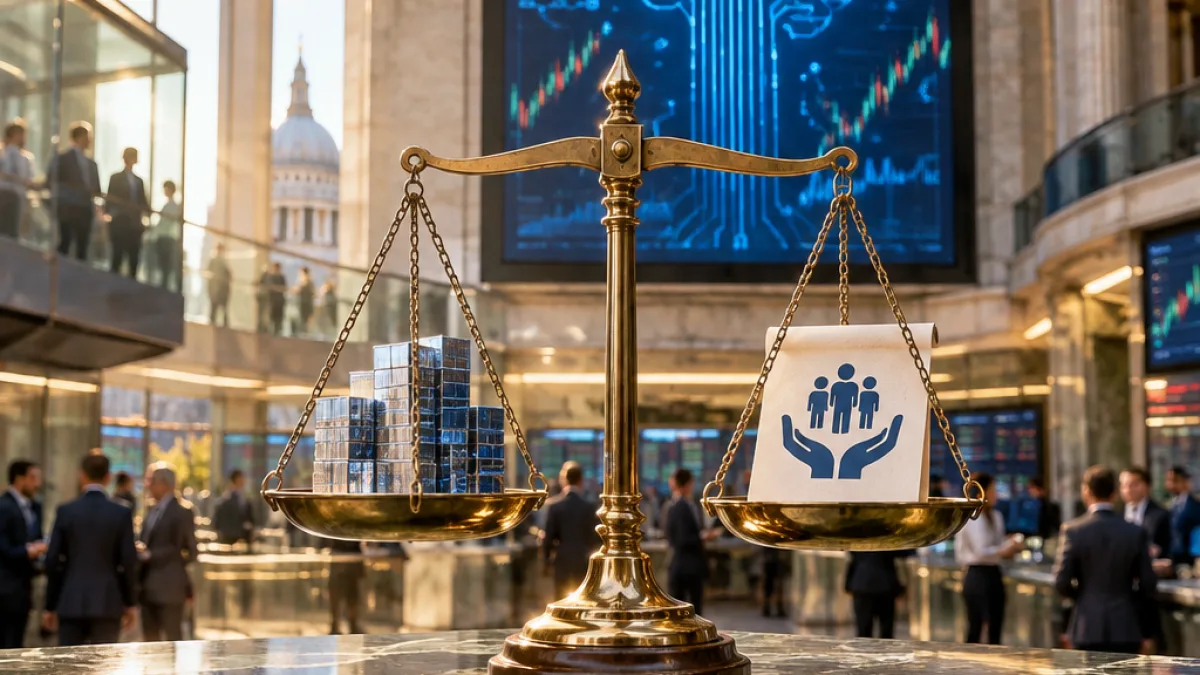
The developer of Claude has adopted an arrangement with two separate power centres. One is its group of seven founders, who hold a collective vote worth 50.1% of the company’s ultimate voting power. The other is the Long-Term Benefit Trust, a financially disinterested body intended to weigh the company’s commercial aims against its stated responsibility to humanity.
The structure is a sharp departure from the traditional principle that ownership and voting rights should broadly match. For much of the period before the rise of the largest US technology companies, the accepted governance standard was “one share, one vote”. That approach gives shareholders the ability, by a simple majority, to remove managers who underperform or misuse their authority.
“The owners should be able to chuck out misbehaving or underperforming managers by a simple majority.”
That model was weakened as technology groups argued that their founders needed protection from short-term investor pressure. Companies including Google, now Alphabet, and Facebook, now Meta, promoted corporate missions which were presented as sufficiently important to justify unequal voting rights. The argument was that founders should retain the freedom to pursue long-term and risky projects without being forced to respond to every demand from ordinary investors.
A governance model built around two authorities
Anthropic takes that logic further. The founders’ collective holding means they can exercise majority voting control, but the arrangement also requires them to reach a common position rather than allowing one individual founder to dominate the group. Alongside them, the Long-Term Benefit Trust has a formal role in overseeing the company’s wider purpose.
| Element | Role or power |
|---|---|
| Seven founders | One collective vote controlling 50.1% of ultimate voting power |
| Long-Term Benefit Trust | Nominates four of the seven directors |
| Trustees | Consider the balance between financial returns and benefits to humanity |
The trust is not designed as a conventional financial investor. Its stated purpose is to consider whether the company’s pursuit of profit remains balanced with its claimed benefit to humanity. It nominates four of the seven directors, giving it a substantial role in the composition of the board even though it is described as financially disinterested.
Among the trustees is Ben Bernanke, the former chair of the US Federal Reserve. His presence gives the arrangement a figure associated with economic and financial oversight, but it does not remove the central question facing investors: who can ultimately hold Anthropic’s leadership to account if the business fails to meet expectations?
What it means for investors and the wider economy
For shareholders, the key issue is not simply whether Anthropic can produce strong commercial returns. It is whether those buying into the $1.4tn listing will have meaningful influence over the company’s direction. The governance design indicates that control will remain concentrated among the founders and the trust, rather than resting with the public investors who provide capital through the market.
That may protect the company from pressure to prioritise immediate earnings, but it can also make it harder for shareholders to challenge strategic decisions. The distinction matters beyond one technology company. As AI businesses seek large amounts of capital and move from private ownership into public markets, investors will have to assess not only sales, costs and potential profits, but also who controls the boards and voting rights attached to their shares.
- Founders retain majority voting power through a single collective vote.
- The trust appoints four of seven directors and is charged with balancing profit against wider human benefit.
- Public investors face a company where ordinary shareholder control is not the central organising principle.
Anthropic’s model therefore revives an old corporate-governance dispute in a new and particularly consequential industry. Supporters of concentrated control can argue that AI development requires long-term decisions and protection from short-term market demands. Critics can ask whether a mission, however worthy, should weaken the ability of owners to challenge management.
The listing will test whether investors are prepared to accept that trade-off. Anthropic’s governance makes clear that buying into the company will mean more than sharing in its financial performance. It will also mean accepting a framework in which the authority to decide the company’s future is deliberately shared between its founders and a trust established to represent interests beyond profit.