Harbour works reach completion
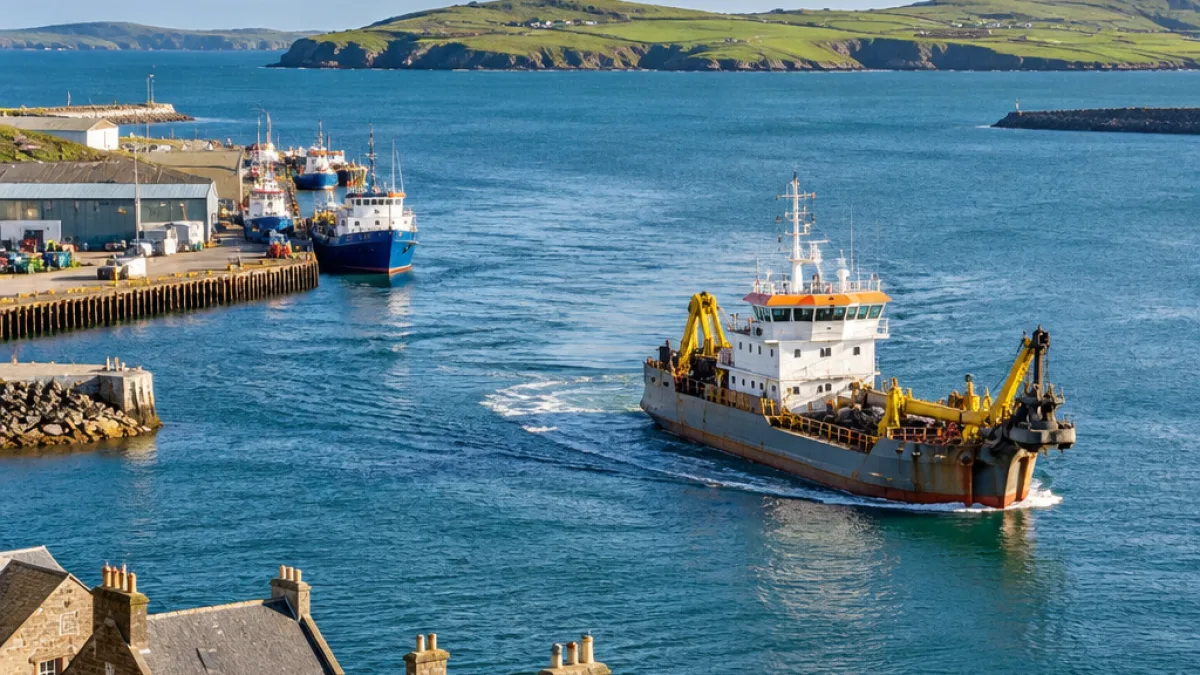
Lerwick Harbour’s £24 million capital dredging project has been completed, marking the conclusion of the largest investment of its kind in the port’s modern history. Almost one million tonnes of material were removed during the operation to deepen and widen important approaches and berthing areas.
The scheme was designed to increase the harbour’s capacity for larger vessels and to support activity across several parts of Shetland’s maritime economy. Its potential reach extends from fishing and cruise operations to offshore development, marine services and decommissioning work. The works were delivered in two phases, involving the removal of both soft seabed material and hard rock. The material was disposed of to the north of Bressay.
Although the main dredging vessels departed on 31 October after final checks were completed, the project has now formally reached its reported conclusion. Delivering the work within a working harbour required the operation to be planned around the port’s existing activities, with Lerwick Port Authority describing the completion as a major milestone.
New depths and wider access
The improvements have altered the navigational profile of several parts of the harbour. The North Ness Channel has been widened to 140 metres and deepened to 10 metres. Mair’s Pier, which extends for 275 metres, now has a continuous water depth of 10 metres alongside its berth. The approaches to Gremista Quay have also been improved.
| Location | Result of the dredging |
|---|---|
| North Ness Channel | 140 metres wide and 10 metres deep |
| Mair’s Pier | Continuous 10-metre berth depth along 275 metres |
| Dales Voe | 14.5 metres beside the quay; approaches to 16 metres |
At Dales Voe, the depth beside the quay has been increased to 14.5 metres, while the approaches have been deepened to 16 metres. Those changes are intended to improve access for larger offshore vessels and strengthen the harbour’s role in supporting offshore exploration, development, production and onshore decommissioning activity.
Capacity across Shetland’s maritime sectors
For the fishing industry, the port authority says the revised harbour infrastructure will enable future quay development at Gremista, including support for greater pelagic-sector capacity. In the cruise market, deeper and more consistent access through the North Ness Channel and central basin could create opportunities for larger ships to use Mair’s Pier.
- Improved access for larger offshore vessels at Dales Voe.
- Additional scope for future fishing infrastructure at Gremista.
- Greater navigational access for cruise vessels through the channel and central basin.
The changes do not themselves represent a commitment to any particular future development or vessel call. Rather, they provide the physical capacity for the port to respond to changing requirements in the industries it serves. For Lerwick and Shetland, the significance lies in maintaining a working harbour that can accommodate a broader range of marine activity as vessel sizes and offshore requirements evolve.
“This project has been about ensuring we have the infrastructure and capacity to meet the changing needs of the industries we serve,” said Lerwick Port Authority chief executive Captain Calum Grains.
Captain Grains said improved access and the ability to accommodate larger vessels would create opportunities across several sectors while reinforcing Lerwick’s contribution to the Shetland economy. He also acknowledged the planning and co-operation required to carry out a project of this scale in a busy harbour, and thanked those involved in bringing the marine works to completion.
The project was managed by Arch Henderson LLP, a company of Haskoning, with the dredging undertaken by specialist contractor Boskalis Westminster Ltd. With the marine works complete, the harbour now has revised depths and approaches intended to support its established fishing and cruise roles while improving its prospects in offshore and marine operations.