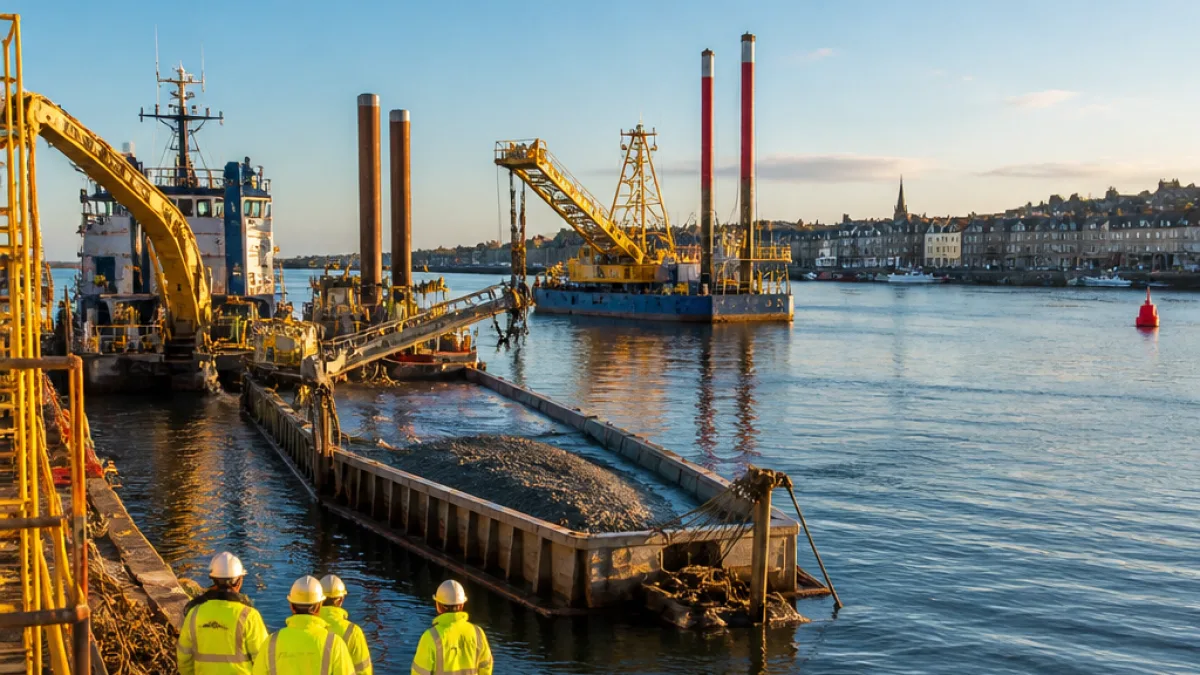
Final phase of harbour works under way as residents report early-morning disturbance
The major dredging programme at Lerwick Harbour has reached its concluding weeks, with the contractor authorised to carry out operations around the clock as crews complete works aimed at improving access to key berths and supporting future growth in the fishing sector.
The project entered its final stage in June and is estimated to be complete by early September. Specialist contractor Boskalis Westminster returned to Lerwick in June to finish the programme, deploying a fleet that includes drill barge Rock Mate, backhoe dredgers Manu Pekka and Odin, workboat Jenny D and cargo vessel Shetland Trader, supported by hopper barges George and Hans.
“The dredging contractor has the flexibility to work within the hours stated in the notice,” the Lerwick Port Authority said, adding that in practice the vessels are “mostly carrying out works during the morning and early evening to suit operational requirements.”
Local residents, particularly in the Staney Hill area, have at times complained of being awoken early by sounds and vibrations related to the dredging activity. A public notice issued last month made clear that vessels involved in the final phase would be permitted to operate seven days a week, 24 hours a day.
Scope and environmental controls
All material recovered by the dredgers is being transported to an offshore disposal site. The Lerwick Port Authority (LPA) said the work is being carried out in “carefully controlled stages around operational shipping activity and to meet environmental requirements.”
The final stage includes a series of deepening and widening operations across approaches and berths. The LPA described the objectives as increasing navigational margins, improving access to Mair’s Pier and supporting future growth in the fishing sector by deepening approaches to Gremista Quay.
- North Ness Channel: to be deepened and widened to increase navigational margins and improve access to Mair’s Pier.
- Mair’s Pier berth: to be dredged to a continuous depth of 10 metres.
- Dales Voe quay (section completed 2016): to be deepened to match the existing quay at 12.5 metres, with final depths alongside increasing to 14.5 metres and approaches to 16 metres.
| Location | Target depth |
|---|---|
| Mair’s Pier (berth) | 10.0 m |
| Dales Voe (quay section) | 12.5 m |
| Final depths alongside (Dales Voe) | 14.5 m |
| Approaches (Dales Voe) | 16.0 m |
Local impact and operational balance
The presence of dredgers and supporting vessels has kept the harbour busy. Backhoe dredger Odin arrived at the end of last month specifically to begin lifting rock from the seabed, while earlier-deployed units — including Rock Mate and Manu Pekka — were familiar to Lerwick, having taken part in the 2008 dredging campaign.
The LPA stressed that operational shipping activity remains a consideration during the work. While the contractor has the capacity to work 24/7 under the terms of the public notice, the authority said that, operationally, the vessels are “mostly” active in the morning and early evening to fit port needs.
For residents concerned about disturbance, the combination of notice provisions and the LPA’s statement on staged, controlled operations will be central to how the final weeks are managed. The offshore disposal of dredged material is intended to limit environmental impacts in harbour waters, though specific monitoring or mitigation measures were not detailed in the public statement.
When complete, the dredging is intended to leave Lerwick Harbour with deeper, more accessible berths and approaches designed to support larger and deeper-draught vessels, and to underpin future activity in the fishing and wider maritime sectors.
Work is due to continue through August, with the LPA's timetable indicating completion by early September.