A project tied to Peterhead’s energy future
Plans to develop a carbon-capture and storage network connected to Peterhead have entered a period of renewed uncertainty after the UK Government confirmed that capital grants for Acorn are to be replaced by other forms of financial support.
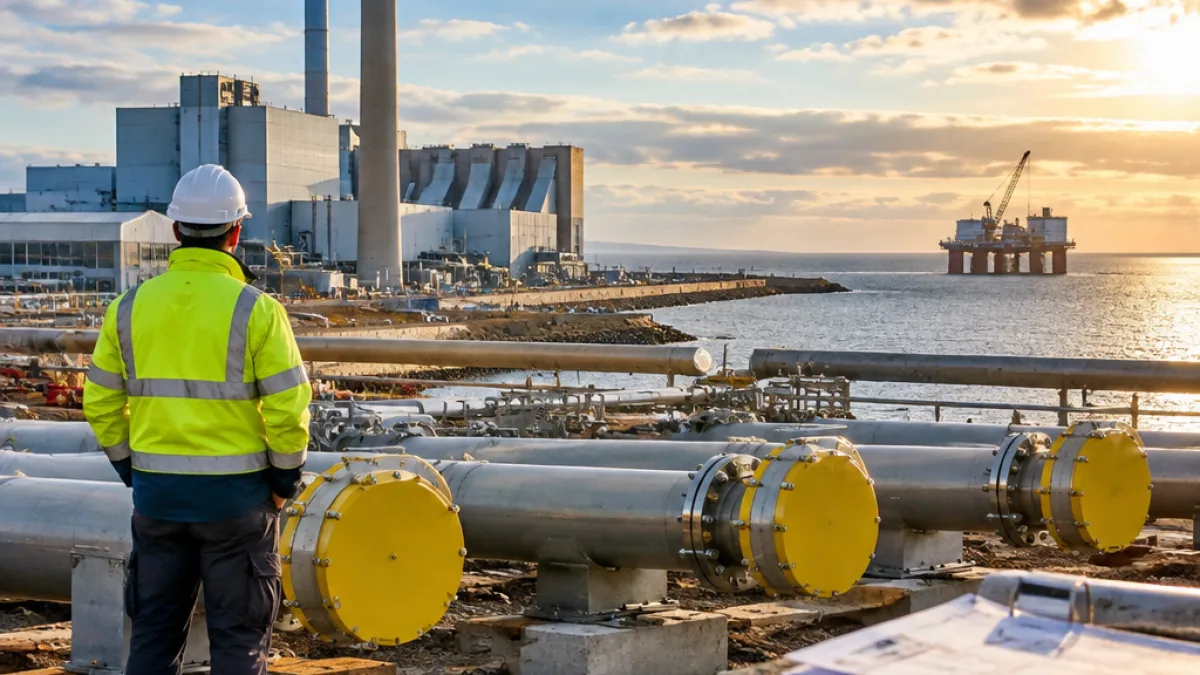
Acorn is intended to capture emissions from Peterhead’s gas power station and other industrial sites before transporting them for storage beneath the North Sea. Its progress has therefore been closely linked to wider arguments about the future of gas-fired generation, the delivery of net zero and the economic role of energy infrastructure in the north-east.
The revised approach means that direct grants will be replaced by potential loans or equity stakes. Scottish Secretary Douglas Alexander said the project faced “significant challenges”, including questions about whether the technology was ready for the market and how its commercial arrangements would work.
“Significant challenges”
A UK Government spokesperson said the new arrangements represented better value for the British taxpayer. However, the change has intensified debate over how Acorn can be developed if the public funding model underpinning it is altered. For Peterhead, where the proposed carbon-capture plans are connected to a gas power station, that uncertainty is not simply an abstract policy dispute. It goes to the question of how the town’s existing energy identity may fit within a lower-carbon system.
Two governments, different decisions
The funding decision comes against a backdrop of apparently conflicting developments. The Scottish Government has approved a new gas-fired power station, while, a day later, the UK Government cut the funding mechanism intended to make such a project part of a net zero energy system. The sequence has prompted questions about whether the different parts of the energy strategy are being taken forward in a sufficiently joined-up way.
That tension matters because the case for combining gas generation with carbon capture depends on the capture and storage system being available, commercially credible and capable of handling the emissions produced. Without that connection, critics argue, the role of a new gas station in a decarbonising electricity system becomes harder to explain. Supporters of Acorn, by contrast, see carbon capture and storage as part of the infrastructure required to manage emissions from industrial activity and energy production.
| Issue | Position reported |
|---|---|
| Acorn funding | Capital grants are being replaced by loans or equity stakes |
| Planned storage | Captured emissions would be stored beneath the North Sea |
| Project challenge | Technology readiness and commercial arrangements |
Local significance amid national argument
The debate has also been sharpened by the decision of Acorn developer Storegga to announce plans to sell its stake last year. Campaigners including Friends of the Earth have described carbon capture and storage as unrealistic and have urged ministers to direct time and money towards other climate measures. Their criticism reflects a wider concern that resources could be committed to a technology they believe is not yet sufficiently proven.
Those arguments leave Peterhead at the centre of a difficult energy question. The town is associated with a project designed to preserve a role for gas generation while reducing its emissions, yet the financial and technical conditions needed to make that proposition work remain unsettled. The change from grants to investment-style support does not, on its own, confirm that Acorn will proceed or that it will be abandoned. It does mean that the project must now be assessed through a different funding model, with responsibility and risk shared in a different way.
The immediate issue for residents is therefore less a final verdict on Acorn than clarity over what happens next. Decisions by the Scottish and UK governments will need to align if Peterhead is to be part of a coherent clean-energy programme rather than a series of disconnected announcements. With the project tied to both a proposed gas-fired station and the storage of emissions beneath the North Sea, its future will remain an important test of how the competing demands of energy security, public spending and climate policy are reconciled.