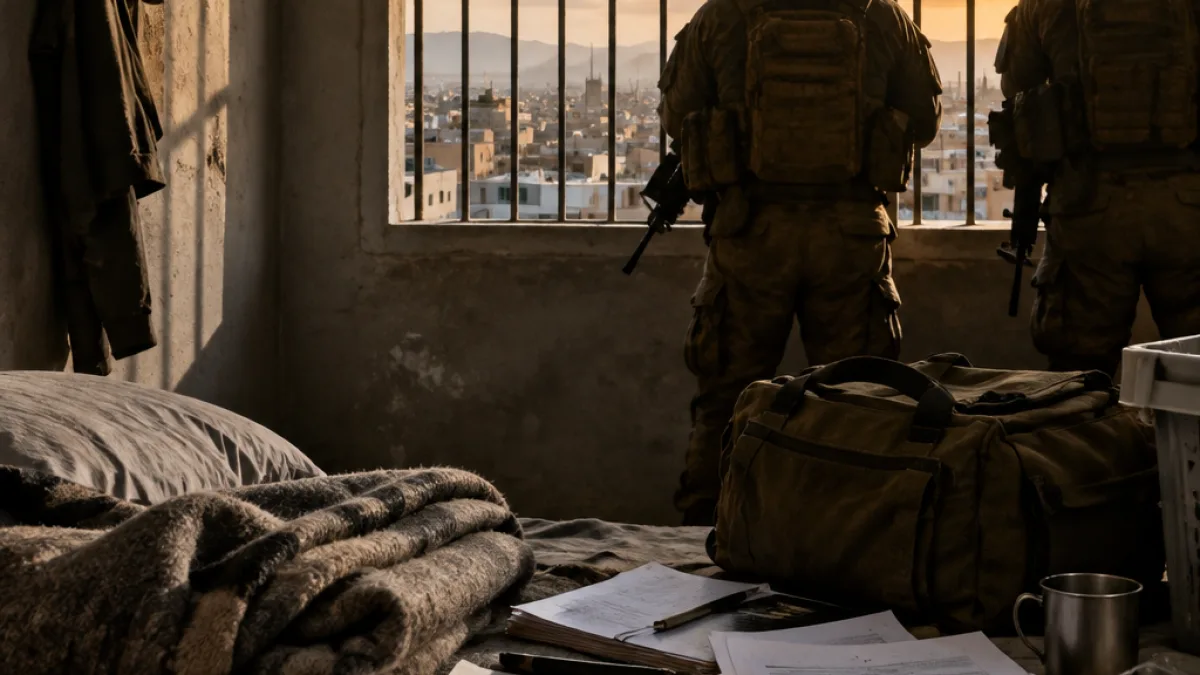
A detention that began before the attacks
Two Australian aid workers have spoken about the fear and uncertainty of being detained by the Taliban in Afghanistan, reflecting on an ordeal that began 25 years ago and ended with the group’s rescue by US special forces. Peter Bunch and Diana Thomas were among eight Shelter Now International workers seized in Kabul after being accused of preaching Christianity to Afghans.
The arrests took place on August 3, 2001, around six weeks before the attacks on the World Trade Centre in New York. The group included six foreign workers, among them four Germans and two Americans, as well as local staff. Bunch and fellow detainee Georg Taubmann have described being taken at gunpoint and held in conditions that became increasingly frightening as the international crisis surrounding Afghanistan intensified.
“I made peace with myself and God,” Peter Bunch said.
Bunch, now 83, recalled that a religious police officer placed a Kalashnikov against his head during the arrest. Thomas, now 76, said the allegations against the organisation were unfounded and that the workers had been operating as a respected aid group. The detainees were separated and questioned for weeks, while their families and governments faced the difficulty of securing assistance in a country ruled by an increasingly isolated regime.
Trial threats and prison conditions
The aid workers were brought before what Bunch described as a “kangaroo court”, with the prospect of a fundamentalist trial under Sharia law and the death penalty hanging over them. The source account says no formal charges were initially laid and that the group was confronted with a court process involving a Pakistani lawyer whom Bunch considered ineffective. The workers eventually went on hunger strike in an effort to force greater clarity about their situation.
- The group was arrested in Kabul on August 3, 2001.
- Eight aid workers were held, including six foreign staff and local employees.
- They faced accusations of preaching Christianity and the possible death penalty.
- US special forces later rescued the group.
Thomas, speaking from her home in Nollamara, described the allegations as “a load of rubbish”. Her account underlines the gap between the aid workers’ stated purpose and the claims made against them. The source says the Taliban’s real objective, in Thomas’s view, was to obtain money, while the prisoners were left to endure a process marked by fear, separation and uncertainty.
A diplomatic dilemma
Australian diplomat Alastar Adams was sent to Kabul to assist. He later described the case as highly unusual, while also noting the limits placed on diplomatic intervention in a foreign legal system. His recollection captures the difficult position faced by officials: the detainees required urgent help, but Afghanistan’s authorities insisted on treating the matter as a domestic legal issue.
The imprisonment unfolded against the backdrop of a Taliban government known for severe restrictions on women and harsh public punishments. When the September 11 attacks occurred, the prisoners’ circumstances became even more dangerous as bombs fell and Afghanistan moved to the centre of international attention. The source account describes the eight workers as Taliban prisoners of war during that period, with their fate uncertain until the eventual rescue operation.
For Bunch, Taubmann and Thomas, the story remains one of survival rather than a settled historical episode. Their recollections bring a personal dimension to the events that placed Afghanistan at the heart of global politics in 2001. They also preserve the experiences of aid workers who, according to the account, were detained before the attacks that transformed the conflict and the world’s attention to the country.