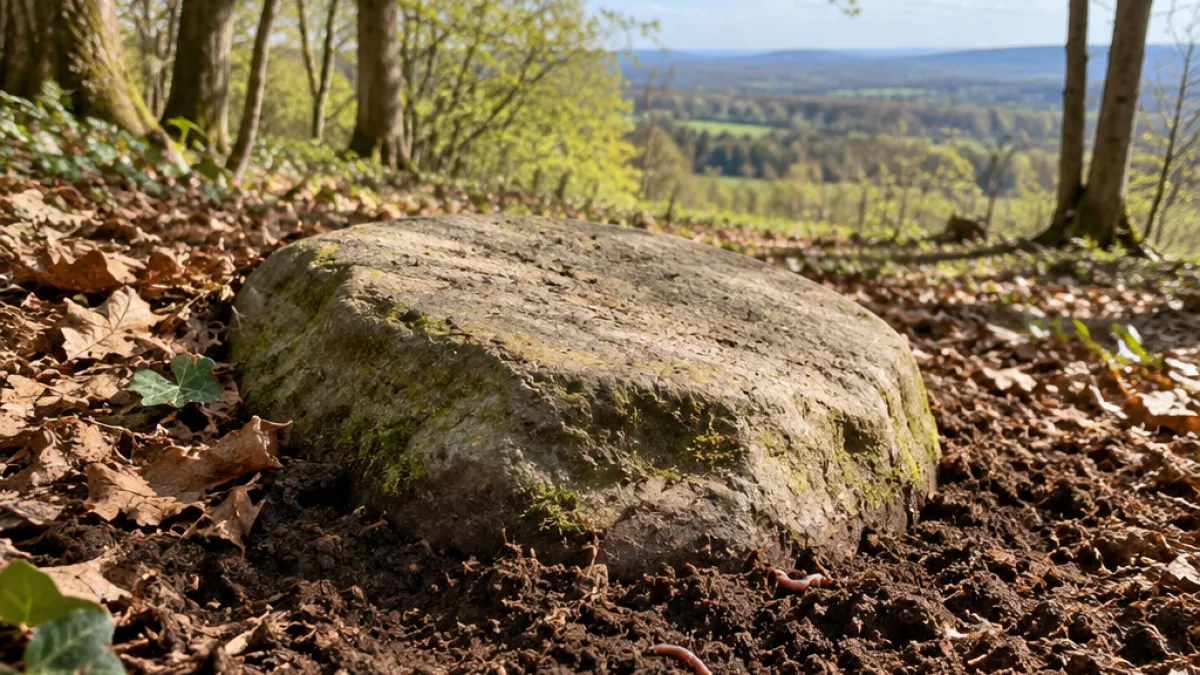
A largely unmarked stone among the trees at Leith Hill in Surrey formed part of Charles Darwin’s decades-long investigation into the way earthworms transform the landscape.
The hill is widely associated with its broad views across Surrey, but the lesser-known object is linked to Darwin’s work at nearby Leith Hill Place, where his sister Caroline Wedgwood lived. Catherine McCusker of the National Trust told Secret Surrey that the naturalist used the stone as part of an effort to understand how much soil earthworms could move.
A question about buried Roman remains
Darwin’s interest began with a puzzle involving Roman remains. According to McCusker, Darwin and his uncle wondered how structures or objects that had once stood above ground could gradually become covered by soil. His uncle proposed that earthworms might be responsible and encouraged Darwin to investigate.
That suggestion led to a sustained programme of observation. Darwin placed the stone on the ground and watched the activity around it, recording the movement of worms and the casts they left behind. The observations helped him estimate the quantity of soil the animals could shift across an acre.
“He really, really rated them.”
McCusker said Darwin studied worms in earnest for about 40 years, an unusually prolonged focus on animals that were often overlooked. His research eventually informed his final major published work, The Formation of Vegetable Mould, Through the Action of Worms.
Why earthworms matter beneath the surface
The importance of the research extends beyond Darwin’s biography. McCusker said scientists now describe earthworms as “ecosystem engineers” because their activity changes the structure and condition of soil. As they burrow and process organic material, they help aerate the ground and improve drainage.
In simple terms, their movement continually redistributes soil. McCusker compared them with natural ploughs, explaining that they move material both upwards and downwards. The result is a reminder that a familiar garden or woodland animal can have a significant influence on the environment without attracting much attention.
| Part of Darwin’s study | What it showed |
|---|---|
| The stone placed on the ground | A fixed point for observing changes caused by worms |
| Worm casts and movement | Evidence of soil being shifted and redistributed |
| Long-term observation | A basis for estimating the amount of soil moved per acre |
A quiet piece of scientific heritage
The account also gives Leith Hill Place a place in the story of Darwin’s scientific life. Rather than a formal laboratory, the setting allowed him to observe a natural process over time. The work depended on patience, repeated examination and attention to changes that could easily be missed during a short visit.
McCusker said the stone remains a little-known feature and that there is no placard identifying Darwin’s connection to it. For visitors interested in natural history, that absence is part of its character: the site does not rely on a large display to explain its importance, and the object’s significance comes from the observations associated with it.
- Location: Leith Hill, Surrey, near Leith Hill Place.
- Historical link: Charles Darwin studied earthworms during visits connected with his sister Caroline Wedgwood’s home.
- Scientific relevance: The work helped explain how worms aerate, drain and redistribute soil.
Darwin’s study offered a new way of seeing an animal that is easy to ignore. Earthworms may spend most of their lives out of sight, but their effects can accumulate across the ground over many years. The unassuming stone at Leith Hill therefore marks more than a private experiment: it represents a piece of research that helped reveal how living creatures can steadily reshape the world around them.