
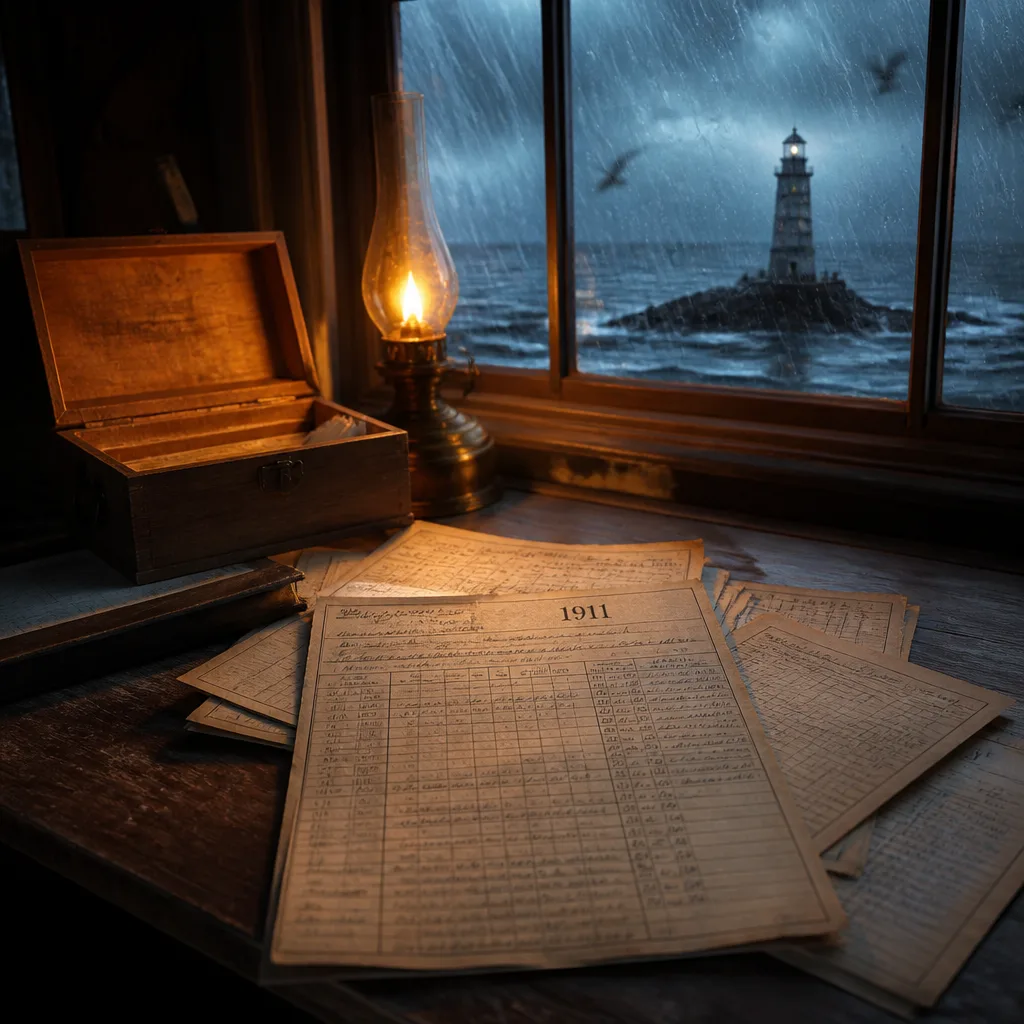
Somewhere in a wooden box in Scotland sits a printed form dated 1911 in which a lighthouse keeper recorded the passage of birds past a lonely rock in the Pentland Firth. That unassuming, hand-written sheet is part of a collection of several hundred surviving records now held by the Scottish Ornithologists’ Club, and it illustrates why lighthouse keepers were, for decades, among Britain’s most important observers of bird migration.
Why lighthouses became scientific observatories
The practice began long before the surviving Scottish forms. In 1880, following advice from Alfred Newton, the British Association for the Advancement of Science created a committee to study bird migration and turned to keepers of lighthouses and lightships to supply observations.
The reasoning was straightforward and elegant. Migrating birds often travel at night and frequently follow the coastline. A lighthouse stands at the junction of sea and land, and its keeper is one of the few people awake and outside during the hours when nocturnal migration occurs. The light itself often attracts birds, sometimes with fatal consequences. That combination of timing, location and the presence of alert observers made keepers especially valuable contributors to migration studies.
"so that it escapes the notice of all save those few peculiarly placed observers, the light-keepers"
The quotation, written by the Scottish ornithologist William Eagle Clarke in 1903, underlined that night migration would largely have gone unrecorded were it not for these 'peculiarly placed observers'. Clarke not only championed the use of lighthouse data but also spent months living at lighthouses to make his own observations. His work culminated in a two-volume set, Studies in Bird Migration, first published in 1912.
What survives and why it matters
Several hundred of the original printed forms completed by keepers around Scotland have survived and are now curated by a national bird body. The material includes examples such as the Pentland Skerries entry from 1911. Although the recorders were not professional scientists, their regular, systematic notes — often kept over many years — provide a rare, long-term perspective on migration timing, routes and the species affected by lights on the coast.
These documents are more than historical curiosities. They form part of a continuous observational lineage in British ornithology that links volunteer field recording to formal scientific study. The committee that began the scheme in 1880, and figures such as Eagle Clarke who collated and expanded these data, helped turn episodic observation into a coordinated effort that could reveal patterns across seasons and years.
- 1880 — British Association committee set up to study bird migration, advised by Alfred Newton.
- 1883 — William Eagle Clarke joined the committee and later led the natural history department at the Royal Scottish Museum.
- 1912 — Eagle Clarke’s two-volume Studies in Bird Migration published, drawing on lighthouse observations.
| Year | Event |
|---|---|
| 1880 | Committee formed to study bird migration using lighthouse keepers |
| 1912 | Publication of Eagle Clarke’s two-volume study |
Records such as the Pentland Skerries form offer a direct window into the behaviour of migrating birds more than a century ago. They also illustrate the value of observer networks located precisely where natural phenomena occur: in this case, where coastal flight paths intersect with lights and human presence at night.
Broader implications for modern science
Historical datasets assembled by non-professional observers have increasing relevance today. Long-term baselines are crucial to detect shifts in migration timing, route changes and species’ responses to environmental pressures such as climate change and artificial light at night. The lighthouse forms are a reminder that carefully made, routine observations by people outside formal laboratories can create enduring scientific resources.
Preserving and digitising such archives also allows contemporary researchers to re-examine old questions with new methods — for example, combining historical sighting records with modern radar, tracking and light-pollution mapping. The continuity from a printed form in a wooden box to present-day analytical techniques is a satisfying arc: it shows how a modest, local practice contributed to the national understanding of bird migration.
The surviving lighthouse logs, now in custodianship of the Scottish Ornithologists’ Club, are at once a cultural artefact and a scientific resource — testimony to a period when the night-watch duties of a keeper could shed light on movements too often hidden from human eyes.









